How to Read Liverpool Through Its Buildings
This is not just a guide to Liverpool landmarks. It is a guide to how the city made itself visible through architecture.
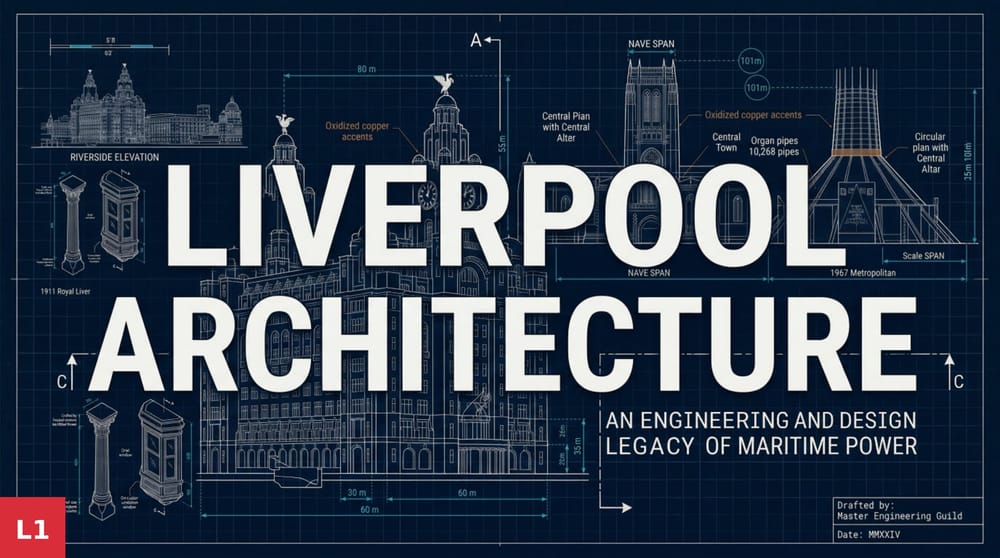
Liverpool's architecture is easier to understand once you stop treating it as a list of landmarks and start reading it as a record of what the city was doing at different moments.
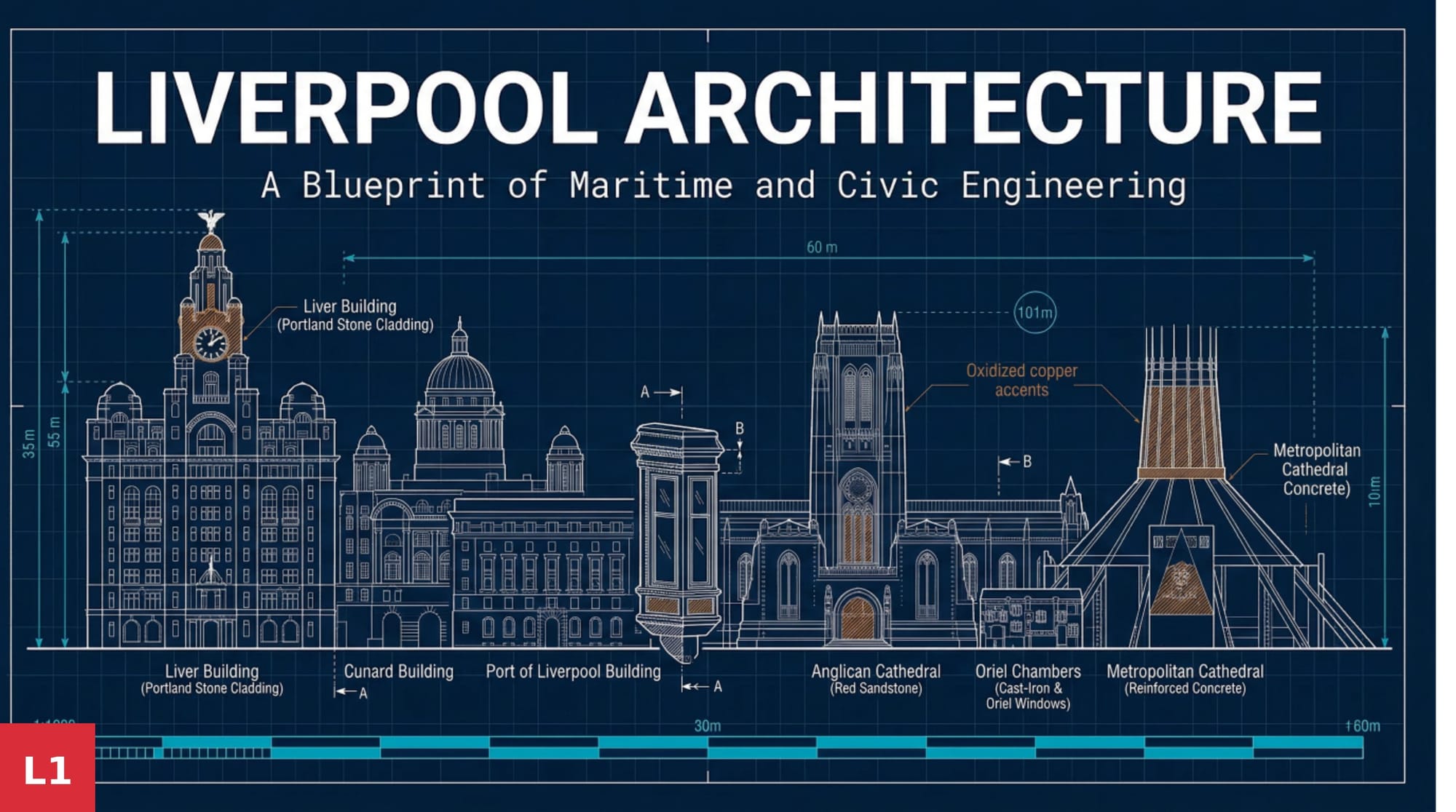
The short version: a port city that accumulated serious wealth across two centuries left behind serious buildings. Georgian civic confidence, Victorian engineering ambition, industrial-scale warehouse construction, Art Deco inter-war elegance, two cathedrals that could not be more different, and one building from the 1860s that quietly changed how architecture developed globally. That is a lot for one city, and most of it is still standing.
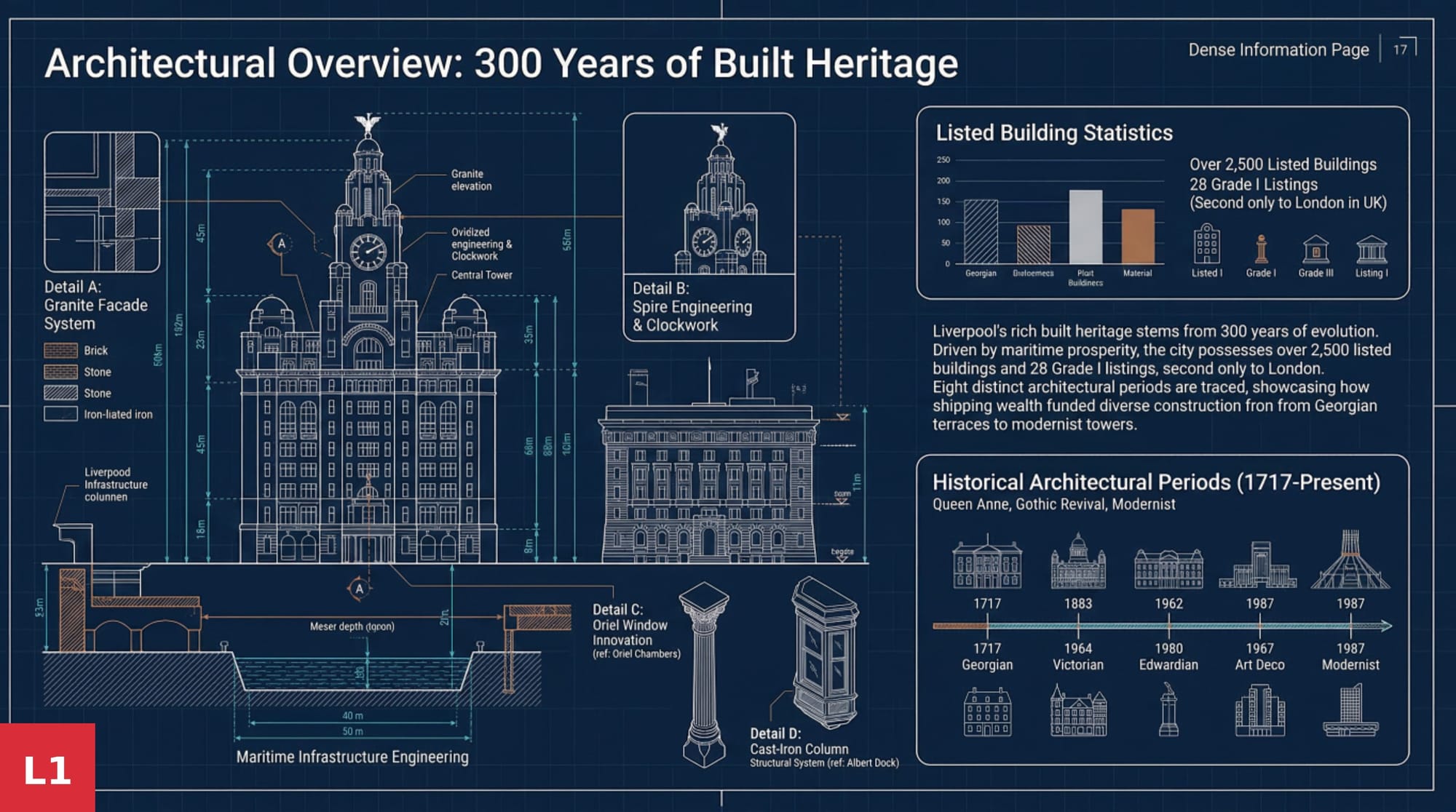
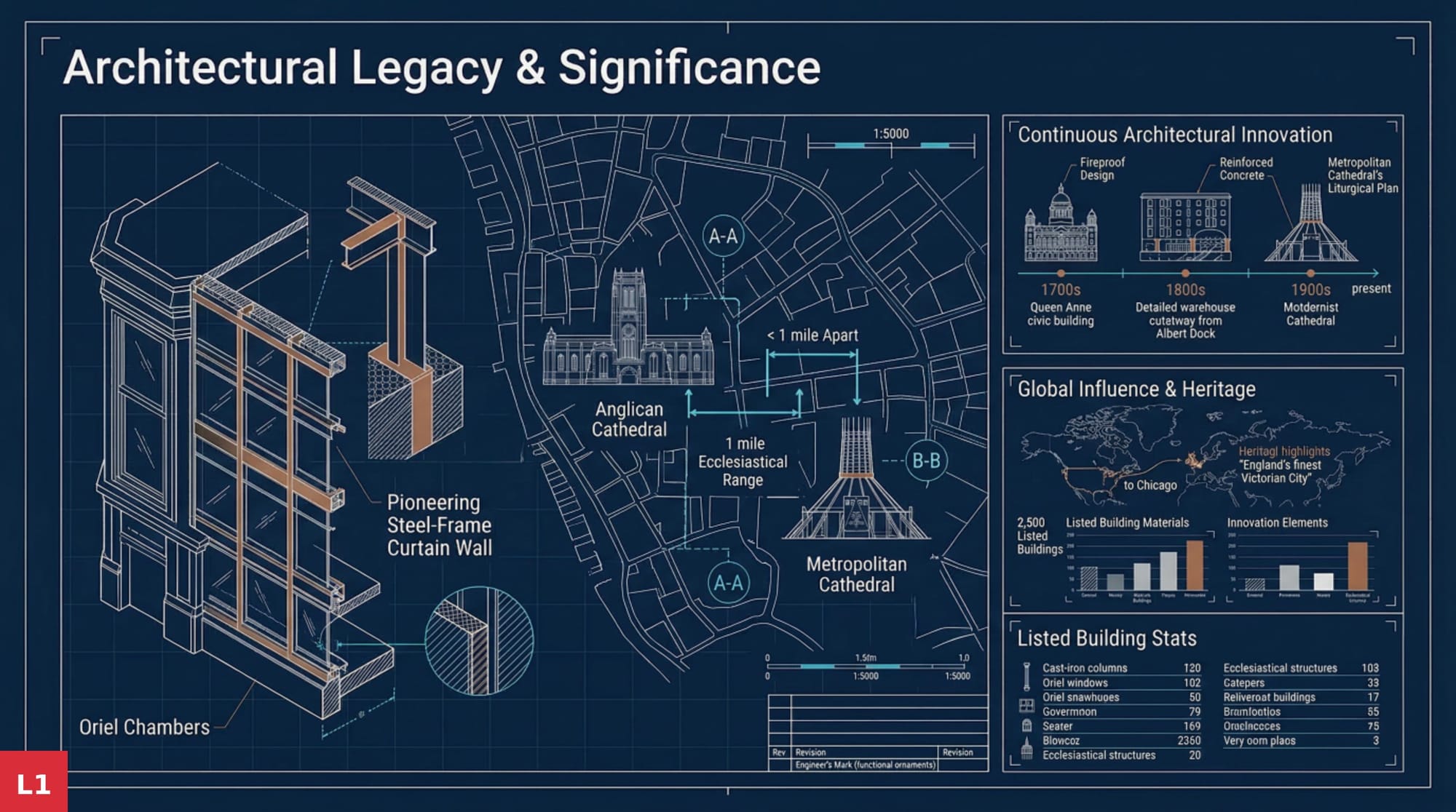
Liverpool has over 2,500 listed buildings and 28 Grade I listings — second only to London in the UK. Eight distinct architectural periods are traceable from Georgian through to contemporary, each shaped by what the city needed and could afford at the time.
The Waterfront: Three Buildings That Still Set the Tone
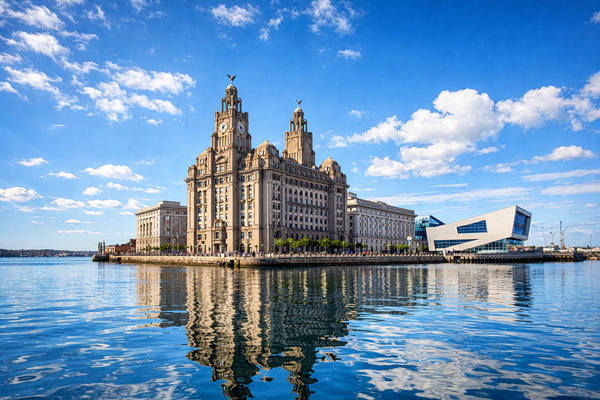
The Pier Head end of the waterfront is where most visitors start, and the three buildings there — the Liver Building, the Cunard Building, and the Port of Liverpool Building — are worth spending more than a glance on.
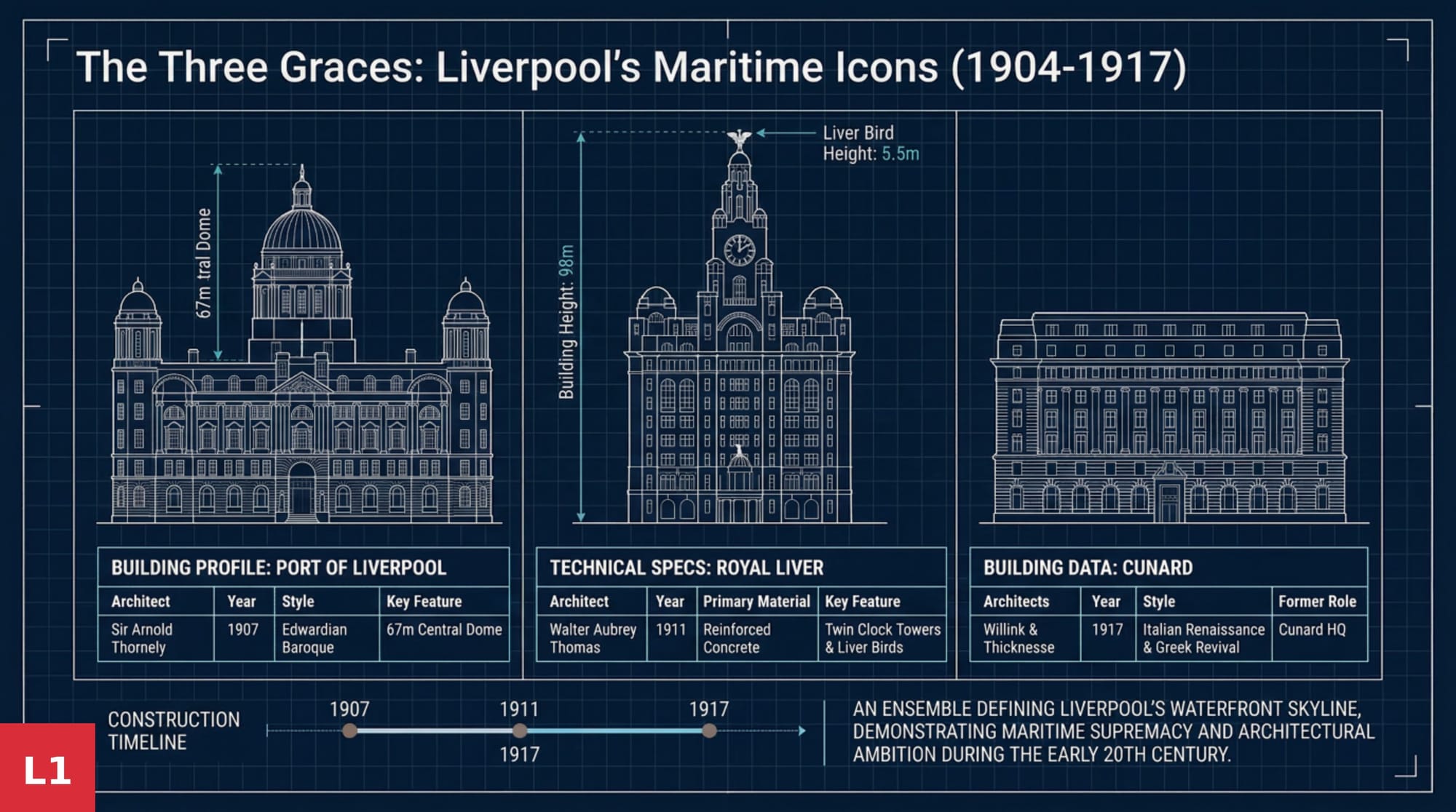
The Liver Building (1911) was one of the first large buildings in Britain to use reinforced concrete as the main structural material. The two clock towers are slightly different heights. The Liver Birds on top — copper, 5.5 metres tall — face in different directions, one towards the sea, one towards the city. Portland stone cladding gives it the grey-white appearance that photographs well in almost any weather.
The Cunard Building (1917) took a more classical approach: heavy Edwardian baroque with Italian Renaissance touches, housing the administrative offices of one of the world's most powerful shipping operations.
The Port of Liverpool Building (1907) has the dome and colonnaded base. Edwardian imperial in proportion, softer than the other two. Together they form what the city calls the Three Graces — built across a decade, by different architects, they read as a single statement of what this city thought it was worth.
Queen Anne Foundations: Bluecoat Chambers (1716)
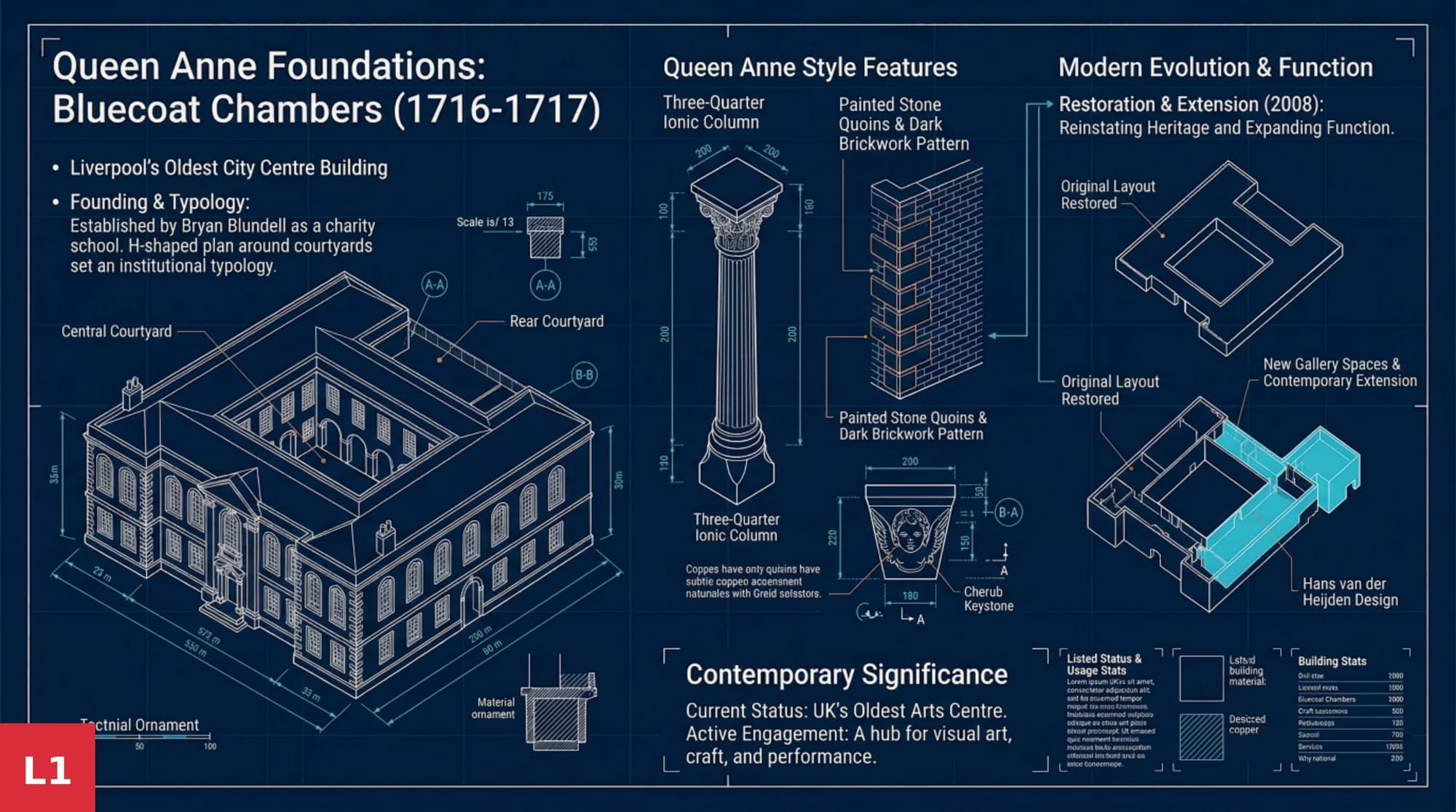
Bluecoat Chambers on School Lane is Liverpool's oldest surviving city centre building, built as a charity school by merchant Bryan Blundell. The H-shaped courtyard plan, Queen Anne detailing — Ionic columns, dark brickwork, painted stone quoins — established an institutional typology the city kept returning to.
It now functions as an arts centre, one of the oldest in the UK. The 2008 extension by Biq Architects added a contemporary performing arts wing while respecting the Queen Anne vocabulary of the original. The result is one of the more successful historic additions in the city.
Georgian Grandeur: Town Hall and the Georgian Quarter
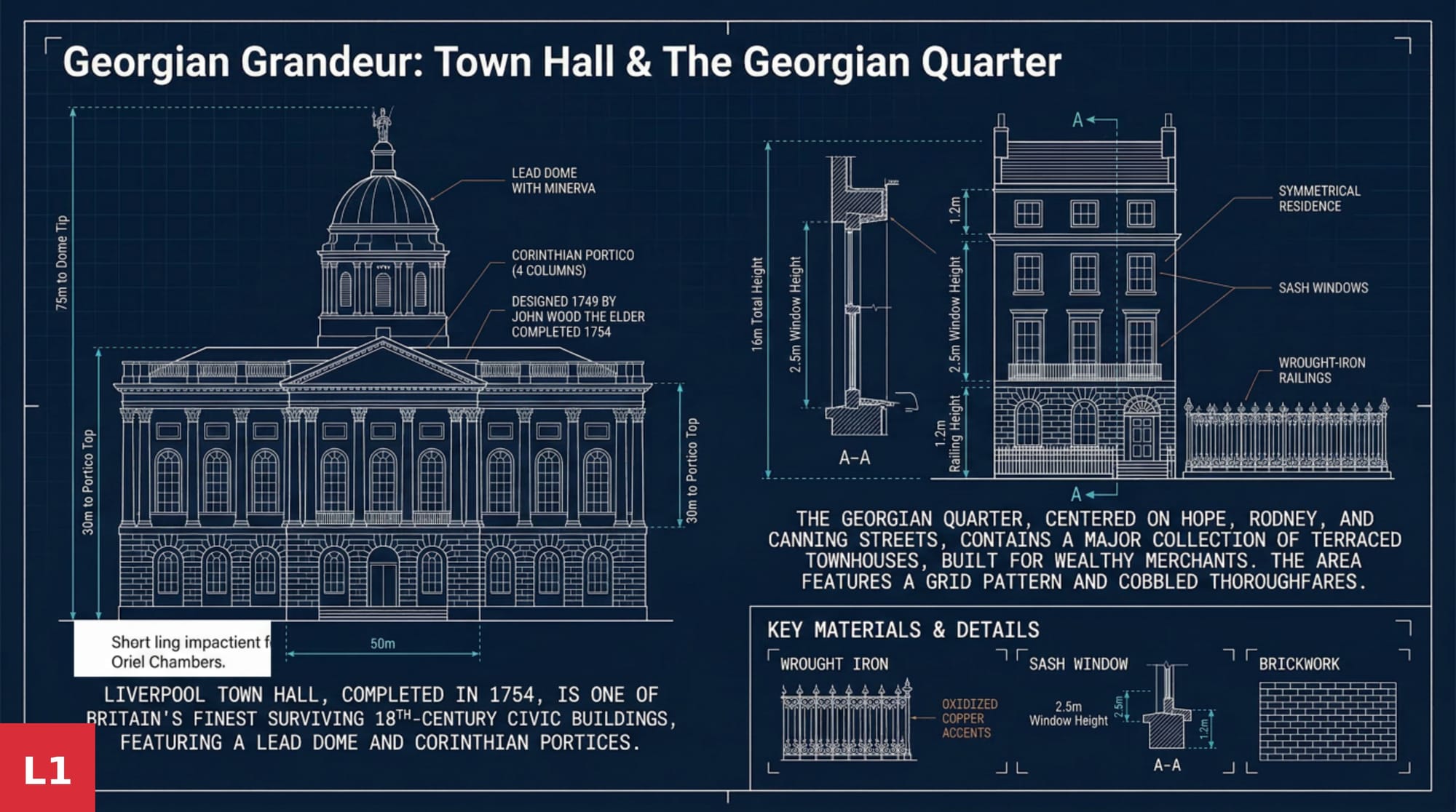
Liverpool Town Hall (1754) is one of Britain's finest surviving eighteenth-century civic buildings. Designed by John Wood the Elder, it has a lead dome topped by a statue of Minerva and a Corinthian portico across the front. Its position at the junction of Water Street and Dale Street — both running to the docks — was deliberate. The merchants who governed the city placed their civic building where commercial and administrative routes converged.
The Georgian Quarter, centred on Hope Street, Rodney Street, and Canning Street, is one of the largest surviving collections of Georgian townhouses outside London. Built on a grid — unusual for the period — with three and four-storey terraced houses, sash windows, wrought-iron railings, and cobbled streets. These were built for merchants who wanted to be close to the commercial core without living in it.
Victorian Innovation: St George's Hall (1854)
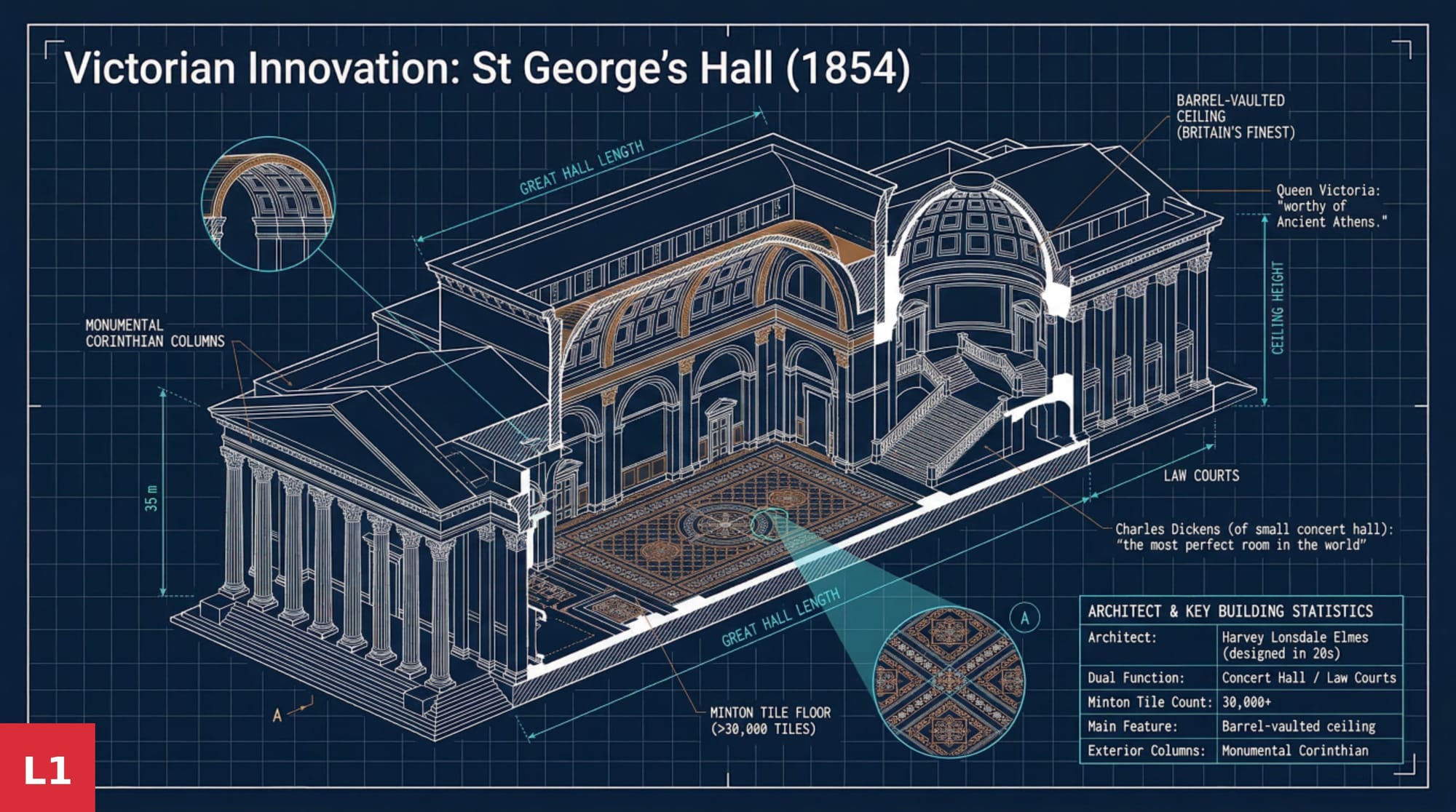
St George's Hall is the building that tends to stop architects in their tracks.
Harvey Lonsdale Elmes designed it in 1841, aged twenty-five. It simultaneously houses a concert hall and law courts — a dual function that required complex acoustic and structural engineering. Elmes died before completion; Charles Robert Cockerell finished it.
The exterior is monumental Greek Revival with a row of Corinthian columns running the full south facade. Inside, the Great Hall has a barrel-vaulted ceiling — considered one of the finest in England — and a floor of over 30,000 Minton tiles. Charles Dickens described the small concert room as "the most perfect room in the world." Queen Victoria reportedly called it "worthy of Ancient Athens."
It sits on the plateau opposite Lime Street station. Most people arriving in Liverpool by train walk past it within the first five minutes.
Industrial Heritage: Albert Dock (1846)
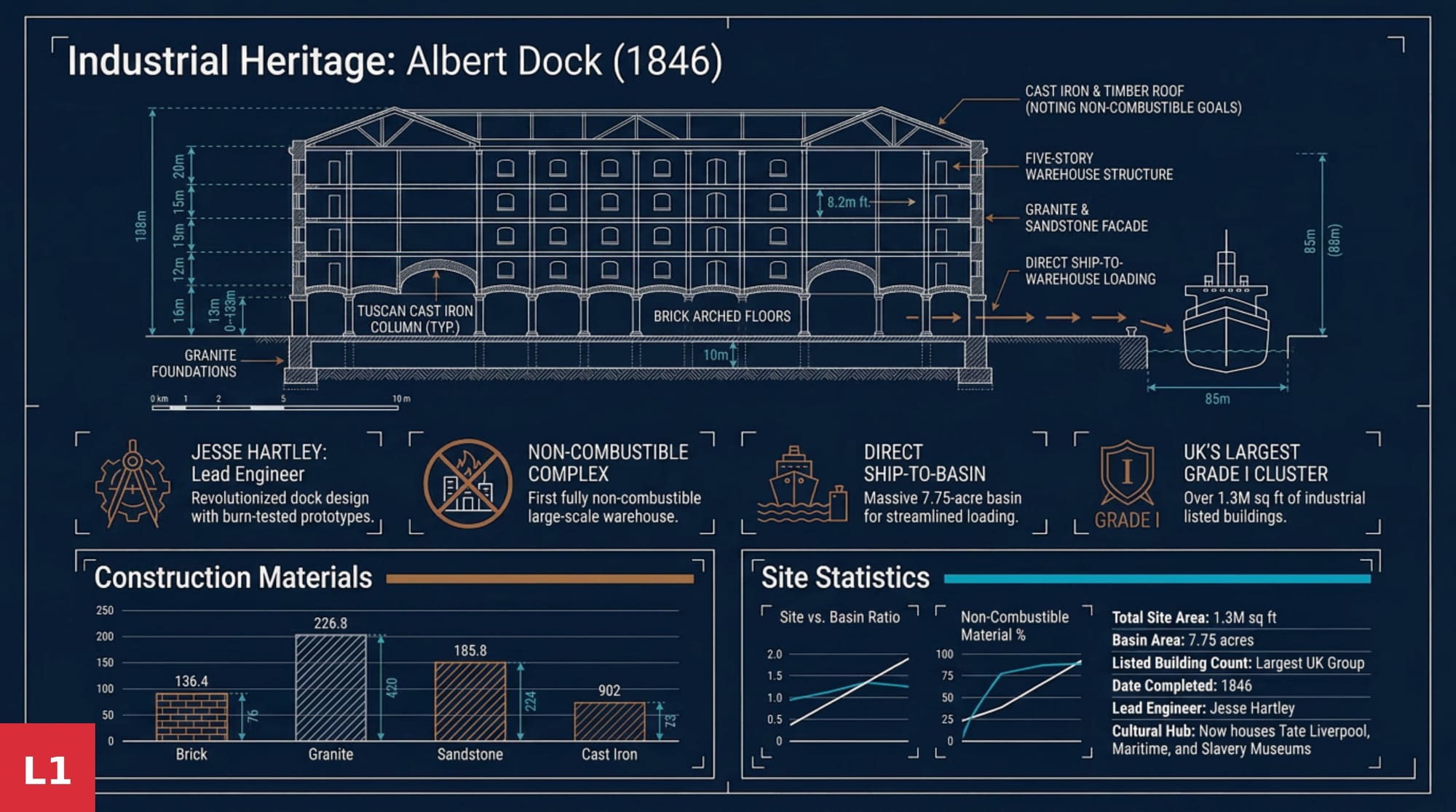
The Albert Dock complex was built as a fully non-combustible cargo handling facility — a new idea at this scale in 1846. Jesse Hartley, the lead engineer, chose every material for fire resistance: granite foundations, Tuscan cast-iron columns, brick arched floors. The five-storey warehouses gave direct ship-to-warehouse loading without goods touching the ground.
The dock basin covers 7.75 acres. Construction materials: 226,900 tonnes of brick, 185,800 tonnes of granite, 902 tonnes of cast iron.
Derelict for most of the twentieth century, regenerated in the 1980s. Tate Liverpool, the Merseyside Maritime Museum, and the International Slavery Museum now occupy the warehouse buildings. It remains the largest cluster of Grade I listed buildings in the UK.
Pioneering Modernism: Oriel Chambers (1864)
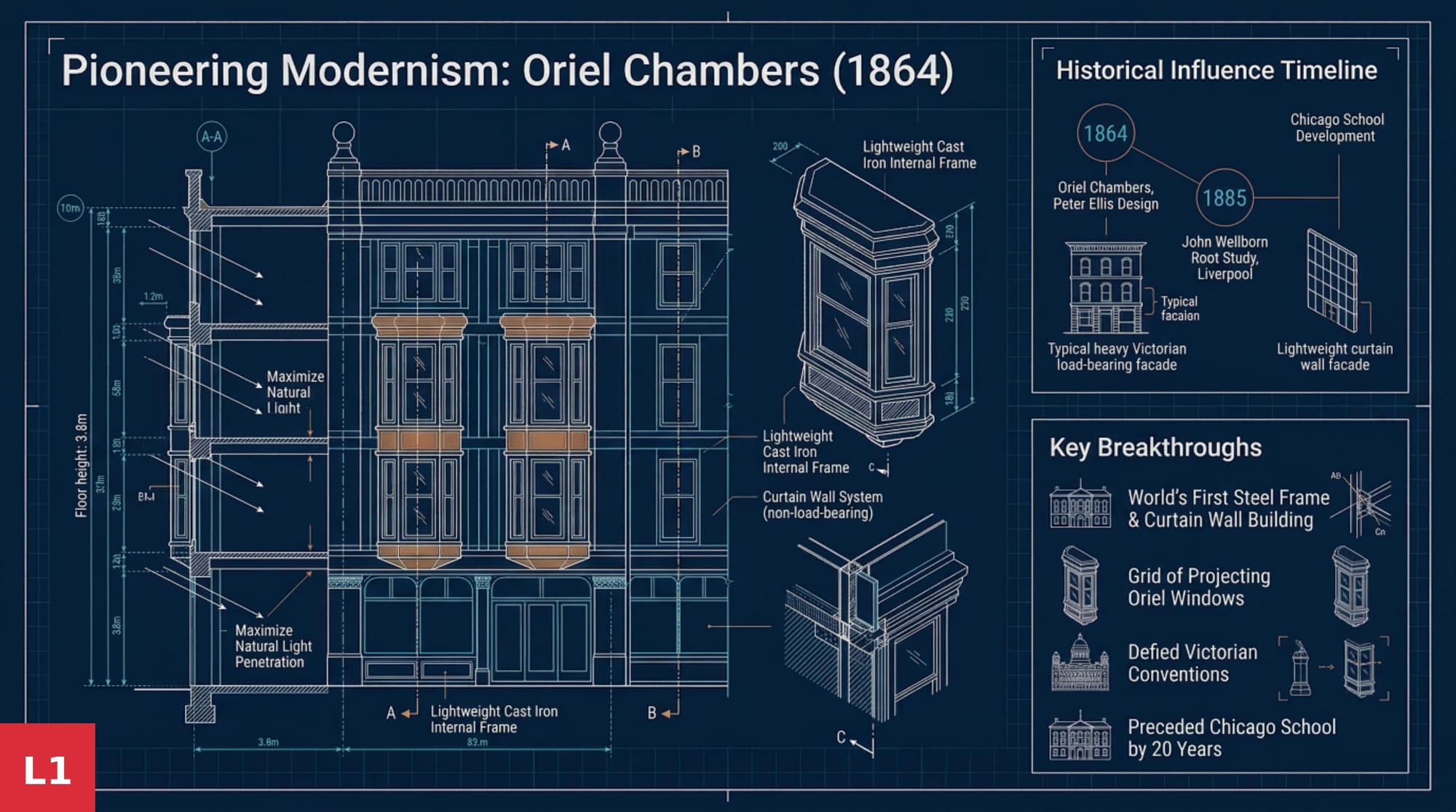
Oriel Chambers on Water Street is the building most people walk past without understanding what they are looking at.
Peter Ellis designed it in 1864 as an office building. The key decision was to use a lightweight cast-iron internal frame as the structural element, making the external wall entirely non-load-bearing. That allowed the facade to become almost entirely glass — large projecting oriel windows across every floor, maximising natural light.
In 1864 this was genuinely strange. Victorian buildings used load-bearing facades. Oriel Chambers introduced the curtain wall — a non-structural external skin hung from an internal frame — twenty years before the Chicago School developed the same principle and received the credit.
John Wellborn Root, one of the founders of the Chicago School, visited Liverpool in 1885 and studied Oriel Chambers directly. The connection is documented. The building is Grade I listed and still in use as offices.
Art Deco and the Inter-War Period
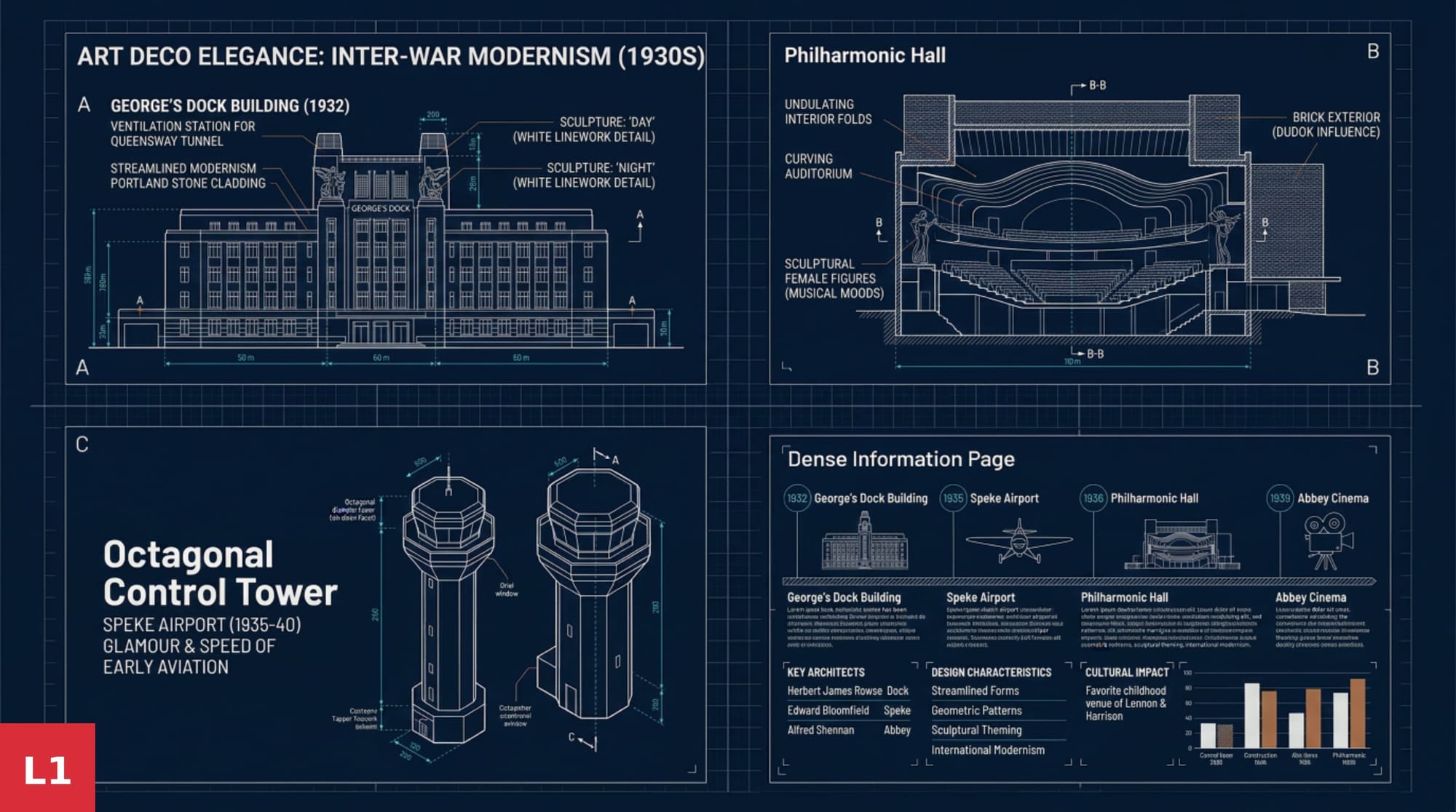
The inter-war decades produced some of Liverpool's most distinctive buildings, each responding to the modernist movement in a different way.
George's Dock Building (1932) on the Pier Head is a ventilation station for the Queensway Tunnel — infrastructure dressed in streamlined Art Deco, Portland stone cladding, and Linework sculptures representing Day and Night by Edmund Thompson. It is one of the clearest examples of the period's conviction that functional infrastructure should also be architecturally significant.
Liverpool Philharmonic Hall (rebuilt 1939) on Hope Street has a brick exterior with Dudok influence and a sculptural auditorium interior. It is the home of the Royal Liverpool Philharmonic Orchestra and one of the best mid-century concert hall interiors in the north of England.
Speke Airport (1935–40), now Liverpool John Lennon Airport's listed terminal building, was designed by Edward Bloomfield in a streamlined modernist style that captured the glamour and speed of early aviation. The octagonal control tower is one of the period's most recognisable airport structures in the UK.
Hope Street: Two Cathedrals
The Anglican Cathedral and the Metropolitan Cathedral stand at opposite ends of Hope Street, about half a mile apart. The contrast between them is one of the most useful things in Liverpool's built environment.
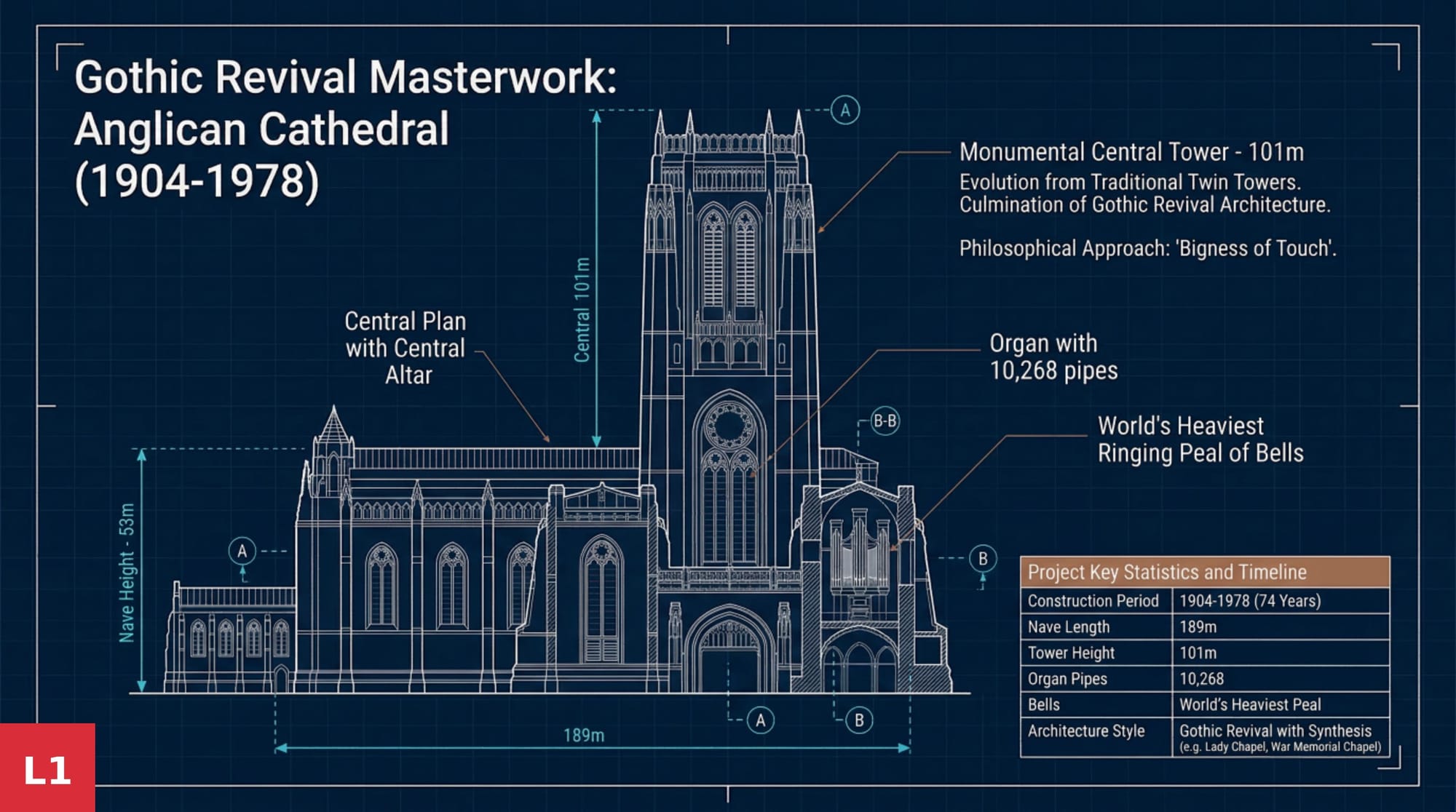
The Anglican Cathedral (1904–1978) is red sandstone Gothic Revival, designed by Giles Gilbert Scott when he was twenty-two after winning an open competition. It is the largest cathedral in Britain — nave length 189 metres, tower height 101 metres, organ with 10,268 pipes, and the world's heaviest peal of ringing bells. The central space under the tower is one of those architectural experiences that is difficult to prepare for from photographs.
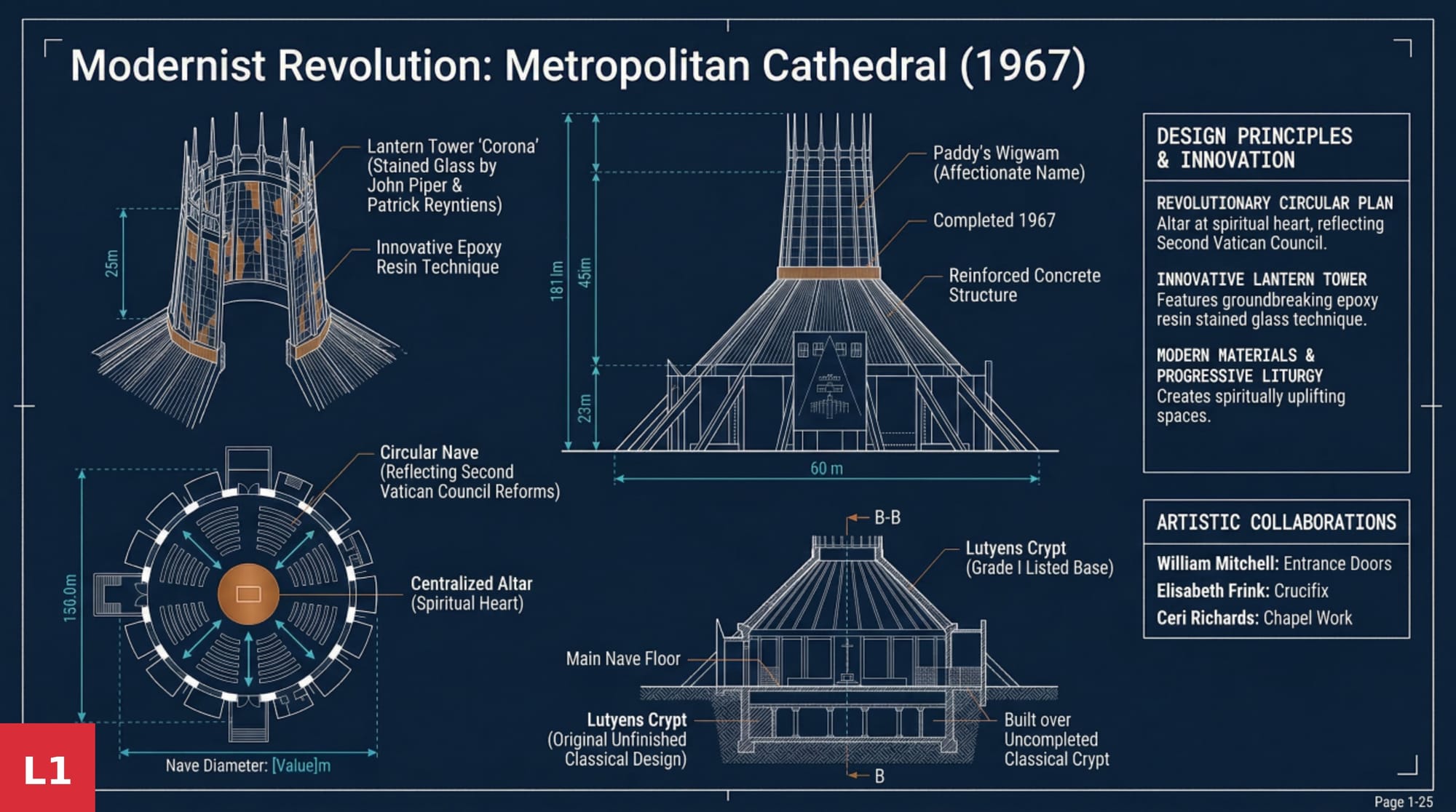
The Metropolitan Cathedral (1967) operates on a completely different logic. Frederick Gibberd's circular design — reinforced concrete structure, central lantern tower of stained glass by John Piper and Patrick Reyntiens, epoxy resin technique throughout — was completed in five years to replace the impossibly expensive Lutyens classical design. The Lutyens Crypt, which was partially built, still exists beneath the current building and is Grade I listed independently.
The interior lit through the lantern works better than the exterior suggests. The two cathedrals sit less than a mile apart — the walk between them takes twelve minutes and covers more architectural range than most European city tours manage in a full day.
Contemporary Liverpool
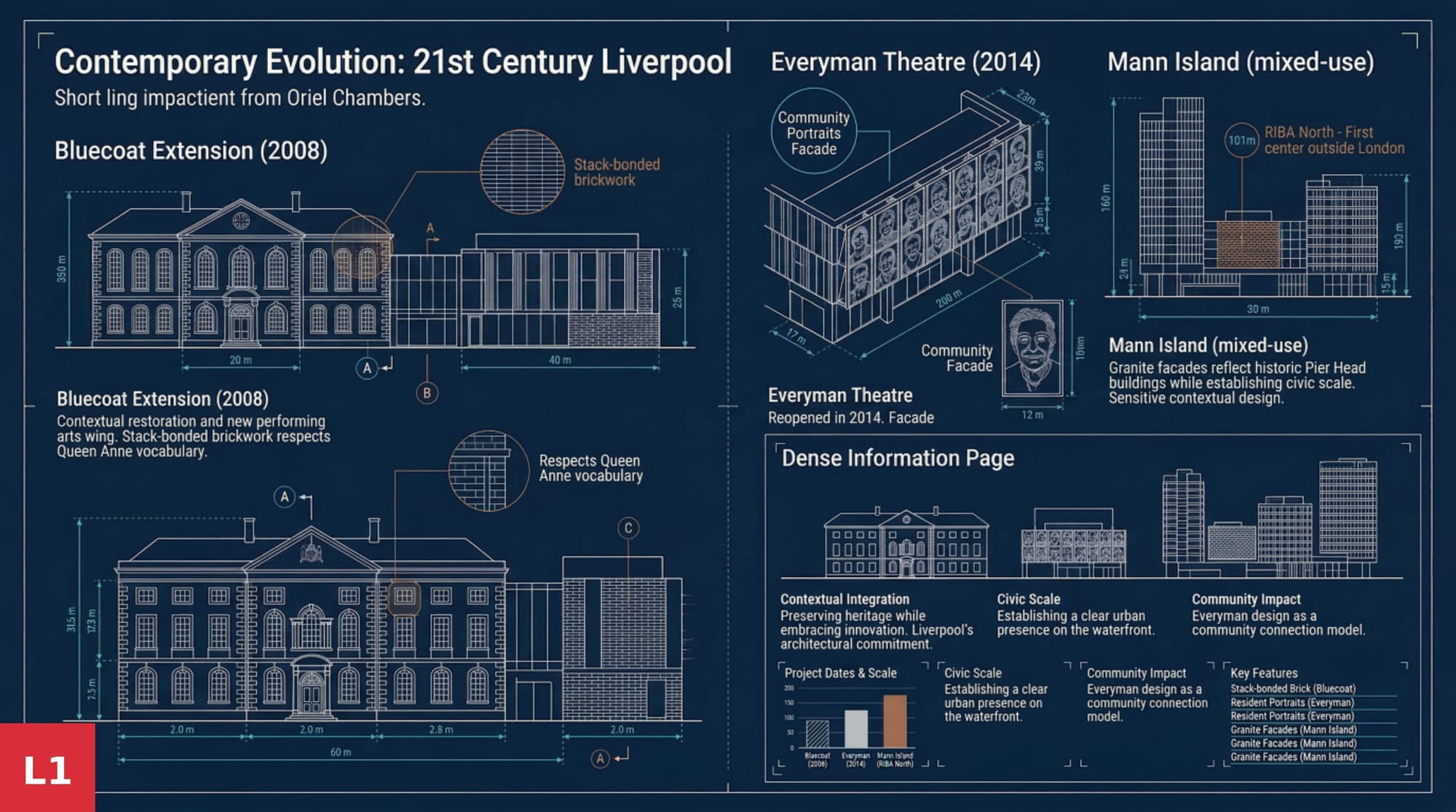
The most recent period of significant building in Liverpool has produced mixed results, but three projects are worth knowing about.
The Bluecoat Extension (2008) by Biq Architects added a contemporary performing arts wing to the 1716 Bluecoat building using stack-bonded brickwork that references but does not imitate the Queen Anne original. One of the more thoughtful historic additions in the city.
The Everyman Theatre (reopened 2014) on Hope Street replaced the beloved original with a building by Haworth Tompkins that incorporates community portraits into the facade and maintains the civic presence of the original at street level. It won the RIBA Stirling Prize in 2014.
Mann Island (mixed-use, completed 2012) on the waterfront alongside the Three Graces uses granite facades that reference the historic Pier Head buildings. It was the first RIBA North building outside London. Whether it sits comfortably next to the Three Graces is a question the city is still debating.
What This Adds Up To
Liverpool's architectural range is unusually legible if you slow down to read it. Queen Anne civic foundations, Georgian merchant confidence, Victorian engineering ambition, industrial-scale non-combustible construction, Art Deco inter-war elegance, two cathedrals representing different eras and communities, one building that changed architecture globally, and a contemporary period still finding its level.
The City Centre and waterfront are the places to start. Hope Street, Albert Dock, and the Georgian Quarter extend it into a full day. All of it is walkable.
Enjoying this? Get new guides, local news and what's on — straight to your inbox.
Subscribe free →