Liverpool Heritage Trail: Walking the City's History
A practical walking trail connecting Liverpool's key historical sites, from the Three Graces at the Pier Head through the Georgian Quarter to the two cathedrals on Hope Street.
Liverpool's history is not hard to find. It is in the buildings, the street layout, the dock engineering, and the decisions that shaped the city across three centuries of maritime trade. The difficulty is not finding it but understanding what you are looking at once you do.
This walking trail connects the main historical sites in an order that makes the city's development legible. It covers roughly two miles at a comfortable pace, with stops that can be extended into half-days on their own if you want to go deeper.
Start: The Pier Head and the Three Graces
Begin at the Pier Head and face the three waterfront buildings.

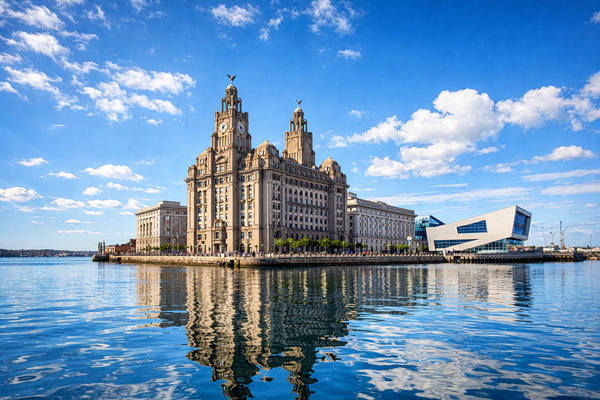
The Three Graces at the Pier Head — Liver Building, Cunard, and Port of Liverpool
The Royal Liver Building (1911), Cunard Building (1916), and Port of Liverpool Building (1907) represent Liverpool at its commercial peak. By the time they were built, Liverpool was handling a significant proportion of global maritime trade. The buildings were not civic vanity — they were working commercial headquarters for the institutions that ran the port.
The Liver Building used reinforced concrete in a way that was experimental at this scale in 1911. The Liver Birds on the roof — copper, about 5.5 metres tall — were the largest sculptures in the country when installed.
Time here: twenty minutes to look properly at all three buildings and walk the Pier Head arc.
Stop 2: Albert Dock (1846)
Walk south from the Pier Head along the waterfront to the Albert Dock.

Albert Dock — Jesse Hartley's non-combustible warehouse complex
Jesse Hartley built the dock complex between 1841 and 1846 specifically to eliminate fire risk from tobacco, cotton, and other goods stored at the port. Every material was chosen for non-combustibility: granite foundations, cast-iron Tuscan columns, brick arched floors. The five-storey warehouses surrounding the dock basin gave direct ship-to-storage access without goods touching open ground.
The dock was derelict from the 1970s and regenerated in the 1980s. It is now the largest cluster of Grade I listed buildings in the UK.
The International Slavery Museum inside the dock buildings is one of the more important historical destinations in the city. Liverpool's wealth was substantially built on the transatlantic slave trade, and the museum addresses this without equivocation. It is free and worth an hour.
Time here: thirty minutes for the dock itself, two-plus hours if you go into the museums.
Stop 3: Liverpool Town Hall (1754)
From Albert Dock, walk north through the city centre to Dale Street and the Town Hall.

Liverpool Town Hall — one of Britain's finest surviving 18th-century civic buildings
The Town Hall was completed in 1754 to a design by John Wood the Elder. The lead dome, Corinthian portico, and the overall proportions make it one of the finest surviving Georgian civic buildings in Britain.
Its position at the top of Water Street and Dale Street — both of which run to the docks — was deliberate. The merchants who financed and governed the city placed their civic building at the point where the commercial and administrative streets met.
The Town Hall is still in use as Liverpool City Council's formal space. The exterior is freely accessible; the interior is open for guided tours and civic events.
Time here: ten to fifteen minutes for the exterior.
Stop 4: St George's Hall (1854)
Continue east to Lime Street and the plateau where St George's Hall stands.

St George's Hall — Greek Revival engineering at civic scale
Harvey Lonsdale Elmes designed St George's Hall in 1841, aged twenty-five. The building simultaneously houses a concert hall and law courts — a dual function that required complex acoustic and structural engineering. Elmes died before it was finished; Charles Robert Cockerell completed it.
The Great Hall interior has a barrel-vaulted ceiling that is considered one of the finest rooms in England. The floor is made of 30,000 Minton tiles. Charles Dickens described the small concert room as "the most perfect room in the world."
The building is free to enter and worth going inside. The plateau it stands on, with the Walker Art Gallery and World Museum opposite, gives a sense of the Victorian civic investment in a city that believed itself to be on a level with London.
Time here: thirty minutes minimum to see the exterior, plateau, and a quick interior visit.
Stop 5: Bluecoat Chambers (1716)
Walk south from Lime Street through the city centre to School Lane and Bluecoat Chambers.

Bluecoat Chambers — Liverpool's oldest surviving city centre building
Bluecoat is Liverpool's oldest surviving city centre building, built in 1716 as a charity school by merchant Bryan Blundell. The Queen Anne style courtyard building preceded the Georgian Quarter by decades and established an institutional typology — courtyard plan, painted stone, formal symmetry — that influenced subsequent civic building in the city.
It now functions as an arts centre: galleries, studios, performance spaces, and a cafe in the courtyard garden. The 2008 extension by Biq Architects integrated a contemporary wing without compromising the historic core.
Time here: twenty minutes for the building; longer if you want the galleries or cafe.
Stop 6: Hope Street and the Two Cathedrals
Walk south from Bluecoat through the Georgian Quarter to Hope Street and the full half-mile between the two cathedrals.

Hope Street — connecting the two cathedrals of Liverpool
Liverpool Anglican Cathedral at the south end of Hope Street is the largest cathedral in Britain. Giles Gilbert Scott won the design competition in 1903 aged twenty-two. Construction ran from 1904 to 1978. The red sandstone exterior and the scale of the central tower — 101 metres — require some time simply to take in from different distances outside before going in.
The interior space under the tower is one of the most significant architectural experiences in the north of England. The proportions are not fully apparent from photographs.
At the other end of Hope Street, the Metropolitan Cathedral (1967) by Frederick Gibberd operates on a completely different logic: circular plan, reinforced concrete, central lantern of coloured glass and oxidised copper. It was built in five years to replace an impossibly expensive Lutyens design. The interior lit through the lantern is worth experiencing independent of any opinion about the exterior.
Walking between them takes twelve minutes. Together they represent a complete cross-section of Liverpool's religious, cultural, and architectural history.
Time here: an hour minimum to do both cathedrals any justice.
The Full Trail
| Stop | Walking from previous |
|---|---|
| Pier Head | Start |
| Albert Dock | 10 min south along the waterfront |
| Town Hall | 15 min north through the city centre |
| St George's Hall | 10 min east to Lime Street |
| Bluecoat Chambers | 10 min south through the city centre |
| Anglican Cathedral | 15 min south through the Georgian Quarter |
| Metropolitan Cathedral | 12 min north along Hope Street |
Total walking: approximately two miles over three to four hours with stops. A full day if you go inside each building properly.
Best next reads
Enjoying this? Get new guides, local news and what's on — straight to your inbox.
Subscribe free →