Liverpool Waterfront Walk: A Practical Guide
The Liverpool waterfront is one of the best urban walking routes in the north of England. This guide covers the full route from the Albert Dock to the north docks, with stops worth knowing.
Liverpool's waterfront is the part of the city most visitors arrive at and fewest actually walk properly.
The problem is usually framing. People treat the Pier Head as a destination — take the photos, see the Liver Building, move on. The walk along the waterfront, north and south, is better than the fixed point. This guide covers the route with enough practical detail to make it useful rather than just descriptive.
Starting Point: Albert Dock
The Albert Dock is the southern anchor of the practical waterfront walk.

Albert Dock — the largest cluster of Grade I listed buildings in the UK
The dock basin itself is worth walking around at a slow pace before going into any of the museums. Jesse Hartley's 1846 warehouse complex — non-combustible construction, cast-iron columns, granite and sandstone walls — is one of the most significant pieces of Victorian industrial engineering in the country. The engineering logic is visible in the structure: direct ship-to-warehouse access, five-storey storage, nothing that could catch fire.
Tate Liverpool and the Merseyside Maritime Museum are both in the dock buildings and both free. If you want to spend time inside either, build a separate half-day rather than trying to combine them with the walk.
Coming out of the dock basin and heading north along the waterfront path takes you towards the Pier Head. The walk is flat and along the river edge.
The Pier Head: The Three Graces
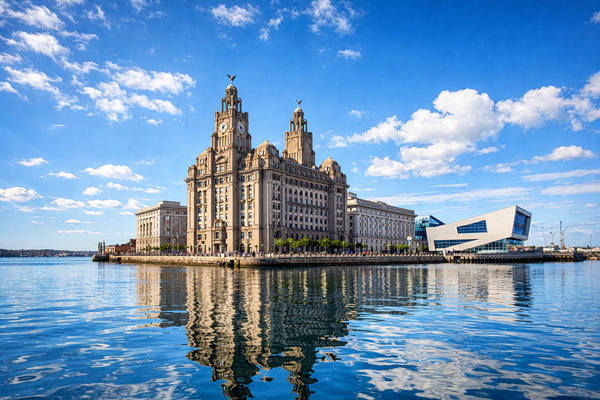
The Pier Head section is where the three landmark buildings — the Liver Building, the Cunard Building, and the Port of Liverpool Building — sit together on the waterfront.

The Three Graces at the Pier Head
The Royal Liver Building (1911) is the one with the clock towers and the Liver Birds on top. It was one of the first large reinforced concrete buildings in Britain. The two towers are slightly different heights. The birds at the top face in different directions — one towards the sea, one towards the city.
The Cunard Building (1916) sits next to it in heavier Edwardian baroque. The Port of Liverpool Building (1907) completes the three. Together they face the Mersey and read as a single statement even though they were designed by different architects across different decades.
The ferry terminal operates from the Pier Head. Mersey Ferries run regular crossings to Birkenhead and Seacombe on the Wirral side. The crossing takes about ten minutes and is one of the better views of the Liverpool skyline if the weather is reasonable.
Mann Island and the Museum of Liverpool
Walking north from the Pier Head, the Museum of Liverpool sits at the Mann Island development.

The Museum of Liverpool at Mann Island
It is free to enter and covers the social, cultural, and maritime history of the city across multiple floors. The building is modern — grey stone and glass, completed in 2011 — and controversial in terms of how it sits alongside the three older buildings to the south. The interior is more widely liked than the exterior.
Worth an hour at minimum if you have not been. The Liverpool Lives gallery and the Popular Culture collections are the best starting points for a first visit.
The Leeds and Liverpool Canal: Turning Inland Slightly
Just north of Mann Island, the Leeds and Liverpool Canal reaches its western terminus at Stanley Dock, about a mile inland and north from the Pier Head.
This part of the waterfront walk — from Mann Island north and inland — is less obvious but interesting. The canal towpath is accessible from the Pier Head area and runs through the north docks district. The Stanley Dock Tobacco Warehouse (1901) at the canal terminus is one of the largest brick buildings in the world, currently being converted into residential use.
It is not a conventional tourist route, which is part of why it is worth walking.
North Docks: Bramley-Moore and the Everton Stadium
Further north along the waterfront, the Bramley-Moore Dock is the construction site of Everton Football Club's new stadium, due to open for the 2025-26 season.
The north docks area — Stanley Dock, Collingwood Dock, Bramley-Moore — was the commercial heart of Liverpool's nineteenth-century port operation and is still largely industrial in character. The waterfront here is less finished as a public space than the Pier Head end.
The Everton stadium, once complete, will significantly change the footfall and character of this part of the waterfront. For now it is worth knowing about but the walk from the Pier Head to Bramley-Moore and back (about three miles round trip) is a genuinely different experience from the polished southern section.
Practical Route Notes
South route: Albert Dock to the Pier Head is about a mile of flat waterfront path. Easy in any weather with the road on one side and the Mersey on the other.
North route: Pier Head to Stanley Dock adds another mile or so and goes through rougher urban territory. Worth it for the canal terminus and the tobacco warehouse.
The full route: Albert Dock to Bramley-Moore and back is around five miles. Half a day with stops.
By ferry: The Mersey Ferry from the Pier Head to Birkenhead takes ten minutes and gives a clear view back to the waterfront from the river. Return crossing included in the ticket price.
Cafes and stops: Albert Dock has several cafes and restaurants. The Pier Head area has the Mersey Ferry terminal cafe and a handful of options. The north docks stretch has nothing practical until you reach the residential areas near Vauxhall.
Getting to the start: Albert Dock is a fifteen-minute walk from Liverpool Central station via the Strand. The Pier Head bus stops handle most routes from the city centre and are clearly marked.
Best next reads
Enjoying this? Get new guides, local news and what's on — straight to your inbox.
Subscribe free →