How the Liverpool Echo Went From Front Page to Pop-Up Farm
The Echo once sold 285,000 copies a day and had the pink Football Echo on the streets by teatime. Now it sells 7,645 and asks you to disable your adblocker.
Ask anyone over forty in Liverpool about the Echo and they will tell you about a paper round: a canvas bag, a dark teatime, and a first wage earned before they were old enough to spend it on anything sensible. Or about the seller outside Central Station shouting a word that shared two or three letters with "Echo". Or about a dad waiting on the pink Football Echo on a Saturday to read about a match he had just watched with his own eyes.
For nearly 150 years the Echo told Liverpool what was happening in Liverpool: the match, the docks, the council, the courts, who your nan should be worried about.
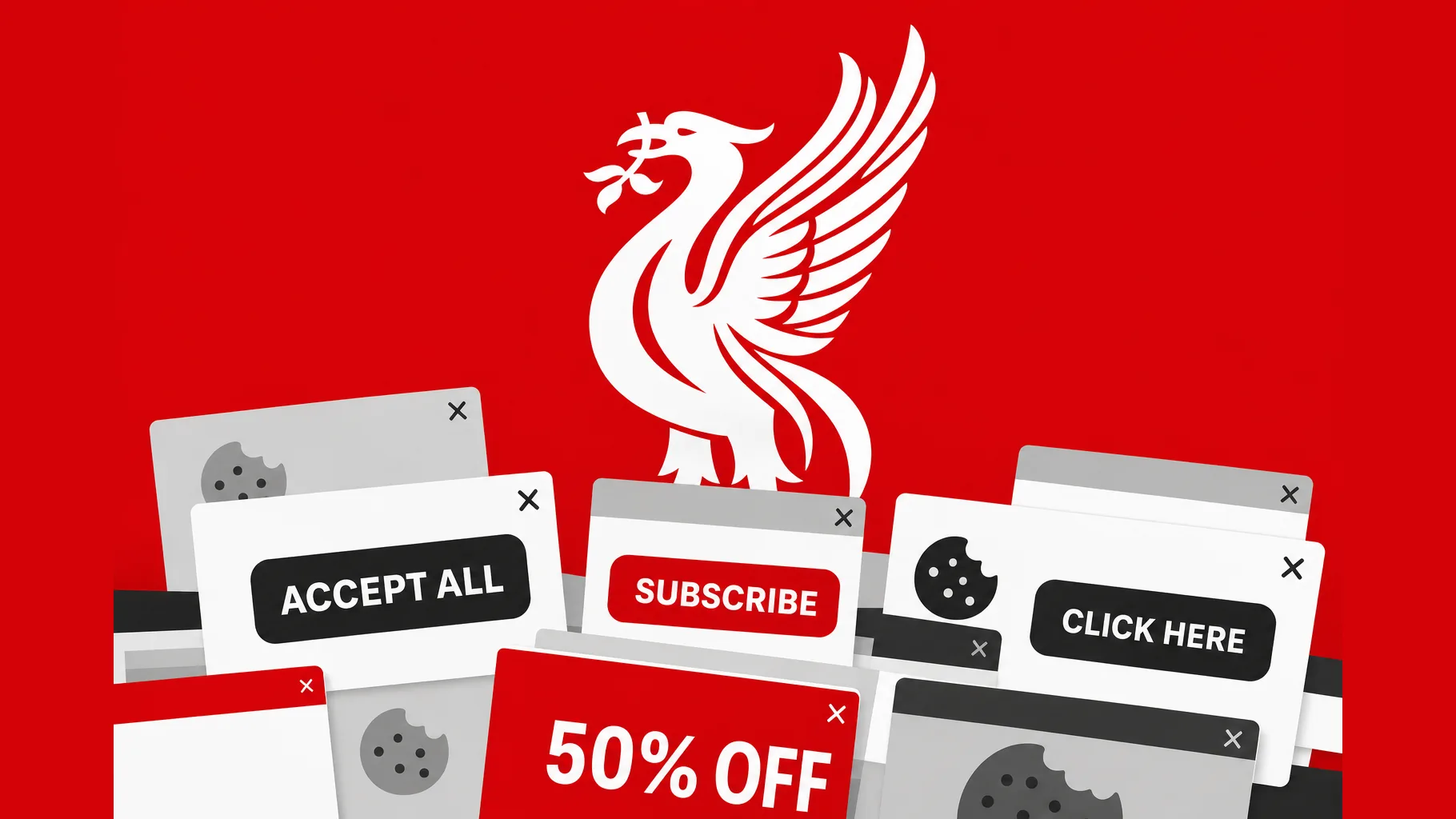
Today it is a website that asks you to disable your adblocker while a video follows you down the page. A lot of people in this city hold its owner, Reach plc, responsible. This is the story, with the numbers, because the numbers are brutal.
The Echo's circulation, then and now
The Echo launched on 27 October 1879 at half a penny a copy, and in its prime printed up to ten editions a day.
In 1976 it sold more than 285,000 copies a day. The latest audited figure is 7,645.
The pink Football Echo, on the streets minutes after full time, printed its last Saturday edition in 2004.
Its morning sister paper, the Daily Post, closed in 2013 after 158 years.
The Echo survives online under Reach plc, where reporters have been set targets of 850,000 page views a month. Many readers blame Reach for what the paper has become.
In December 2025 the Echo launched a £4.99-a-month subscription whose main promise is fewer adverts.
The paper that ran the city
The Echo was founded in 1879 by Alexander Jeans as the cheap, fast evening sister to the morning Daily Post. It cost half a penny, a price it held until 1917, and in its prime it put out as many as ten editions a day from Victoria Street, re-set in hot metal as news broke through the afternoon. The current website struggles to load one page without a cookie banner falling over a video advert. The 1904 Echo re-made the entire paper ten times between breakfast and bedtime.
The Echo gave Liverpool more than headlines. An Echo round was the first job for generations of kids, and the corner sellers made a trade of it, complete with their own street cry. A paper selling to most of the city could afford reporters at the council, the courts and the docks. And the paper itself was a habit: bought on the way home, read at the table, swapped at work the next morning. The Echo moved to Old Hall Street in 1973 and carried on being the thing you picked up at the end of the day, because if it mattered in Liverpool, it was in the Echo by teatime.
The pink Football Echo
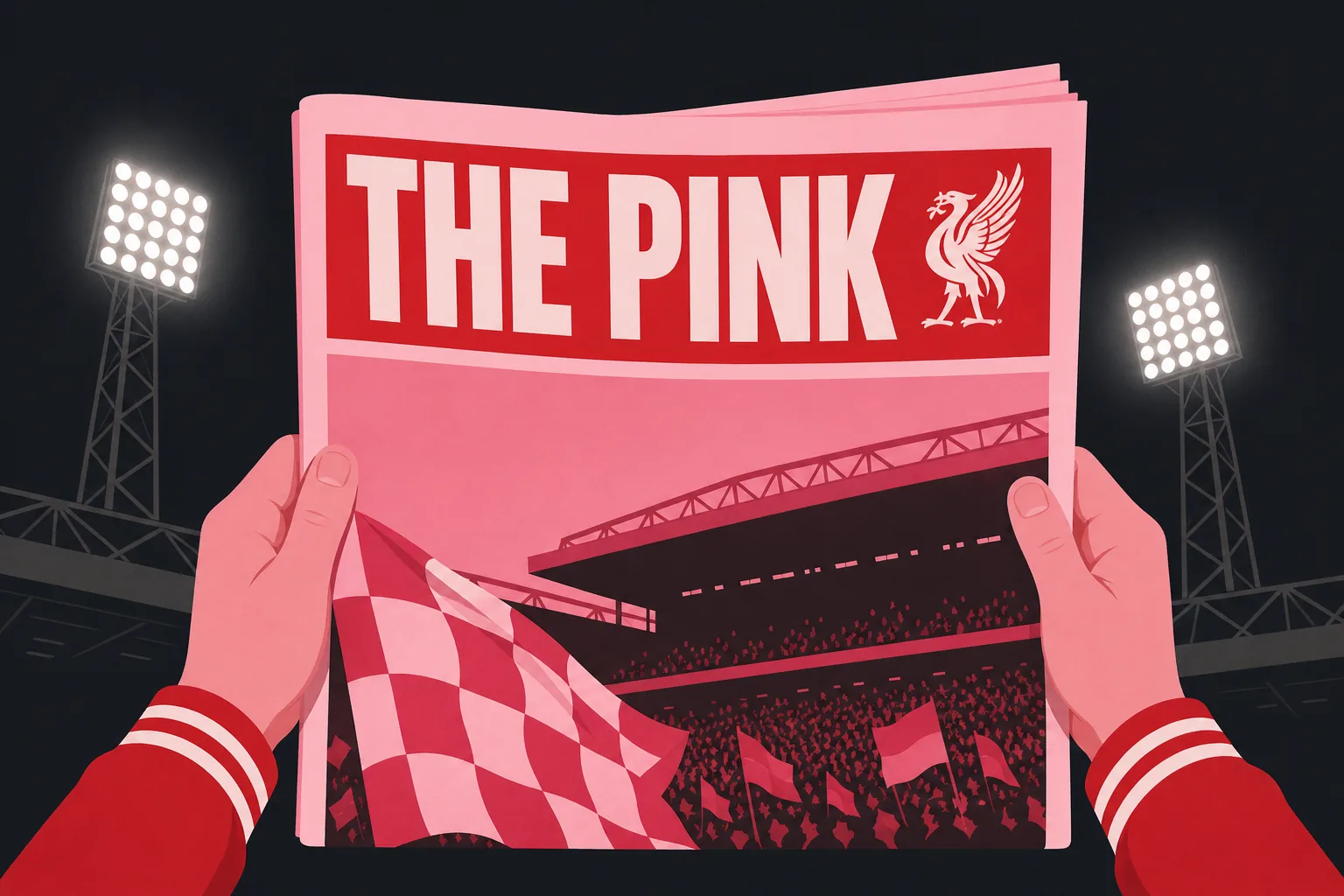
The Football Echo was the cleverest thing the paper did: match reports, league tables and every result in the country, printed on pink paper and on sale while fans were still walking away from Anfield and Goodison. Full time was quarter to five. The pink was in your hand by teatime, with a considered report of a game that had finished forty minutes earlier. It did the job of a smartphone using typesetters, printing presses and vans.
Teletext, mobiles and the internet killed it, as they killed the Saturday pinks across England. The last pink went out in 2004. For a while it survived as a preview pull-out in the Saturday morning paper, and then it was gone.
Full time at quarter to five, the pink in your hand by teatime · L1 Local editorial illustration
Even at 7,645, the Echo is still one of the best-selling regional dailies in England, which says less about the Echo than about how deep the whole industry's problem runs. The Daily Post went first: daily until 2012, weekly for a stretch, then closed for good in December 2013 after 158 years.
The print business collapsed, and the paper survived by moving online. Online has its own rules.
The downfall, in five steps and 46 ads
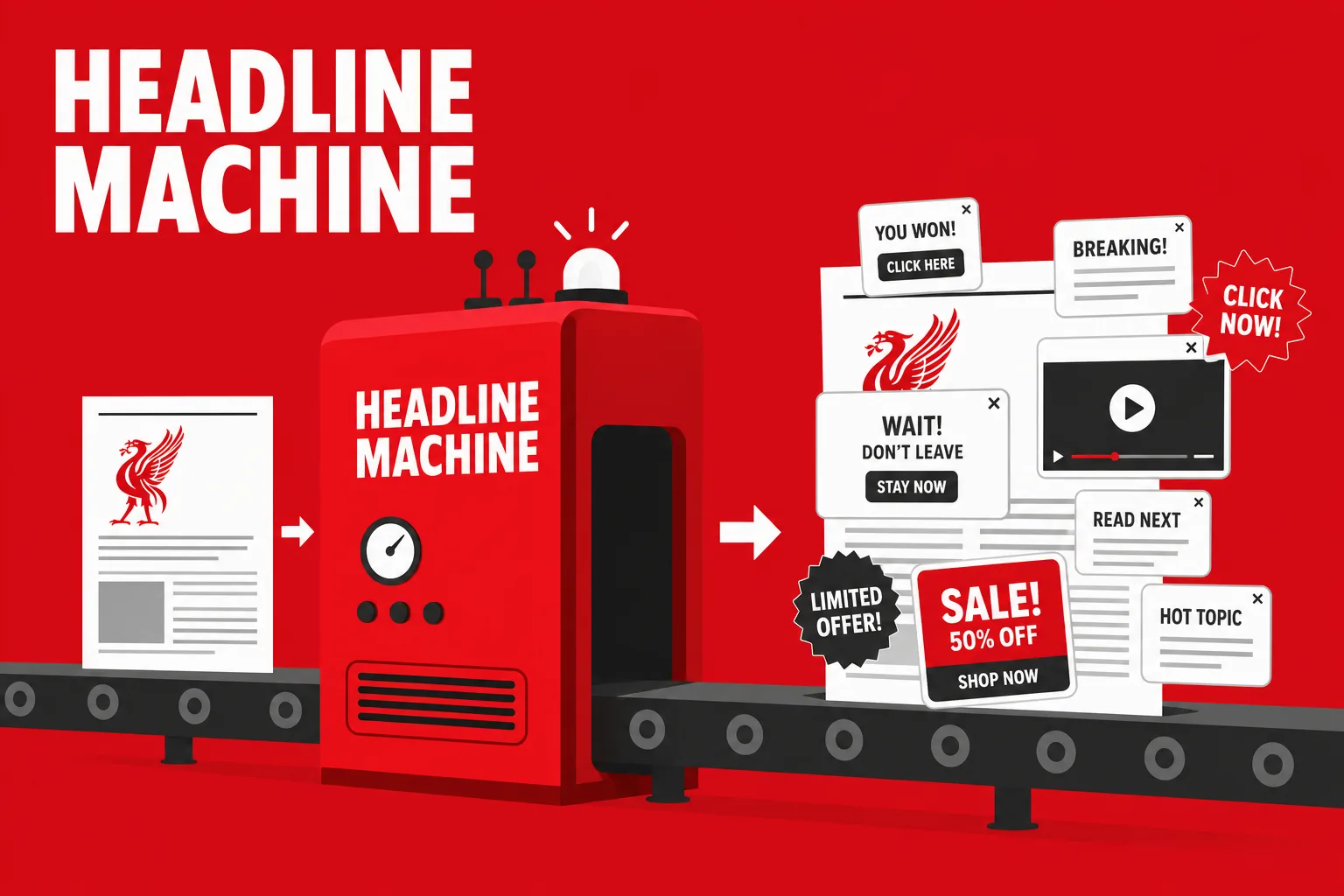
Somewhere between the newsroom and your phone, a machine gets involved. We have reverse-engineered it:
Take simple local news.
Remove the useful information.
Add "people are only just realising."
Insert 46 advertisements.
Call it journalism.
From the reader's side:
Step
What happens
1
Something normal happens in Liverpool
2
The headline removes the name, the place and the point
3
You have to click to find out the obvious
4
The page loads like it is powering a small industrial estate
5
The useful information appears after you have lost the will to live
The headline machine, reverse-engineered · L1 Local editorial illustration
The locked-cupboard headline
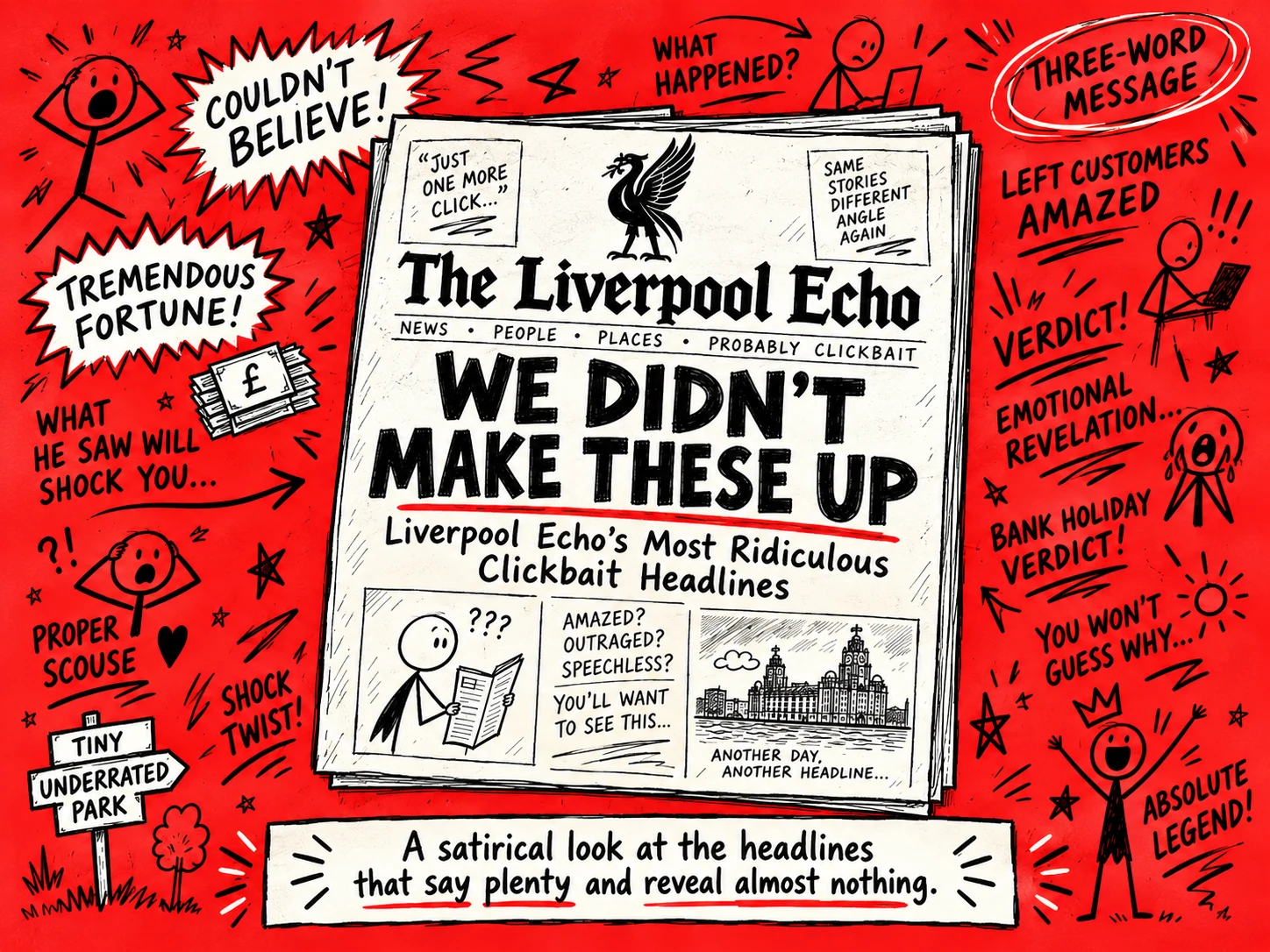
You will know the pattern. "People are only just realising" something everyone in Liverpool has known for years. A place "crowned best for this one thing", with the one thing kept behind the click. A "key reason" and a "here's why", both also behind the click.
That is not a headline. It is a locked cupboard. The thing is the news. Put it in the headline. That is where headlines live. The 1976 Echo would have told you on the front page, in the first edition of ten.
When the story is a death
The formula stops being funny when the story is serious. You will recognise the shape of the headline: "Woman found dead in Liverpool area." No name released, which is normal and right while police contact family. But the headline also names no district and no street, nothing that tells a city of half a million whether this is their road, their mate, or their daughter who did not text back last night.
People click out of fear. No editor has to plan it that way: a vague tragedy headline turns worry into traffic, because anyone with a loved one in Liverpool has to open the story to rule themselves out.
Social media is where the pattern earns its keep. The vague headline gets posted to Facebook, lands between a cousin's wedding photos and a lost cat appeal, and travels on alarm: shares, tags, rows of "hope everyone's OK" comments. Fear is the most reliable engagement a post can have, and a headline built for the algorithm is built to cause it.
When something serious happens, the job of a local paper is to get the important information out as fast and as clearly as possible: where, when, what is known, what is not, and who to contact. The old Echo understood that ten editions a day. Trading on a city's worry for page views is the click placed above the reader, on the one story where the reader matters most.
The owner: Reach plc
The Echo belongs to Reach plc, Britain's biggest regional publisher, called Trinity Mirror until 2018. Ask around Liverpool and you will hear a blunt opinion: Reach destroyed the Echo. That is an opinion, not a court finding, but it is not hard to see where it comes from.
It was Trinity Mirror that closed the Daily Post in 2013. In 2022 the Liverpool Post reported that general reporters on the Echo were expected to bring in 850,000 page views a month, a target one journalist called "clickbait-encouraging madness". And in 2025 Reach announced its biggest-ever reorganisation, cutting 321 editorial roles with 135 new ones created, as referral traffic from Google and Meta fell away.
To be fair, it is not the journalists, and it is not only Reach. Print sales collapsed everywhere. Facebook took the attention, Google took the traffic, and digital adverts pay a fraction of what the printed page did. But mark reporters on page views and you get the paper you asked for: more news, thinner, louder, wrapped in adverts.
The 46 ads are barely an exaggeration
Reading the Echo online should not be harder than producing it was in 1904.
You open the page for one sentence about your own street. A video starts. The page jumps. A newsletter box appears. Something flashes. Your thumb clips an advert, and suddenly you are reading about garden furniture in Wigan while the story you came for vanishes.
The complaints are on the record. The Liverpool Post argued back in 2022 that when the Echo publishes important journalism, it is rendered almost unreadable by pop-ups and ads. Trustpilot reviews of the Echo site repeat the same complaints: slow pages, pop-ups, stories jumping around mid-read. Trustpilot is not a formal audit, but the pattern is hard to miss. Meanwhile Reach promotes local news sites to advertisers as environments that drive 26% more trust and 41% more reassurance than other media, which is a bold claim to make about a page you cannot scroll in a straight line.
Now there is a paywall too
In December 2025 the Echo launched Echo Premium, two weeks after its Reach sister title in Manchester: £4.99 a month for subscriber-only stories, puzzles, and what Reach calls an "ad-lite" experience. The site became almost unreadable under adverts, and the remedy on sale is a subscription, from the owner of the adverts, to see fewer of them.
Paying for local journalism is a fine idea. It is how the halfpenny Echo worked, and a subscription that funds reporters is a better deal than a page view ever was. But Reach has said the page-view chase carries on for everything outside the paywall. The clean Echo costs £4.99 a month. The free one stays a pop-up farm.
What local news should do instead
None of this is complicated, and the old Echo proved it daily. Tell people what happened. Tell them where. Tell them why it matters. Give the background, link the source, and do not make readers fight through half the internet to find out what the front page would have said for half a penny.
That is what we are trying to do at L1Local: explain the city properly, not just what happened today, but why the place matters. Read our about L1Local statement to see how we fund and run independent Liverpool reporting, or browse our city centre area guide for the streets where Liverpool's press history unfolded.
Ten editions a day, one clear headline
The Echo got ten editions a day onto the streets of Liverpool with hot metal, typesetters, vans and kids with canvas bags. Getting one clear headline onto a phone screen should not be harder than that.
So here is our counter-formula, in memory of the paper the Echo used to be:
Take simple local news.
Keep the useful information.
Respect the reader.
Then call it journalism.
A satirical look at genuine Liverpool Echo headlines that say plenty, reveal almost nothing, and somehow still make you click to find the missing detail.
Comments
Join the conversation with your L1Local Community account. Keep it civil and on topic.