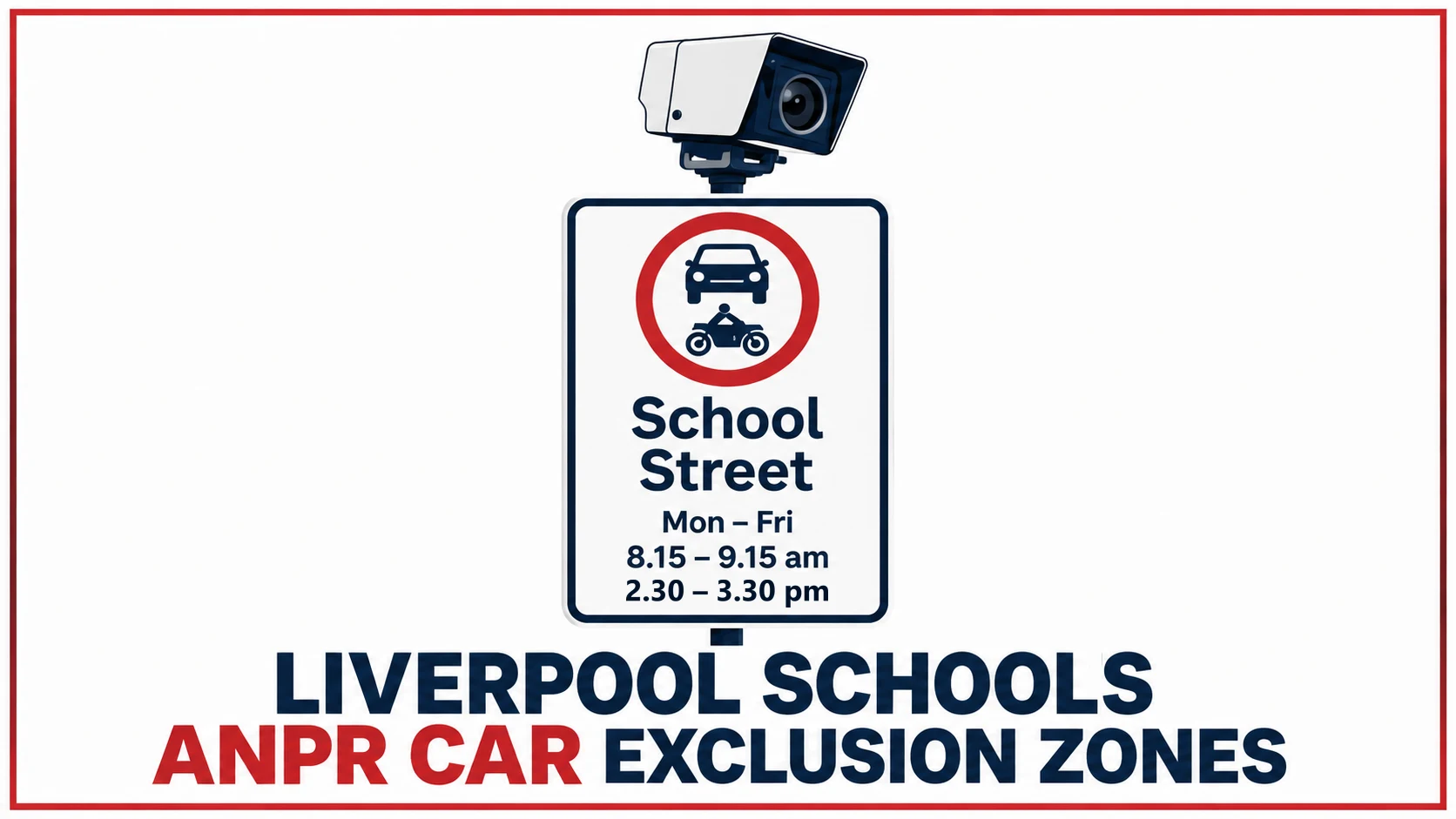
Driving near a Liverpool primary school at drop-off or pick-up? Fourteen schools now have ANPR cameras enforcing a School Street, and the restriction catches you for driving in at all, not for parking badly. The fine is £70. This page lists every camera site, the exact times, who can get an exemption and how, and the three places where the council's own paperwork does not match its website.
Everything below was checked against Liverpool City Council, the council's March 2026 traffic order and Department for Transport guidance on 20 August 2026.
Which schools, and what times
14 Liverpool schools have School Street ANPR cameras.
Restricted times are 8.15am to 9.15am and 2.30pm to 3.30pm, Monday to Friday, term time only. One school stops at 9am.
Cameras follow Liverpool City Council term dates, not your individual school's dates.
Driving in is the offence. You do not have to stop or park.
£70 fine, £35 if paid within 21 days. New cameras send warning letters for the first six months.
Residents apply for an exemption themselves. Blue Badge, carer and SEND access goes through the school.
Exemptions run for one school year and need renewing.
The council wants up to 50 more School Streets in four years. A citywide survey closed on 14 August 2026 with no results published yet.
What a School Street actually restricts
A School Street closes a road, or a short section of one, to most motor traffic at drop-off and pick-up. Residents and other qualifying vehicles keep access through an exemption list.
ANPR stands for automatic number plate recognition. The camera photographs the plate of every vehicle that enters and checks it against that exemption list. It does not know who is driving or where they live, which is why the paperwork below all comes back to one thing: the registration.
The important part for drivers is that this is a moving traffic offence, not a parking one. Liverpool enforces it under Part 6 of the Traffic Management Act 2004, using the same powers it uses for bus lanes and yellow box junctions. You can pick up a penalty by driving into the street during the restricted hour even if you do not stop, do not park and turn straight back out.
The Department for Transport's guidance on setting up a School Street tells councils to design each one around the specific road: where the school entrance sits, how residents and businesses get in, where traffic will divert to, and whether parking simply shifts onto the next street.
The 14 Liverpool schools with School Street cameras
These are the sites Liverpool City Council names on its moving traffic offences page. The road extents come from the council's March 2026 traffic order.
Standard hours at 13 of the 14
8.15am to 9.15am and 2.30pm to 3.30pm, Monday to Friday, during Liverpool City Council term dates. St Paul and St Timothy's is the exception: its morning restriction ends at 9am.
School
Road restricted
All Saints Primary
Oakfield, from Walton Breck Road and from All Saints Church
Christ the King
Meadway from Wavertree Nook Road, and Fieldway from Thingwall Road
Greenbank Primary
Arlington Avenue, from Greenbank Road and Nicander Road
Holy Family Primary
Toxteth Street from Rhyl Street, and Upper Essex Street from Steble Street
Much Woolton Primary
Watergate Lane from Woodrock Road, and Watergate Way from Priorsfield Road
Rice Lane Primary
Brockenhurst Road, from Rice Lane
Rudston Primary
Rudston Road, between Score Lane and Okehampton Road
St Anne's Primary
Overbury Street, between Cardwell Street and Angela Street
St Clare's Primary
Garmoyle Close, from Wellington Avenue
St Cleopas Primary
Barclay Street, from Mill Street
St Cuthbert's Primary
Church Road, from 50m south of Prescot Road to Selkirk Road
St Gregory's Primary
Montreal Road, from Winnipeg Drive
St Michael in the Hamlet
Neilson Road, from St Michael's Road
St Paul and St Timothy's
South Parkside Drive from Melwood Drive, and Spring Grove from Town Row. Morning restriction ends at 9am, not 9.15am.
Do not carry one school's times across to another. Spring Grove and South Parkside Drive, in West Derby, reopen at 9am. Every other listed road stays shut until 9.15am.
The sign at the entrance to the road is what a driver is legally expected to read. The council says the operating dates and times are displayed there, and the sign wins over any webpage.
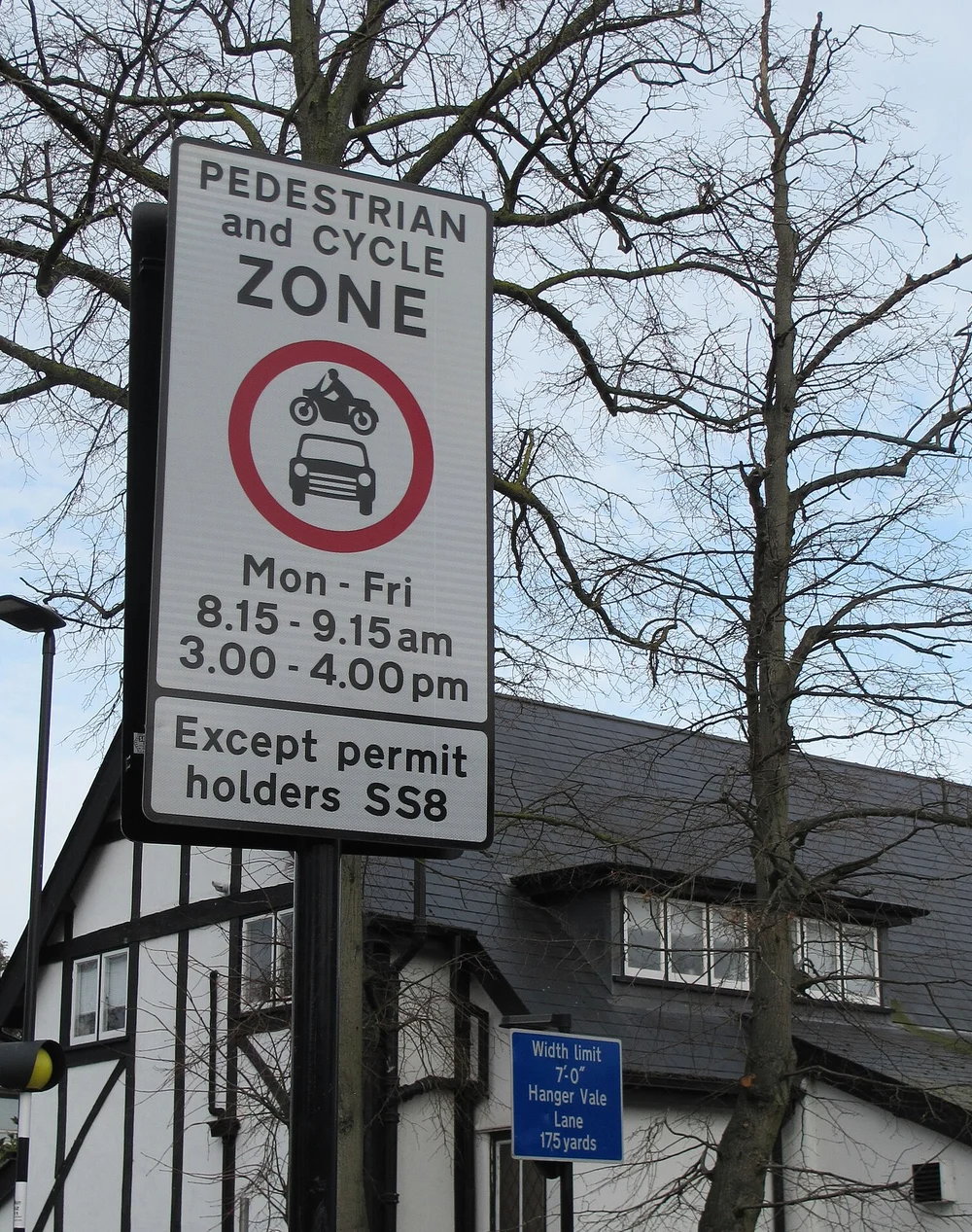
A School Street sign in Hanger Vale, Ealing. Liverpool's work the same way: a no-vehicles roundel, the hours, and a permit-holder exception. Note the afternoon window here is 3pm to 4pm, not Liverpool's 2.30pm to 3.30pm, which is exactly why the sign in front of you beats any list. Photo by David Hawgood, CC BY-SA 2.0.
The cameras follow council term dates, not your school's
This one catches people out. Liverpool says the cameras run to Liverpool City Council's term dates, even where an individual school starts later or breaks up earlier. A school with an extra training day is still a term day as far as the camera is concerned.
Autumn term: Tuesday 1 September to Friday 18 December 2026
Autumn half term: Monday 26 to Friday 30 October 2026
Spring term: Monday 4 January to Friday 26 March 2027
Spring half term: Monday 15 to Friday 19 February 2027
Summer term: Monday 12 April to Wednesday 21 July 2027
Summer half term: Monday 31 May to Friday 4 June 2027
May Day: Monday 3 May 2027
Catholic, Church of England and Hebrew schools set some of their own dates, and every school allocates five training days from the 195. Those local variations do not move the camera.
Three things the council's own paperwork does not agree on
Reading the live webpage against the March 2026 traffic order throws up three mismatches. None of them change what a sign at the kerb says, but they matter if you are trying to work out whether your road is in or out.
1. Fielding or Fieldway at Christ the King
The council's camera page names "Fielding" from Thingwall Road. The March 2026 traffic order names Fieldway, "from its junction with Thingwall Road in a southerly direction to its terminus", and the council's earlier announcement about the scheme also said Fieldway. Fieldway is the road with legal backing. The webpage looks like a typo.
2. Lynwood Road is restricted but not listed
At Rice Lane Primary, the camera page names only Brockenhurst Road. The traffic order also restricts Lynwood Road, from its junction with Rice Lane. If you live off Rice Lane and assumed only Brockenhurst Road was affected, check the signs on Lynwood Road.
3. Lugard Road is in the order and on no camera list
The same traffic order restricts Lugard Road, from Milner Road to Dundonald Road, in Aigburth. Sudley Primary School's infant site sits on Dundonald Road. Lugard Road appears nowhere on the council's list of School Street camera locations.
Those two facts do not have to conflict. A road can carry a School Street restriction without a camera on it. What the published material does not tell you is whether Lugard Road is restricted without camera enforcement, waiting for a camera, or simply missing from the page. Until the council says, treat it as restricted by sign and not confirmed as an ANPR site.
What happens if you drive through
For the first six months after a camera is switched on, a first-time contravention gets a warning letter rather than a fine. That matches the national guidance, which tells councils to run a warning period when they start enforcing moving traffic offences.
After that, or on a repeat, the registered keeper gets a penalty charge notice of £70, reduced to £35 if paid within 21 days of issue.
A warning letter is not a free pass and it is not permission to carry on. It is a notice that your registration has been recorded going through the restriction.
Who can get an exemption, and who applies
Liverpool runs a separate School Street camera exemption permit. The route depends on who you are, and getting this wrong is the most common reason people end up waiting.
You apply directly if you live on the street. Use the online application form. You need one document showing you live at the address:
council tax records
electoral register records
a recent bank statement or utility bill
driving licence
mortgage document
tenancy agreement
TV licence
Plus one linking you to the vehicle: insurance documents, the V5C logbook, or a letter from the employer if it is a company car.
The school applies for you if you are staff. Ask at the school office rather than filling in the resident form.
The school also applies for Blue Badge and SEND access. If you are a parent or carer with a Blue Badge, or your child has SEND and needs to be dropped inside the zone, that request goes through the school.
A resident applies for a visiting Blue Badge holder or a regular carer. For a Blue Badge visitor, the council wants copies of the front and back of the badge and the vehicle details. For a carer, it wants evidence or a letter from a medical professional confirming that regular visits are needed to provide care.
A School Street exemption lasts one school year and has to be renewed. It is not a permanent registration.
You get an acknowledgement with a reference number when you apply. The council then checks the evidence and emails to confirm when the vehicle is actually exempt. Applying is not being exempt. Wait for the confirmation before you drive through at 8.30am.
Two more limits worth knowing. The exemption does not guarantee you a parking space, and it does not let you ignore yellow lines or any other parking restriction. It gets your registration past the camera and nothing else.
Businesses, deliveries and trades: the gap in the guidance
The council's exemption page opens by saying permits are for people who live or work in a School Street. It then sets out a clear process for residents, school staff, Blue Badge holders, carers and SEND access, and stops.
There is no published step-by-step route for someone who works at an ordinary business inside the restriction, or for:
plumbers, electricians and other trades
delivery and courier drivers
district nurses and visiting healthcare staff
temporary or agency carers
removal vans and contractors
courtesy and replacement cars
taxis and private hire
National guidance says School Streets typically exempt vehicles registered to residents and businesses in the area, and tells councils to think about access and the effect on trade when designing a scheme. That is guidance to councils, not a rule that makes your van exempt in Liverpool.
If you service, deliver to or work at a property inside one of these streets, email the council and get the answer in writing before September. Do not assume the national wording covers you.
If you change your car, change the permit
The camera reads a registration plate. It does not know who is driving, where they live or that the usual car is at the garage.
So if you are an exempt resident and you change vehicle, borrow a courtesy car, or spot that the registration you gave the council has a digit wrong, sort it before the next school run. The exemption belongs to the plate, not to you.
A parking permit is not a School Street exemption
Liverpool runs several permit schemes and they do different jobs. A residents' parking permit controls where you can park in a permit zone. A School Street exemption controls whether your registration can pass the camera during the restricted hour.
Holding one does not put you on the list for the other. If you live in a permit area that has now become a School Street, you need both.
The pipeline has been building for a while. In November 2024 the council had six School Streets running, six more phasing in, and said consultations had taken place at a further 20 schools.
On money, the council's 2026/27 budget says a £2.5 million commitment from the previous year includes "creating School Streets to keep children and parents safe, make life easier for residents and local businesses, improve air quality and encourage active travel". That single figure covers road safety and active travel work as a whole. It is not the cost of the School Streets programme, and the council has not published a per-camera or per-street cost.
The 2026 survey closed, and nothing has been published
Liverpool's Survey on School Streets and Camera Enforcement ran from 1 July to 14 August 2026. It asked for people's initial views on two things: introducing School Streets, and using ANPR cameras to enforce them.
That is worth being precise about. The survey did not name a new set of schools, publish a map of proposed camera sites, or ask about specific roads. As of 20 August 2026 the council's consultations pages carry no results, no response numbers and no list of locations going forward.
So nobody can honestly describe that survey as approval for a particular batch of new School Streets. It was a temperature check on the idea.
When a specific site is proposed near you, the questions that actually matter are narrower than "are School Streets a good idea":
which roads, and where exactly does the restriction start and stop
the morning and afternoon times
whether there will be a camera, and where it sits
who qualifies for an exemption and whether you must register a vehicle
how deliveries and trades are handled
which surrounding roads are expected to take the displaced traffic
whether it is permanent or an experimental order that can be changed
That last one matters. Councils create these restrictions with a Traffic Regulation Order, or TRO. Some use an Experimental Traffic Regulation Order, an ETRO, which runs the restriction as a trial while monitoring continues and objections can still be made. The DfT says experimental schemes should be monitored so the council can decide whether to make them permanent.
What has and has not been measured
Liverpool has said its existing School Streets improved air quality by cutting congestion at the school gate. That claim came in a council announcement, without school-by-school pollution figures alongside it.
The DfT is more careful. It says air quality can be monitored before and after, but a School Street covers a small area for a couple of hours a day, which makes its precise effect hard to isolate. Longer-term trends give a clearer answer than a snapshot.
The same gap applies to collisions. National guidance tells councils to look at collision and casualty data when picking sites, and STATS19 data records injury collisions reported to police in a form you can map. Liverpool's camera page publishes no before-and-after collision figures for any of the 14 schools. The fair thing to say is that the schemes are intended to improve safety, not that a measured drop has been shown at each site.
The other thing worth watching is the next street over. A School Street can empty the road outside the gate while parents park round the corner instead. National guidance specifically asks councils to monitor traffic volume, speeds, vehicle types and displaced parking on surrounding roads, not just inside the zone. Measuring only the restricted street tends to make the scheme look better than it is.
What to do before September
If you drive to one of the 14 schools:
Check whether your school is on the list above, and which road is actually restricted. It is often one section, not the whole route.
Read the sign at the entrance. Those are the legal times.
Do not copy the parent in front. Their vehicle may be on the exemption list.
Ask the school if a Blue Badge or your child's SEND means you need vehicle access. The school applies, not you.
Wait for written confirmation before you rely on an exemption.
Park legally outside the zone and walk the last two minutes if none of that applies.
If you live inside one:
Apply for the exemption if you have not. The camera does not know you live there.
Keep the confirmation email and reference number.
Check the registration on the permit character by character.
Diarise the renewal. It runs out at the end of the school year.
Update it when you change car.
Apply on behalf of a regular Blue Badge visitor or carer.
Keep following the normal parking rules. The exemption covers the camera only.
Which Liverpool schools have School Street cameras?
Liverpool City Council lists 14: All Saints, Christ the King, Greenbank, Holy Family, Much Woolton, Rice Lane, Rudston, St Anne's, St Clare's, St Cleopas, St Cuthbert's, St Gregory's, St Michael in the Hamlet, and St Paul and St Timothy's. Each restriction covers a named road or short section rather than the whole neighbourhood.
What time do Liverpool School Street cameras operate?
The council's March 2026 traffic order sets the restriction at 8.15am to 9.15am and 2.30pm to 3.30pm, Monday to Friday, during Liverpool school term dates. Spring Grove and South Parkside Drive at St Paul and St Timothy's finish at 9am instead of 9.15am. The signs at the entrance to the road carry the legal times.
How much is a Liverpool School Street fine?
A penalty charge notice is £70, reduced to £35 if you pay within 21 days of issue. For the first six months after a camera is switched on, a first-time contravention gets a warning letter instead. A warning letter is not permission to keep driving through.
Who can get a Liverpool School Street exemption permit?
Residents of the street apply directly. School staff, Blue Badge parents and carers, and parents of children with SEND ask the school to apply for them. Residents can also apply on behalf of a Blue Badge holder or a regular carer who visits them. Permits last one school year and must be renewed.
Do delivery drivers and tradespeople get a School Street exemption in Liverpool?
The council's page says permits are for people who live or work in a School Street, but it only sets out a process for residents, school staff, Blue Badge holders, carers and SEND access. There is no published route for a plumber, courier or contractor. Email [email protected] and get it confirmed rather than assuming.
Does a residents' parking permit cover a School Street camera?
No. They are separate schemes. A parking permit controls where you can park. A School Street exemption controls whether your registration can pass the camera during the restricted hour. Holding one does not put you on the other list.
Comments
Join the conversation with your L1Local Community account. Keep it civil and on topic.
Liverpool this week
New places, local news, things to do and our latest guides. Weekly.

Comments
Join the conversation with your L1Local Community account. Keep it civil and on topic.