Stayed in a Liverpool hotel lately? You may have spotted £2 a night added to the bill. Run a guesthouse or a serviced flat here? You have been paying it since 1 June 2025.
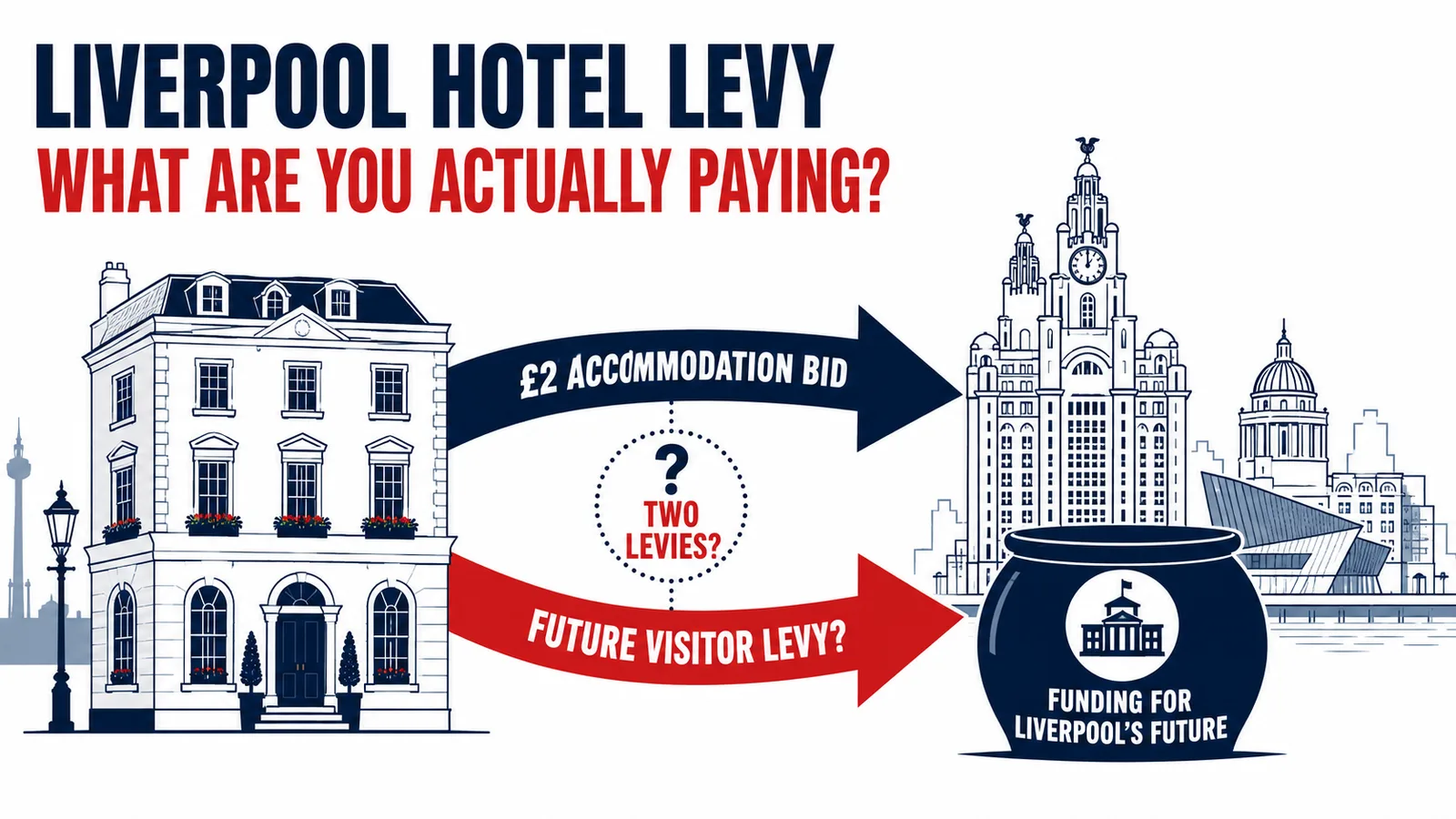
That £2 is not a council tourist tax. It is also not the "visitor levy" you keep seeing in the news. They are two different charges, run by two different organisations, under two different sets of rules. Liverpool City Council is asking for your views until Sunday 13 September 2026 on what should happen if the second one lands on top of the first.
Here is the difference in plain terms, what is decided, what is not, and how to have your say.
What the hotel charge costs and who pays
Liverpool has a £2 per room, per nighthotel charge. It started on 1 June 2025.
The hotel owes that money. Most pass it on to you by adding it to your bill.
It is worked out from how full Liverpool's hotels were on average, not how full yours was.
A separate charge for the whole city region is being planned, using new powers given to mayors on 25 November 2025.
No price has been set for that new one. The £2 belongs to the old charge. Do not assume the new one will match it.
First, what a BID is, because the whole thing rests on it.
A Business Improvement District, or BID, is a group of businesses in one area who vote to pay into a shared pot. They agree a plan for how it gets spent. It is money from businesses, spent on things businesses want. It does not go into the council's budget for bins or schools.
Liverpool has three: one for shops and leisure, one for culture and offices, and one for places you sleep. Only the third one shows up on your hotel bill.
Ranelagh Place. City centre hotels this size sit inside the Accommodation BID. Photo: Rodhullandemu, CC BY-SA 4.0, via Wikimedia Commons
That third one used to charge hotels based on what their building was worth. In spring 2025 the hotels voted to switch to a flat fee per night instead. The vote ran from 27 March to 24 April 2025. It passed, 26 to 18, with one spoiled paper.
These votes have to pass twice over. Once on the number of businesses voting yes, and once on how much their buildings are worth. This one passed both. The yes side's buildings were worth £7,141,250, against £4,768,300 on the no side. The new £2 charge started on 1 June 2025.
How the £2 is worked out
The council's rules for the charge set out the sum. In plain terms, a hotel takes:
the number of rooms it has,
times the nights in the month,
times how full Liverpool's hotels were on average that month,
times £2.
The third line is the one that stings if you run a small place. It is the Liverpool average, worked out by a firm called STR that tracks how full hotels are. It is not your average.
So a quiet month in a quiet street is still charged as if you were as busy as the city centre.
One myth worth killing while we are here. You will see it said that only hotels worth £45,000 or more pay this. That is wrong, and we checked the council's own rules to be sure. The £45,000 cut-off belongs to the other two BIDs, the ones for shops and offices. The hotel charge has no such cut-off. It is counted per room, per night.
Who really owes the £2
You usually pay it. But you are not the one on the hook for it.
Underneath, the bill goes to the hotel. The hotel can then get that money back from you by adding it on. If the bill goes unpaid, the hotel is chased for it, not the guest. That is why it is wrong to say the council charges every visitor £2 a night. The council does not charge it, and you are not the one who owes it.
Liverpool BID Company holds the money and spends it on pulling visitors in. None of it pays for bins, roads or social care.
In March 2026 it announced a pot of almost £10 million built up from the charge. Nearly £7m of that is earmarked for big events, £1m for advertising the city, and the rest for other visitor spending. The thinking is simple enough: use the money from people staying the night to book the kind of events that make more people stay the night.
On 25 November 2025 the Government said England's mayors could start charging for overnight stays. The announcement covered hotels, holiday lets, B&Bs and guesthouses. It set no price.
The Government then asked the public how it should work. That ran from 26 November 2025 to 18 February 2026. It asked which places would be included, how the price would be set, who would pay it, and what the money could be used for.
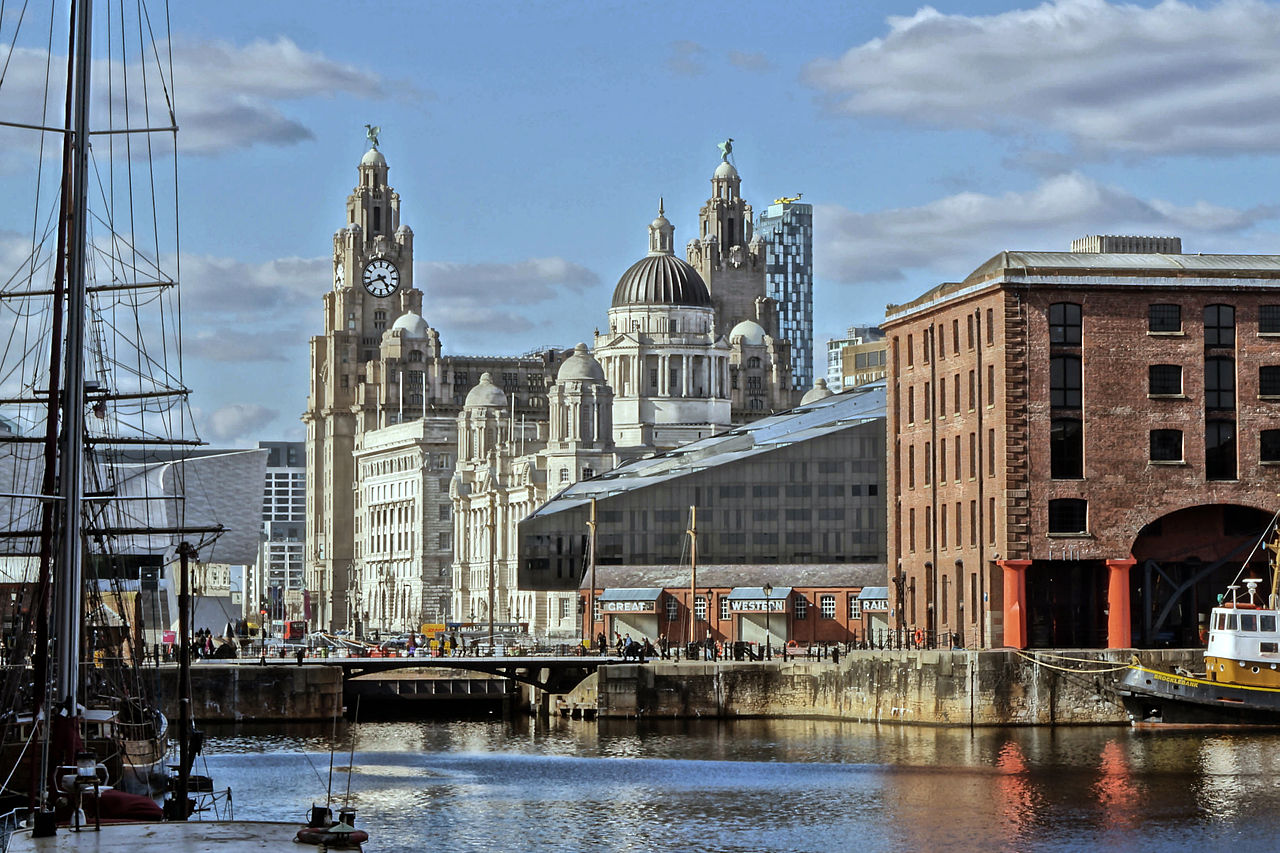
The Pier Head from the Royal Albert Dock. The Combined Authority values the city region's visitor trade at £6.25 billion a year. Photo: Beverley Goodwin, CC BY 2.0, via Wikimedia Commons
Here is the difference that matters. The old charge was made by hotels, voting among themselves. The new one would be set by an elected mayor, using powers handed down by Parliament. Different people, different rules, different way of arguing about it.
What the mayor wants to do
Mayor Steve Rotheram has pushed for this since 2017 and led a group of English mayors lobbying for it. The Combined Authority's reply to the announcement makes clear he intends to use it.
His own estimate is the clearest figure anyone has put on it. "Our visitor economy is worth more than £6bn a year and supports over 55,000 local jobs," he said. "A modest levy could raise up to £17m annually, money that would stay local."
The Combined Authority says the cash could only be spent on a set list: big cultural and sporting events, things visitors and locals both use, advertising the region abroad, training and helping businesses grow. It counts more than 60 million visits a year and puts the visitor trade at £6.25 billion.
Then comes the catch. None of it has been designed yet. Talks with hotels and tourism groups were only starting when the announcement went out. The price, who is let off, how it gets collected and which places count are all still blank.
It would reach well past the city centre
This is the clearest split between old and new. The £2 charge only applies inside its patch of central Liverpool. The new one is meant to cover the whole city region. That is all six boroughs:
Liverpool
Wirral
Sefton
Knowsley
St Helens
Halton
New Brighton seafront. Wirral B&Bs pay nothing to Liverpool's BID today, but would sit inside the new charge. Photo: Bill Boaden, CC BY-SA 2.0, via Wikimedia Commons
So a B&B in Southport, a flat above the front at New Brighton or a holiday let out on the Wirral would start paying. None of them pay a penny towards the Liverpool charge today.
The Combined Authority has also said Airbnb style places would be in. The current charge mostly misses them. If you let out a spare room in Sefton or on the Wirral, that is the line to watch.
The Promenade, Southport. Sefton guesthouses would fall inside a city region charge. Photo: Robert Wade, CC BY-SA 2.0, via Wikimedia Commons
Being charged twice for the same night
This is what the council is asking about, and it is narrower than the headlines suggest.
Liverpool already charges hotels per night. The new one would also charge per night. Put both on the same room on the same evening, and a hotel pays twice for one guest.
The council calls that "double taxation" and wants to know what you think should happen. That is the whole question. Answering it will not set a price, and it will not decide whether Liverpool has a tourist tax.
The Cunard Building at the Pier Head, where Liverpool City Council is based. Photo: Rodhullandemu, CC BY-SA 4.0, via Wikimedia Commons
One should replace the other, but the dates clash
The stated plan is that the new charge takes over when the old one ends, rather than both running at once.
There is a snag. On one page, the Combined Authority says the Liverpool charge "runs until December 2027" and the new one arrives after that. Further down that same page, Faye Dyer, chief executive of ACC Liverpool, is quoted saying it "currently runs until June 2027".
Two dates, six months apart, on one page. We are pointing it out rather than picking one, because that date decides when the handover happens. If you are planning your costs around it, ring the BID company and ask instead of trusting either figure.
The council's question tells you something too. If the handover were as tidy as the announcement made it sound, there would be no need to ask how to stop the two overlapping.
Whether you will see a second charge
For now, no. There is one charge, the £2, and your hotel decides whether to show it at booking, at check-in or at the end.
For the new one, nobody can tell you yet. Who pays and how it gets collected were both still open questions in the Government's consultation, and the mayor has to build his scheme around whatever answer comes back. Anyone promising you a second £2 is guessing.
No price has been set for the new charge
This is the claim to watch out for. The £2 belongs to the old charge and tells you nothing about the new one.
The Government looked at several ways of setting a price, including a flat fee and a percentage of the room rate, and mayors are expected to get some freedom to choose. Until Liverpool City Region publishes a real plan, any figure you read, whether £2, £5 or a slice of the room rate, is somebody's guess.
What hotels have objected to
Most people agree the visitor trade needs money spent on it. Who hands that money over is where it breaks down.
The 2025 vote passed, but 18 businesses said no. Whitbread, which owns Premier Inn, then asked the Government to throw the result out. Liverpool BID Company said on 25 November 2025 that after an investigation, all 11 of Whitbread's complaints were rejected.
Worth remembering, because the next argument will be bigger. A city region charge would cover far more businesses than the 45 that voted in 2025, and plenty of them, especially people letting out rooms, have nothing to do with the BID system today. The questions will be the same ones: how much, who collects it, how much paperwork it makes, whether hotels and spare rooms get treated the same, and who decides where it goes.
How to have your say before 13 September
The consultation is called Consultation on the overnight visitor levy and business improvement districts. It opened on Friday 7 August 2026 and closes on Sunday 13 September 2026.
You can reply if you live here, work here, visit, or run a business that might be affected. Go to the council's consultations page.
If you run somewhere people stay, say what being charged twice would cost you in real money. The council is asking about a fix to a specific problem, so hard numbers on collection, paperwork and your margin will count for more than a general view on tourist taxes.
What happens next
Three things, in this order.
The council's consultation closes on 13 September 2026. Results go up on its consultation results pages.
The Government finishes writing the law that gives mayors the power, after the consultation that ended in February 2026.
Liverpool City Region publishes its own plan: the price, which places are covered, who is let off, and how it gets collected. None of that exists yet.
Until then, the short answer is this. Liverpool has a £2 hotel charge. A bigger one covering the whole region is being planned, with no price attached. The question open right now is how to stop them landing on the same night, not whether to add another £2 to your bill.
Not as most people mean it. Liverpool has a £2 per room per night charge that started on 1 June 2025. The council does not run it. It comes from the Accommodation BID, which is a group of hotels and similar businesses who voted to pay into a shared pot. The hotel owes the money and most add it to your bill. A separate Liverpool City Region visitor levy is being worked on, but it does not exist yet.
How much is the Liverpool visitor levy?
Nobody knows yet. No price has been set. The £2 people quote is the existing hotel charge, which is a different thing. Mayor Steve Rotheram thinks a new levy could raise up to £17m a year, but that is a guess at the total, not a price per night.
Who pays the £2 Liverpool hotel charge?
The hotel owes it. Liverpool BID Company says the charge is £2 per room or unit per night added to the final bill for guests, so in practice most visitors end up paying. But if it goes unpaid, the hotel is chased for it, not you.
When does the Liverpool visitor levy consultation close?
Sunday 13 September 2026. It opened on Friday 7 August 2026. It asks one narrow question: what should happen if the old charge and the new one both land on the same hotel room on the same night. It is not a vote on whether Liverpool should have a tourist tax.
Would the new levy apply outside Liverpool?
That is the plan. The Combined Authority says it would cover all six boroughs: Liverpool, Wirral, Sefton, Knowsley, St Helens and Halton. It says Airbnb style places would be included too. Nothing is final until the law is written and the local scheme is agreed.
Comments
Join the conversation with your L1Local Community account. Keep it civil and on topic.
Liverpool this week
New places, local news, things to do and our latest guides. Weekly.



Comments
Join the conversation with your L1Local Community account. Keep it civil and on topic.