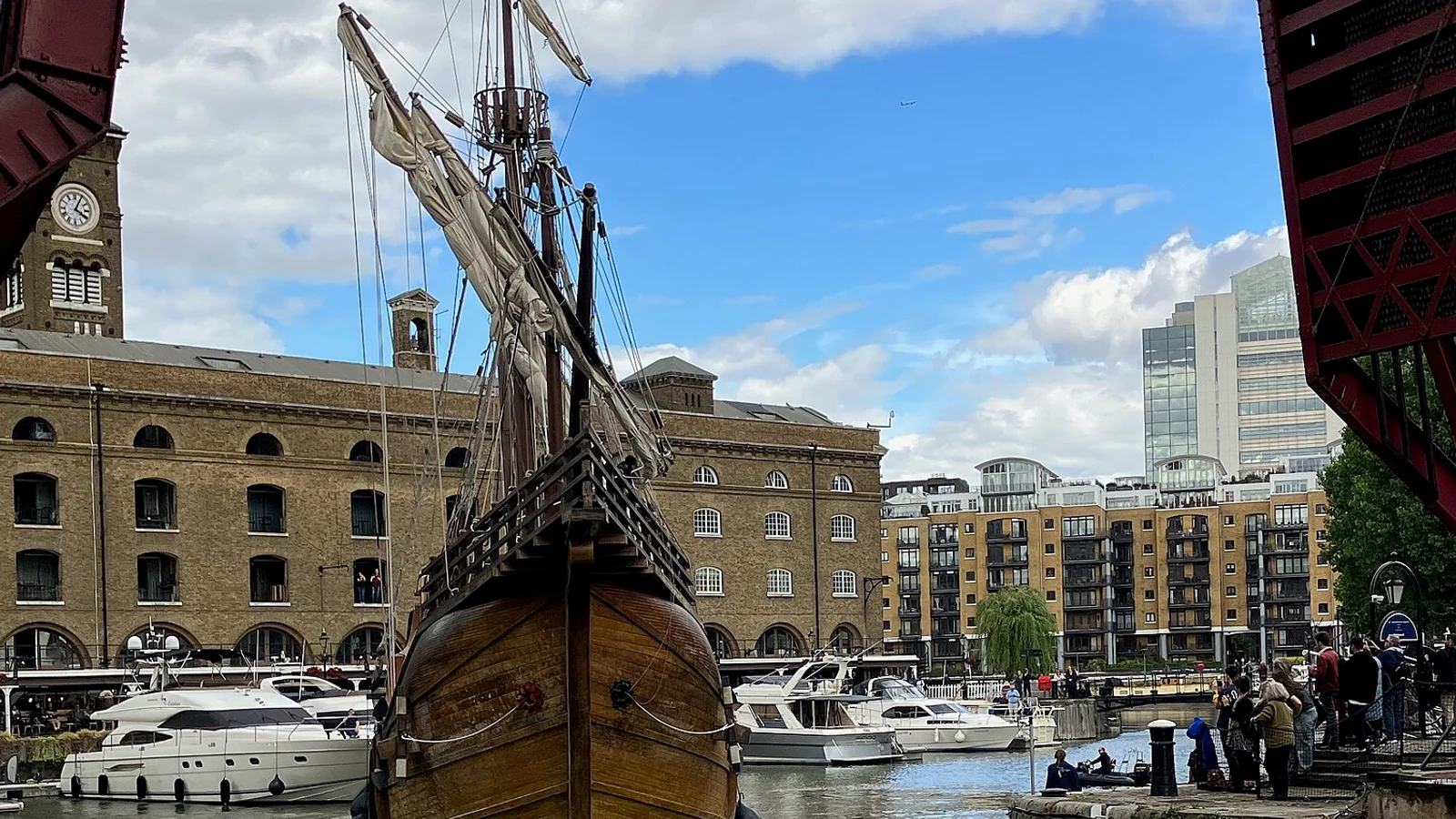
Photo: Nao Santa María, at a previous UK stop in London
News
Nao Santa María at Royal Albert Dock: The Real History Behind Columbus's Ship
A full-scale replica of the Santa María docks at Royal Albert Dock, 12-25 August 2026. Tickets, opening hours and the history the tour material leaves out.
On Christmas morning in 1492, the biggest ship in Christopher Columbus's fleet ran onto a reef off Hispaniola, broke apart in the surf, and never sailed again. Columbus stripped her for timber and used it to build a small fort. When he sailed back the following year, every man he'd left behind was dead.
That's the real story behind the ship now tied up at Royal Albert Dock: a full-scale replica of the Santa María, in Liverpool for two weeks this August. She wasn't even built under that name. The crew that sailed the original was double the size of the one that sails the replica today. And the tidy version of 1492 you probably learned at school skips most of what happened after the ship went down. Here's the fuller story, and what you need to know before you go aboard.
Nao Santa Maria dates and tickets
The Nao Santa María, a full-scale replica launched in Spain in 2018, is at Royal Albert Dock from Wednesday 12 to Tuesday 25 August 2026, open 10am to 8pm daily.
Online tickets are £10 adult and £5 child (5 to 10), rising to £12 and £6 on the day. Under-5s go free, and the online price is only guaranteed until 11 August.
This is a modern rebuild, not the original ship. The real Santa María wrecked off Hispaniola on Christmas Day 1492 and never made it home.
Columbus's voyage is often called the "discovery of America". The Caribbean was already home to established societies, including the Taíno, so that framing doesn't hold up.
Liverpool's own waterfront carries a related history: the city was a major transatlantic slave-trading port in the centuries that followed, documented a short walk away at the International Slavery Museum.
When is the Nao Santa María in Liverpool, and what does it cost?
The ship is docked at Royal Albert Dock from Wednesday 12 August to Tuesday 25 August 2026, open 10am to 8pm daily. Royal Albert Dock's announcement says Liverpool is one of 30 ports on the ship's 2026 tour, supported by Huelva Provincial Council in Spain.
Ticket
Online price
On the day
Adult
£10
£12
Child (5 to 10)
£5
£6
Family (2 adults + up to 3 children 5 to 10)
£25
£30
Under 5
Free
Free
The online prices are advertised as available until 11 August, and Royal Albert Dock's ticket information says online booking takes priority, with limited or no allocation left on the day if it sells out. As with any working ship, hours can shift for weather or operational reasons, so check the booking page before you travel rather than assuming the times above are locked in.
What is the Nao Santa María?
The Nao Santa María at Royal Albert Dock is a full-scale modern replica of the ship traditionally identified as Columbus's flagship on his first Atlantic crossing. The other two ships in that 1492 fleet were the Niña and the Pinta. Nothing survives of the original Santa María in any form, so this is a rebuild made from historical research, not a restoration of anything real.
The replica was built by the Fundación Nao Victoria in Punta Umbría, Huelva, to mark the 525th anniversary of 1492. The foundation says the build involved close to 100 people, including shipwrights, rope makers and historians, and she launched on 16 March 2018 after around 14 months of work. She measures 28.30 metres long by 7.96 metres wide, with a 3.49 metre draught, and weighs roughly 200 tonnes. Under the wooden outer covering that makes her look every inch a 15th-century nao, the hull is fibreglass, built to cross open water on a real touring schedule rather than just sit and look good in a dock.
How accurate is the replica?
No original plans of the Santa María survive, so nobody can say every fitting or measurement on the replica matches the ship Columbus sailed. The Fundación Nao Victoria describes its build as combining historical research with reconstruction, not a copy of a surviving original.
That distinction is easy to miss in photographs, which can make the Liverpool ship look like a genuine 15th-century vessel. It isn't one. It's a modern working replica built to give a physical sense of the ship's scale and layout, which is exactly why walking its decks tells you more than a painting or a diagram can.
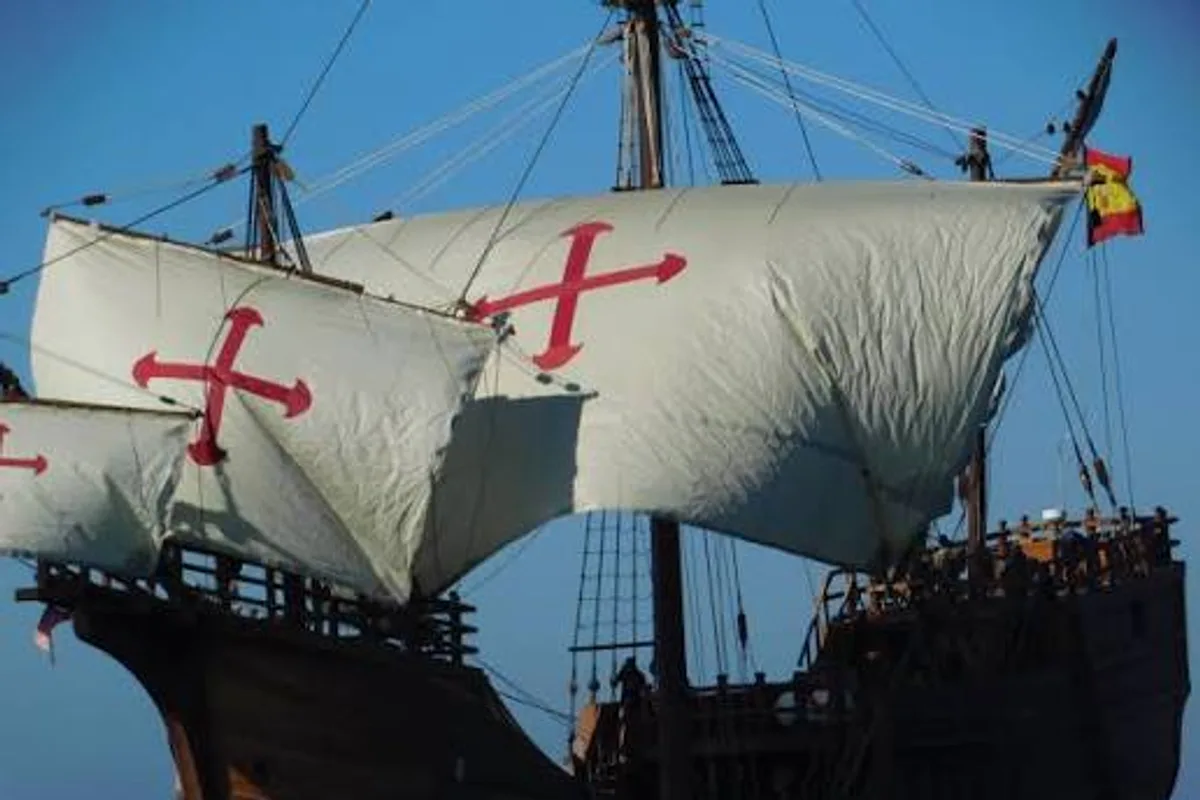
The replica's sails carry the same red-cross markings associated with Spanish ships of the period · Photo: Nao Santa María
The voyage that made her famous
The original Santa María was the largest of Columbus's three ships and served as his flagship, a type of vessel known as a nao. She wasn't launched under that name. Her real name was La Gallega, after Galicia, the Spanish region where she was built, and it was Columbus who renamed her. The Niña and Pinta were smaller, faster caravels, better suited to coastal work, and around 40 men sailed on the Santa María herself, roughly double the 20-strong crew that sails the modern replica today.
Columbus's fleet left Palos de la Frontera in Spain on 3 August 1492, aiming to find a westward sea route to Asia. Ten weeks later, in the early hours of 12 October 1492, a crew member sighted land. Columbus went ashore on an island in the Bahamas, and the fleet pushed on through the Caribbean.
Fun fact
The Niña wasn't really called the Niña either. Her official name was Santa Clara. Sailors nicknamed her "La Niña" after her owner, Juan Niño of Moguer, and the nickname stuck so well that almost nobody remembers her real one.
Christmas Day, and the wreck that ended her
By December, Columbus had reached Hispaniola, the island now shared by Haiti and the Dominican Republic. On Christmas Day 1492, the Santa María ran aground and couldn't be freed. Columbus had her broken up and used the timber to build a small fort he named La Navidad, Spanish for Christmas, then sailed the Niña back to Spain to report what he'd found, leaving around 39 of his men behind to hold the fort.
The Santa María never made it home. When Columbus returned to Hispaniola the following year with a much larger fleet, he found La Navidad burned to the ground and every man he had left behind dead, after conflict broke out with the surrounding Taíno communities. It's a detail the tour material for the replica tends to leave out, and it's an early, ugly sign of how fast contact between the two sides turned violent.
Columbus was not discovering an empty continent
The 1492 voyage is routinely described as the "discovery of America", including in some of the promotional material for this tour. That framing doesn't hold up: the Caribbean that Columbus's fleet reached was already home to established societies, including the Taíno people, who first met the Spanish ships and later fought and died at La Navidad. Columbus didn't discover an uninhabited continent. He opened a period of sustained European contact and expansion in the Caribbean with enormous, often catastrophic consequences for the people already living there, which is the part of the story worth carrying into the ship's visit alongside the shipbuilding detail.
What the voyage set in motion
European colonisation of the Americas followed Columbus's voyages, bringing warfare, forced labour, enslavement and disease to populations that had no prior exposure to many of those diseases. The scale and speed varied by region, but the disruption to Indigenous communities across the Americas was severe. Columbus himself was directly involved in the early Spanish colonial system in the Caribbean, and historical accounts document violence, enslavement and forced conversion connected to his expeditions. That history sits alongside the maritime achievement, not instead of it, and both belong in any honest account of the ship now docked in Liverpool.
How the replica was built
Constructing a historically convincing ship that also has to work as a modern vessel, crossing open water between ports on a touring schedule, is a genuine engineering problem. The Fundación Nao Victoria combined traditional maritime crafts with modern materials and expertise to meet both requirements at once. Since her 2018 launch, the ship has toured 17 cities across Spain and France alone, drawing over 100,000 visitors, before crossing the Atlantic to Puerto Rico and the United States. She's part of a wider fleet of historical replicas the foundation operates, alongside the Nao Victoria and the Galeón Andalucía. Liverpool is a comparatively small stop on a genuinely long itinerary.
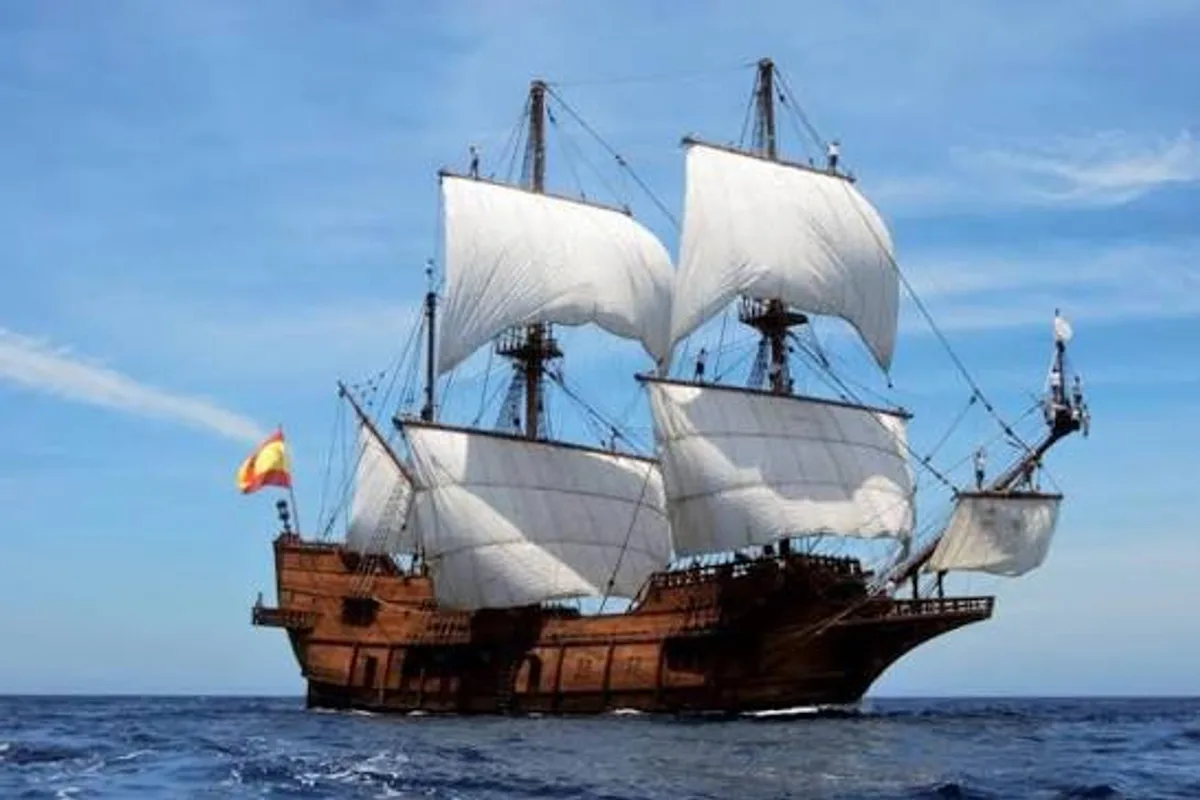
Under full sail. The replica needs to work as a genuine ocean-going vessel, not just look like one · Photo: Nao Santa María
What can visitors see on board
The Liverpool stop is set up as a self-guided visit across the ship's decks, with information panels explaining the vessel and, at some of its other UK stops, crew members on hand to answer questions. This isn't a museum built around genuine 15th-century objects. The ship itself is the exhibit, which makes it more useful as a way of understanding how cramped and how organised a vessel like this had to be than as a collection to browse. Exact arrangements can vary slightly between ports, so check the Royal Albert Dock ticket page for anything specific to the Liverpool visit before you go.
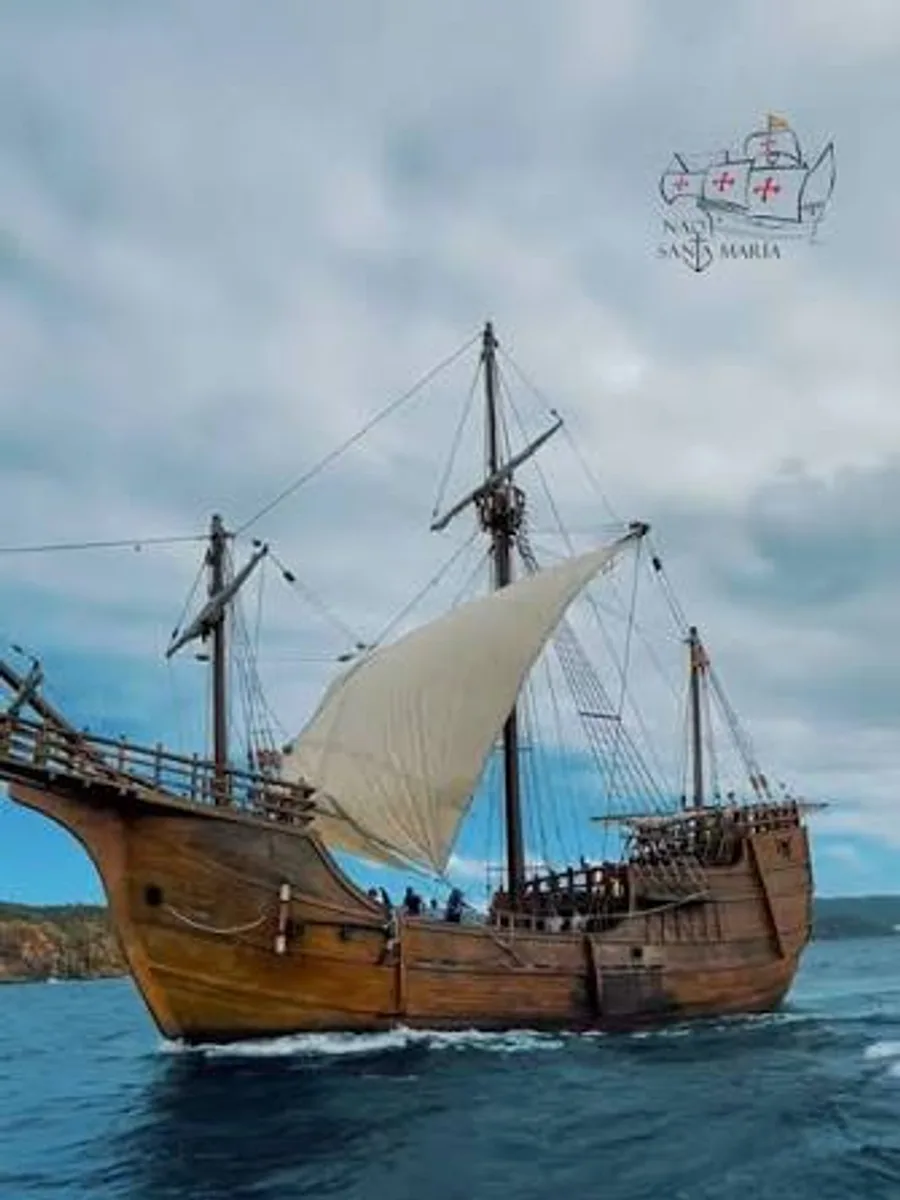
Crew on deck give a sense of scale that photographs alone don't manage · Photo: Nao Santa María
Why this fits Royal Albert Dock, and Liverpool's own maritime history
Royal Albert Dock already holds the Merseyside Maritime Museum and the International Slavery Museum, so the Santa María's visit sits within a stretch of Liverpool's waterfront already set up to explain difficult maritime history rather than just celebrate it. Liverpool's own maritime wealth is centuries younger than the 1492 voyage, built on the dock itself, completed in 1846, but the two are connected by the same wider story of European Atlantic expansion, trade and colonisation.
National Museums Liverpool is direct about this: Liverpool was a major transatlantic slaving port, particularly through the 18th century, and the museum holds original documents connected to that trade. A visit to the replica pairs naturally with time at the International Slavery Museum next door, which sets out what that history involved rather than leaving it as a footnote.
Getting to Royal Albert Dock
Royal Albert Dock sits just south of the city centre. James Street is the closest Merseyrail station, with Liverpool Central also within walking distance and Liverpool Lime Street a longer walk through town. The dock is close enough to the Museum of Liverpool, Tate Liverpool and Liverpool ONE to build a full afternoon around the visit rather than just the ship itself.
Is it worth seeing, and what to do next
The replica's value isn't that it's an original object, because it isn't one. It's that standing on a 28-metre wooden deck gives you a physical sense of scale that a painting or a school textbook map never quite manages, for a voyage that's usually only encountered flattened onto a page. Book online before 11 August if you want the cheaper ticket, and pair the visit with the International Slavery Museum next door if you want the fuller version of the story the ship represents, not just the shipbuilding half of it.

Comments
Join the conversation with your L1Local Community account. Keep it civil and on topic.