If your landlord has raised the rent, sent an eviction notice or never gave you the government's new information sheet, the date and paperwork matter. The private renting rules in England changed on 1 May 2026, but some notices issued before that date followed temporary rules.
This guide explains what most private renters in Liverpool can now ask for, what a landlord or letting agent must provide and where to get help. It is general information, not advice on an individual case. Get housing advice before ignoring a notice, withholding rent or leaving your home.
What changed for renters on 1 May
Most private assured shorthold tenancies became assured periodic tenancies on 1 May. They now roll weekly or monthly instead of ending on a fixed date.
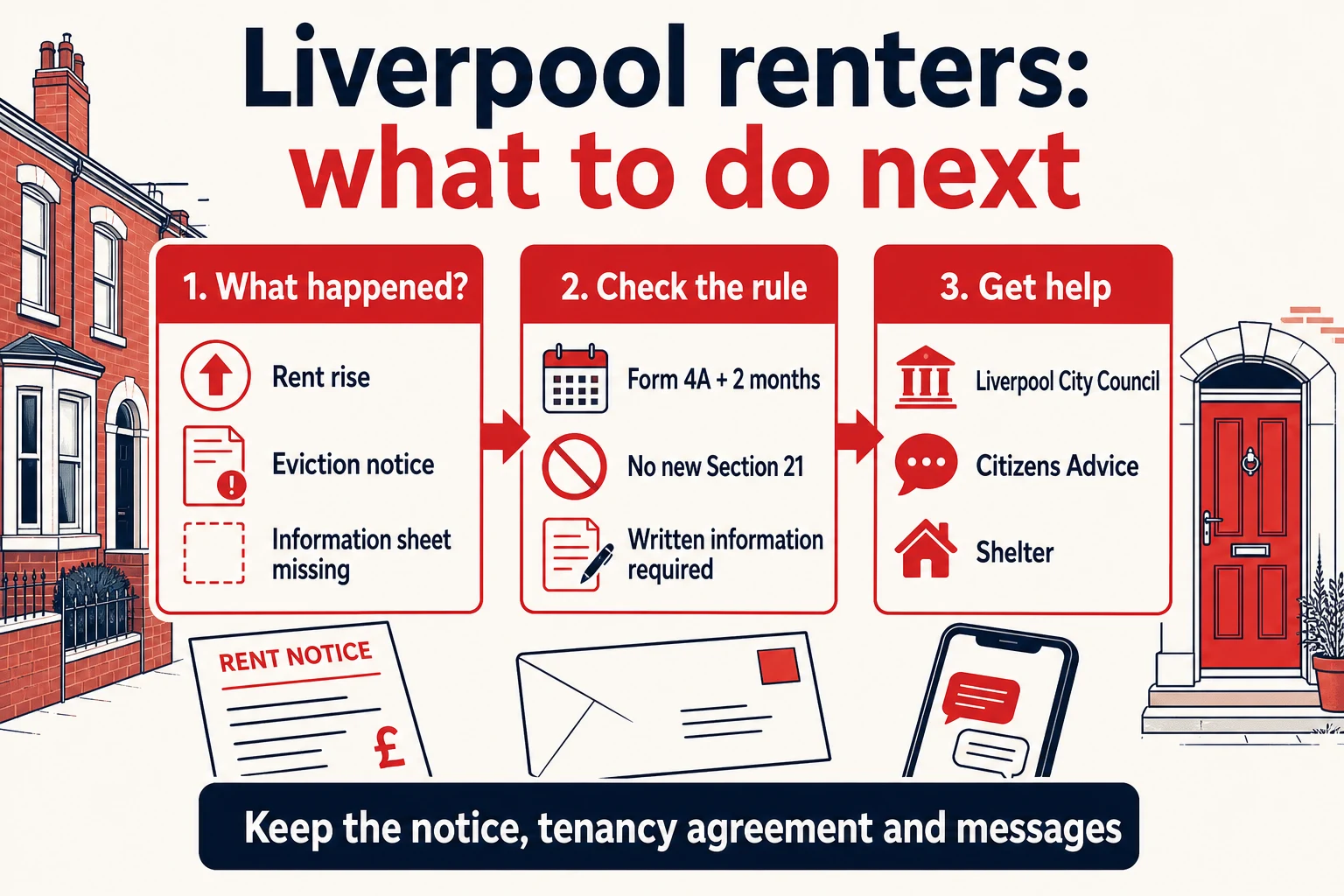
A landlord cannot issue a new Section 21 no-fault eviction notice. They need a legal ground and the correct possession notice.
An old Section 21 or Section 8 notice may still be part of a live court case if the landlord started that case by 31 July 2026. If they did not apply to court by then, they cannot use that old notice now.
For most rent rises after 1 May, the landlord must use Form 4A, give at least two months' notice and wait at least a year between increases.
Most tenants with an existing written agreement should have received the official Renters' Rights Act Information Sheet by 31 May 2026. A tenant with a wholly verbal agreement should instead have received the required terms in writing.
For advice, start with Citizens Advice Liverpool or Shelter. Liverpool City Council can investigate breaches and housing conditions. Contact Housing Options if you may lose your home.
Which Liverpool tenancies are covered?
The main changes apply to most private tenants in England who had an assured tenancy or assured shorthold tenancy. That includes many houses and flats rented through private landlords and Liverpool letting agents.
Different rules usually apply if you rent from Liverpool City Council or a housing association, live with your landlord as a lodger, occupy holiday accommodation or live in university halls. Some private purpose-built student accommodation can also sit outside the main assured tenancy system when the provider follows an approved student housing code.
The label on the agreement is not always enough to settle your legal status. If you are unsure, show the full agreement and any notices to Citizens Advice Liverpool, Shelter or a housing solicitor.
Most fixed terms became rolling tenancies
Most existing assured shorthold tenancies automatically became assured periodic tenancies on 1 May. A fixed end date in the old agreement no longer ends the tenancy by itself. New assured tenancies are also periodic, usually rolling monthly or weekly according to how the rent period works.
You normally end an assured periodic tenancy by giving two months' written notice. The notice should end on the day the rent is due or the day before. A shorter period can apply where it has been agreed in writing, so check the agreement and get advice if your landlord or agent disputes your leaving date.
Students should not assume that every hall, studio or shared house follows the same rules. Our Liverpool student guide for 2026 explains the difference between private renting and halls, alongside council tax and moving dates.
How a landlord can raise the rent
For most assured periodic tenancies, a landlord can increase the rent once in a 12-month period. They cannot increase it during the first 12 months of a new tenancy. They must use Form 4A under the Section 13 process and give at least two months' notice.
A message saying that the rent will rise next month is not a substitute for the prescribed form. A rent review clause in an older contract cannot be used for a new increase after 1 May. One transition remains: if a landlord served the old Form 4 before 1 May, that notice can still apply even where the new rent began later.
If the proposed amount is above the open market rent, you can ask the First-tier Tribunal to decide it. You must apply before the new rent's start date, even if you are still gathering evidence. The official market-rent application guidance explains what to send, including the notice, tenancy agreement and comparable local rents.
The application fee is £47, but you do not pay it at all if your notice was dated before 1 May 2026 or you rent from the council or a housing association. If you have little or no savings and are on a low income or certain benefits, you may also get help with court fees.
Do not simply pay the higher amount and assume you can challenge it later. Get advice as soon as Form 4A arrives because the deadline is tied to the date printed on the notice.
Section 21 ended, but some court cases continue
A landlord cannot issue a new Section 21 notice on or after 1 May 2026. To seek possession now, they normally need to use a recognised legal ground, explain that ground on the correct notice and follow the court process if you do not leave.
A valid Section 21 or old Section 8 notice served by 30 April did not automatically vanish on 1 May. The landlord had until 31 July 2026 to ask the court to issue the possession claim. The government's transition guidance for pre-May notices says it is now too late to start a claim using one of those old notices. A case started by the deadline can continue until the proceedings finish.
An eviction notice does not itself give a landlord permission to change the locks or force you out. If you remain after the notice date, the landlord normally needs a possession order and then a warrant enforced by bailiffs. Liverpool City Council tells tenants who receive a notice to get free advice before making a homelessness application.
What written information your landlord should give you
The requirement depends on when the tenancy started and whether its terms were recorded.
Your tenancy
What should have been provided
When
Started before 1 May 2026 with a written agreement or other written record
Written information covering the required key terms
By 31 May 2026
Started on or after 1 May 2026
The required written information, usually included in a tenancy agreement
Before the tenancy is agreed
Every named tenant should receive the information sheet. Where a letting agent manages the property, the agent has its own duty to provide it. The government says a landlord or agent can face a fine of up to £7,000 for failing to provide required information.
A missing sheet does not cancel the tenancy, remove your duty to pay rent or stop the new rights applying. Save the agreement and messages, ask the landlord or agent for the correct document in writing, then report the failure to Liverpool City Council if it is not fixed.
Keep the paperwork first. The correct route depends on whether you have a rent rise, an eviction notice or missing tenancy information.
Other things a private tenant can now ask for
A pet: you can ask to keep one. The landlord must consider the request and should give a reason if they refuse. This is a right to ask and receive a proper response, not an automatic right to keep any pet.
A clear advertised rent: a landlord or agent must state a price and cannot encourage or accept a bid above it.
No more than one month's rent in advance: after the agreement is signed, a landlord can ask for a maximum of one month's rent in advance at the start. They cannot ask for or accept rent before the agreement is signed.
Fair access to renting: landlords and agents cannot refuse you merely because you receive benefits or have children. Existing Equality Act protections also continue.
These rights do not remove the need for affordability checks, a deposit or a lawful possession ground. They change what a landlord or agent can demand and how they must handle the tenancy.
Who to contact in Liverpool
Problem
Best first route
What to have ready
Missing information sheet, suspected unlawful landlord practice, harassment or illegal eviction
Full agreement, Form 4A or possession notice, rent history and key dates
Risk of homelessness, harm or losing your home within two months
Shelter's Merseyside and national services, emergency helpline 0808 800 4444, Monday to Friday, 8am to 5pm. The Merseyside hub is at Holy Trinity Church, Richmond Park, L6 5AD
Notice, court papers, household details and any safety concerns
You have an eviction notice and may have nowhere to live
All notices and court papers, a timeline, income details and previous advice
If the problem is damp, mould or disrepair, report it to the landlord in writing first and keep photographs. If the landlord does not act, use the council's private rented housing conditions service. Do not withhold rent without advice.
What to save before you ask for help
Your tenancy agreement and any later renewal or variation.
The Renters' Rights Act Information Sheet, if you received it.
Form 4A, a possession notice or court papers.
Emails, texts and letters from the landlord or agent.
A simple list of dates, including the last rent increase and when each notice arrived.
Rent statements, bank records and evidence of comparable local rents where relevant.
If you have recently moved into Liverpool, our first-week moving checklist covers meter readings, council tax and the other records worth saving. The Wavertree area guide and Aigburth area guide can help when you are comparing locations, but check the property, landlord and tenancy terms rather than choosing on postcode alone.
What to do now
Start with the document in front of you. Check the date, the form name and the deadline. Keep paying the agreed rent unless a qualified adviser tells you otherwise. If an eviction date or rent-rise date is close, call Citizens Advice Liverpool, Shelter or a housing solicitor today rather than waiting for the landlord or agent to explain the rules.
Liverpool university start dates, moving in, where to live, council tax, the 2026 renting law change, student finance and transport, checked for 2026/27.


Comments
Join the conversation with your L1Local Community account. Keep it civil and on topic.