The Ghosts of Liverpool's Adelphi: What Is History and What Is Legend?
George on the fifth floor, a pageboy in the lift, three naval officers and a Titanic room that never was. Separating Adelphi Hotel history from ghost story.
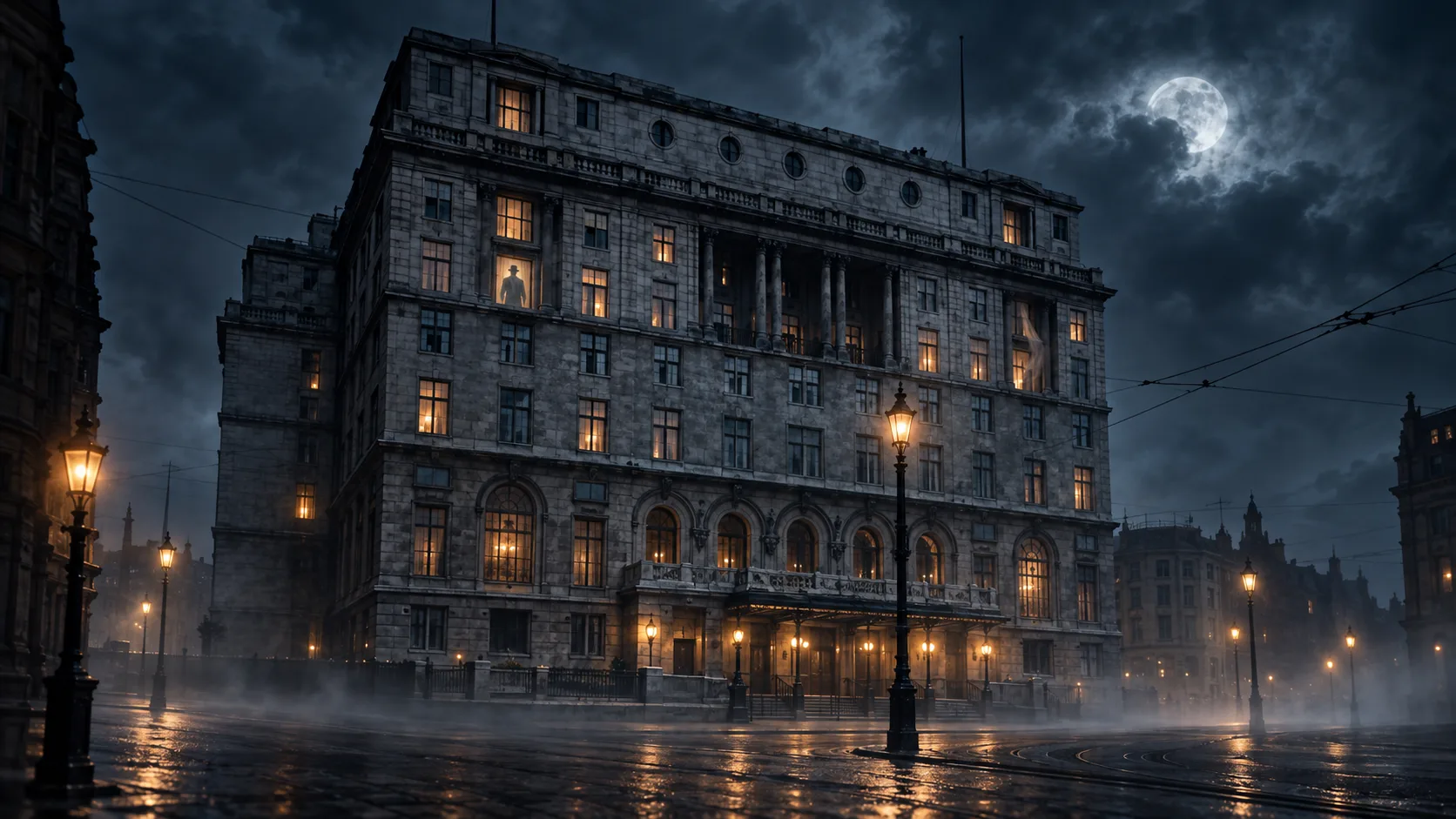
The traffic outside Lime Street begins to thin. Shopfronts go dark. The last trains carry people away from the city centre and the noise that fills Ranelagh Street during the day gradually fades.
Across from the station, the Adelphi is still awake.
Behind its enormous stone frontage are hundreds of bedrooms, sweeping staircases, old function rooms and corridors that seem to disappear into the building.
A lift door opens.
Somewhere further along the corridor, another door closes.
At three in the morning, in a hotel this large, neither sound should be particularly unusual.
Unless you think you are alone.
For more than half a century, stories have circulated about something else occupying the Adelphi.
On the fifth floor, a man called George is supposed to appear beside guests' beds.
Others say a male figure has been seen wandering the corridors or lingering near a window.
Some versions of the story claim he calls for help.
Nobody seems to know exactly who George was.
Elsewhere in the hotel, there are stories of a teenage pageboy who supposedly died in a baggage lift and never quite finished his final shift.
People have reported unexplained whistling near the lifts.
A woman in old-fashioned clothing is said to wander the lower parts of the building.
There are stories of footsteps in empty corridors, sudden cold spots inside bedrooms and doors apparently moving when nobody is there.
Then there are the three uniformed men.
According to one of the strangest stories attached to the Adelphi, three figures dressed like naval officers appeared inside one of the hotel's grand function rooms during an event.
One was older, with a white beard.
Then, witnesses reportedly said, all three disappeared.
Before long, one of them had been linked to Captain Edward Smith of the Titanic.
The Adelphi has collected enough ghosts for several hotels.
But the closer you look at them, the stranger the story becomes.
Because some Adelphi legends can be traced back decades.
Others appear to have changed considerably as they have been retold.
Names appear.
Room numbers move.
An unexplained figure becomes a dead employee with a biography.
A rumour becomes a newspaper story.
A newspaper story becomes history.
So what really happened inside Liverpool's most famous old hotel?
And what belongs to the ghosts?
Before the ghosts, there were three Adelphis
To understand why the Adelphi attracts ghost stories so easily, you have to look beyond the building standing there today.
There has been an Adelphi Hotel on this site since 1826.
Hotelier James Radley opened the first one at Ranelagh Place on land formerly occupied by Ranelagh Gardens. Around half a century later it was demolished and replaced by a much grander second Adelphi in 1876.
That hotel disappeared too.
The present building is the third Adelphi.
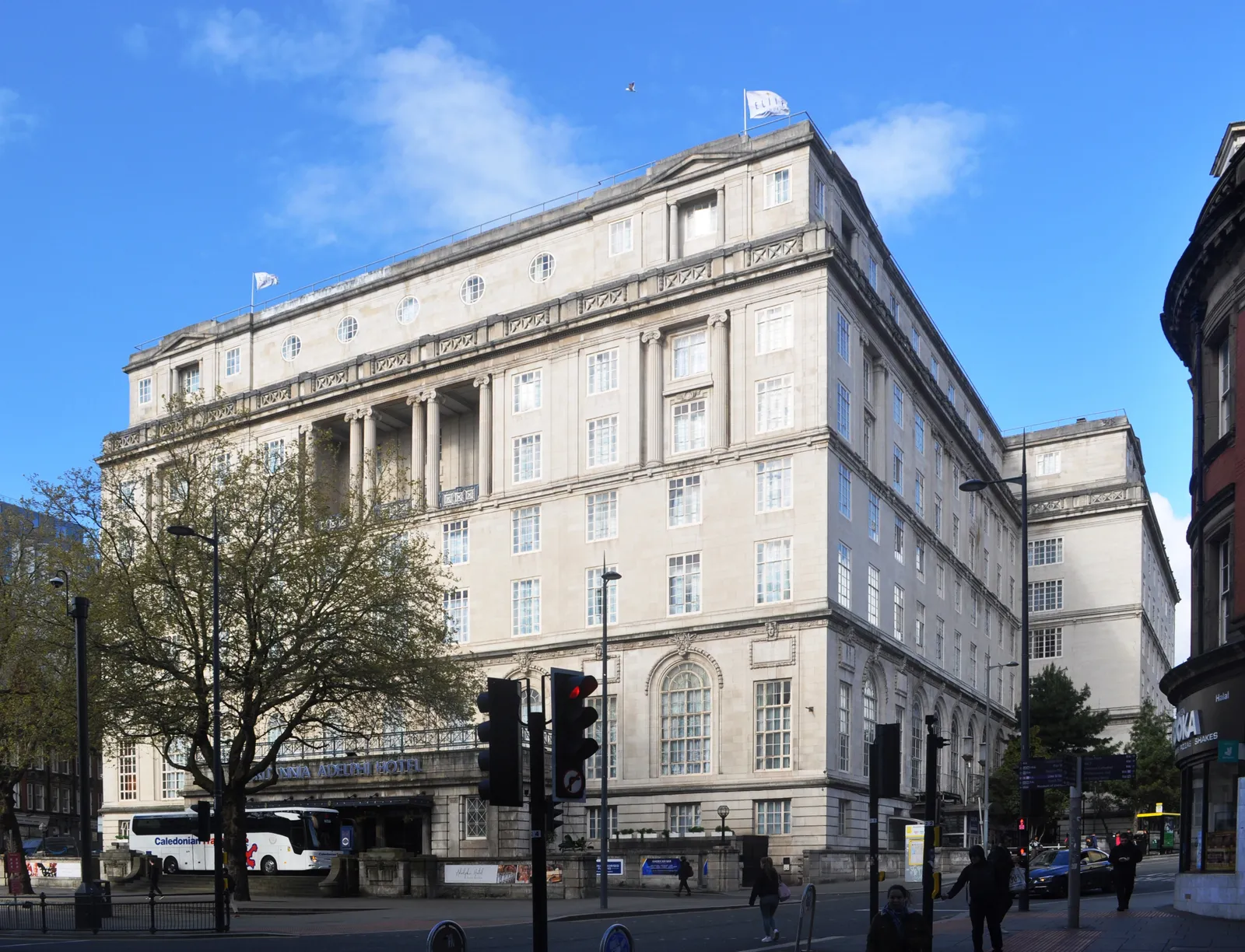
Designed by architect Frank Atkinson for the Midland Railway, the enormous Portland-stone hotel dates from 1912 and opened in its completed form shortly afterwards.
Historic England now lists it at Grade II and describes a seven-storey building containing marble panelling, columns, Greek decoration, coffered arches and an exceptional sequence of public rooms. Original fittings even survive in some bedrooms. (Historic England)
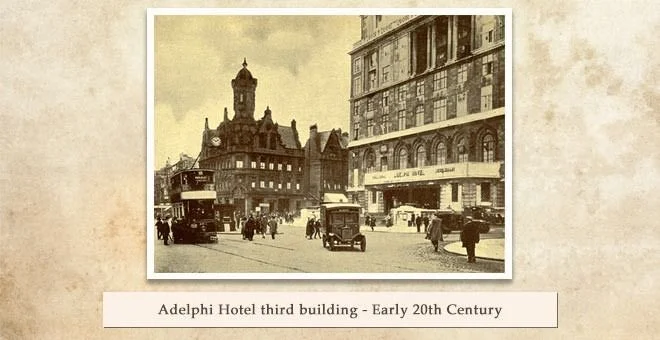
The Adelphi's Portland-stone frontage today. Photo: Hassocks5489 (CC0) via Wikimedia Commons.The third Adelphi building in the early 20th century. Image: Adelphi Hotel history archive.
When the new Adelphi opened, it was built for a Liverpool very different from today's.
Passengers arrived in the city before crossing the Atlantic.
Wealthy travellers came and went.
Porters moved luggage through the building.
Staff disappeared through service passages.
Guests dressed for dinner beneath chandeliers while trains, ships and horse-drawn traffic moved through the city outside.
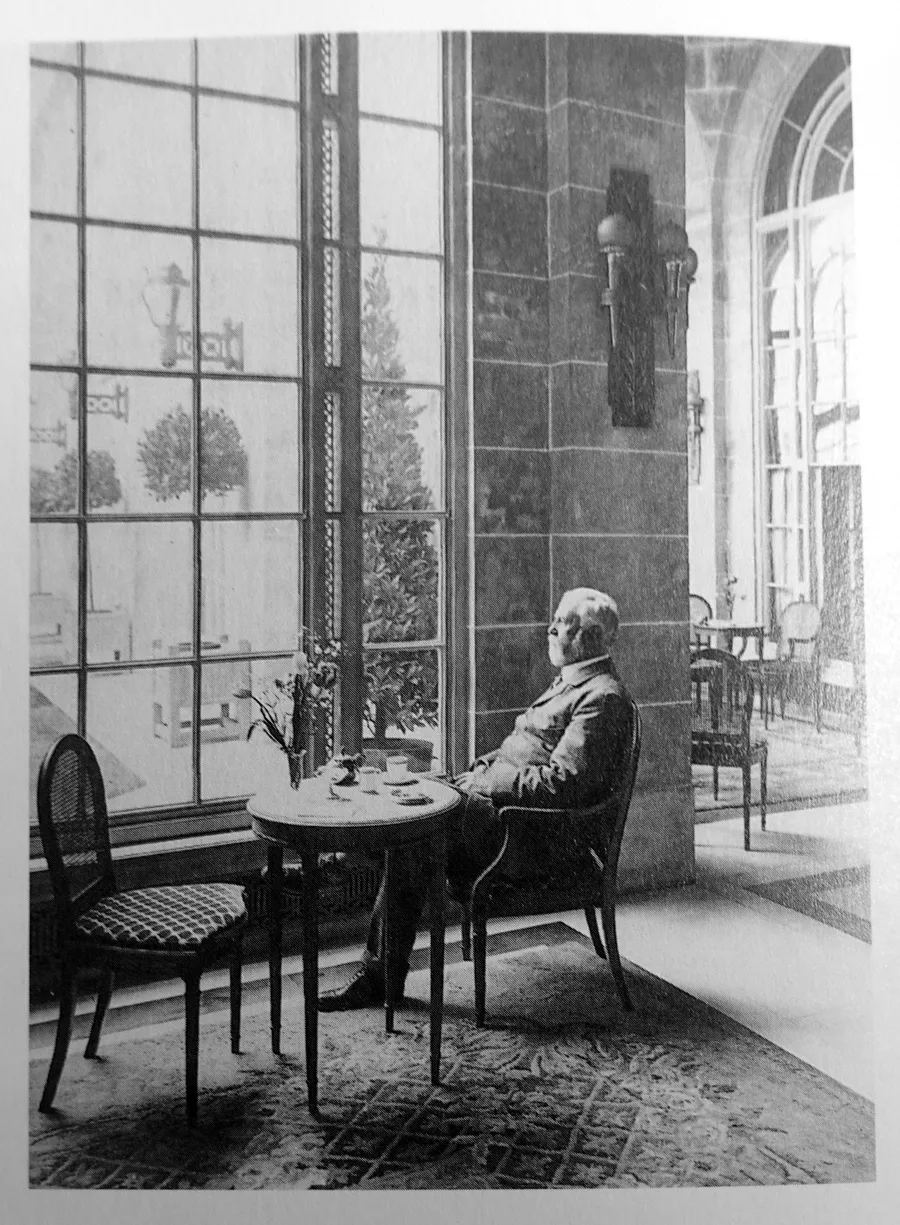
William Towle (1849 to 1929) at the Adelphi Hotel, Ranelagh Place, in 1912. Reprinted photograph, public domain, via Wikimedia Commons.
The hotel had restaurants, Turkish baths, tennis and squash courts, a swimming pool and telephones in its bedrooms.
And it had lifts.
We know exactly what some of those spaces looked like.
Historic England's Bedford Lemere collection contains photographs taken inside the new Midland Adelphi in April 1912.
One photograph shows its lift and staircase.
Another shows bedrooms.
Others capture its kitchens and grand public spaces before generations of guests had passed through them.
Look at those photographs now and there is something unsettling about them.
Not because anything supernatural is visible.
Quite the opposite.
They are immaculate.
Empty.
Waiting.
And many of the places that later appear in Adelphi ghost stories were already there.
The staircases.
The bedrooms.
The lifts.
The corridors.
George is waiting on the fifth floor
Of all the supposed ghosts of the Adelphi, George may have the strongest claim to being its resident celebrity.
The basic story is remarkably simple.
A man called George appears on the fifth floor.
The Paranormal Database records an Adelphi story dating to 1970, stating that George had been seen several times standing beside beds on that floor. The database entry was first added in 2002 and attributes the account to published media. (The Paranormal Database)
It is a wonderfully disturbing image precisely because so little happens.
No chains.
No screaming apparition.
No blood-covered Victorian spectre.
Just a man.
Standing beside the bed.
Imagine opening your eyes in an unfamiliar hotel room during the night.
The curtains are closed.
There is just enough light from the street to make out the furniture.
And somebody is standing beside you.
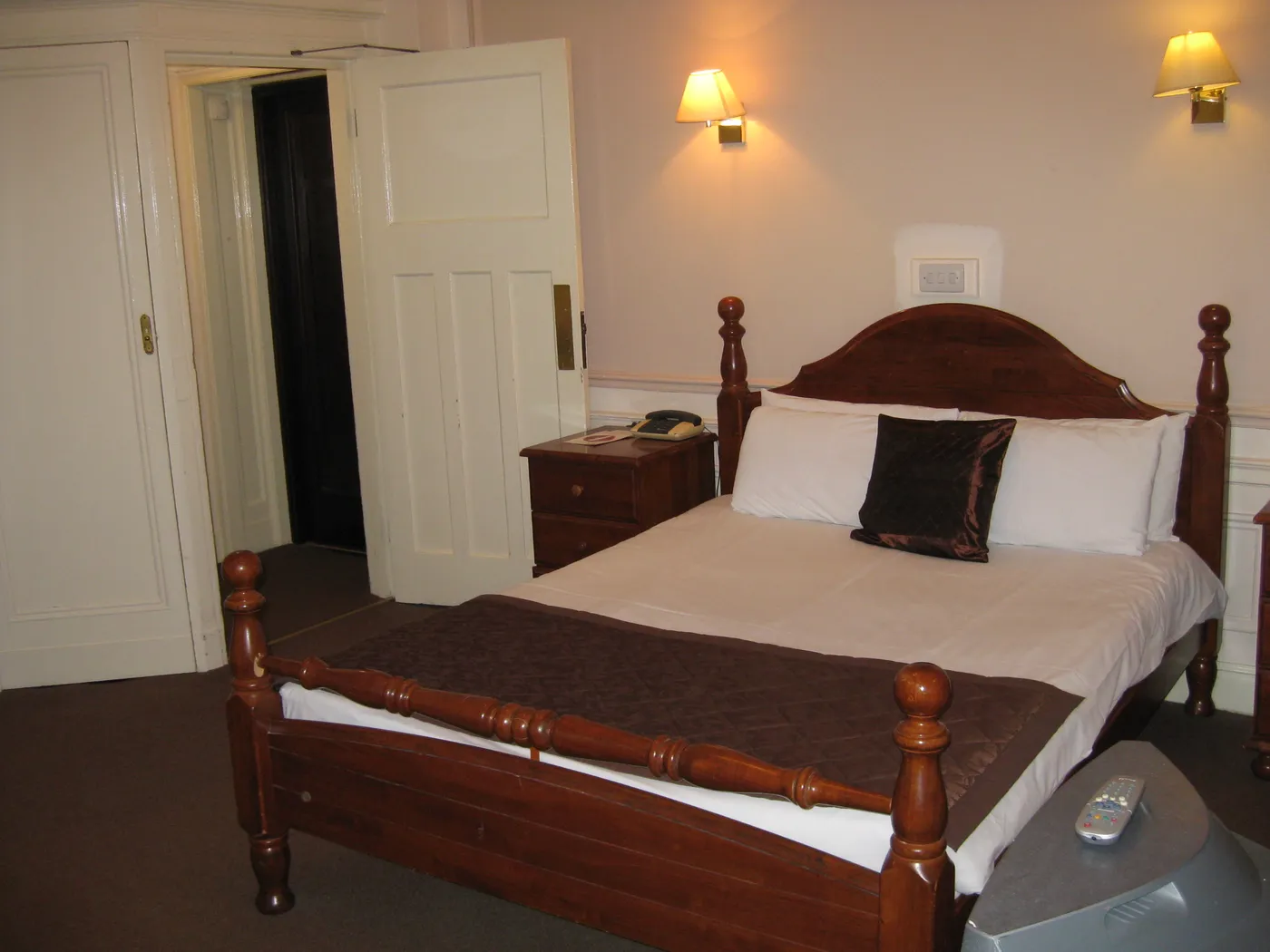
An Adelphi bedroom in 2011. Photo: Chemical Engineer (CC0) via Wikimedia Commons.
That is the heart of the George story.
Later versions become more elaborate.
George is sometimes described moving through the corridors.
In others he appears near a window.
Some retellings give him clothing, a moustache and a story of his death.
One version claims he died by suicide at the Adelphi during the 1930s.
But this is where the floor beneath the story begins to move.
The relatively early tradition of George on the fifth floor can be traced.
George the historical person is much harder to find.
No convincing documentary trail currently establishes who he was, what his surname was or whether a man matching the later stories really died at the hotel.
It raises an intriguing possibility.
Perhaps the ghost existed before the biography did.
Somebody saw a man.
People began calling him George.
Years passed.
Then the story began supplying the missing details for itself.
Raymond Brown and the lift
Another Adelphi story is much more specific.
His name is said to have been Raymond Brown.
He was reportedly 15 years old.
He worked at the hotel as a pageboy.
And, according to the legend, in August 1961 Raymond became trapped in a baggage lift and was killed.
Afterwards, guests supposedly began seeing a young hotel worker around the building.
In some versions, he carries luggage.
Sometimes he simply appears and disappears.
The story has everything a good ghost story requires.
A real-looking name.
A precise age.
A date.
A workplace accident.
And a haunting directly connected to the place where the death supposedly occurred.
It almost feels too complete.
The difficulty comes when you try to step outside the ghost websites and find Raymond.
The story has been repeated widely, but the original historical evidence is elusive.
A fatal accident involving a 15-year-old employee in a major Liverpool hotel in 1961 ought to have left something behind.
A newspaper report.
An inquest.
A death registration.
A record somewhere.
Until that contemporary evidence is located, Raymond Brown should be treated carefully.
He may turn out to have been a real employee involved in a real tragedy.
But currently, the certainty of the modern story is stronger than the documentary evidence behind it.
And yet once you know the story, the old Adelphi lifts feel different.
The lift arrives without being called
Lifts recur again and again in stories about supposedly haunted hotels.
There is something about them.
A small enclosed space.
A door that shuts you away from everyone else.
A mechanical hum.
Numbers illuminating one after another.
Then the doors open onto an empty corridor.
At the Adelphi, visitors and paranormal investigators have told stories about lifts stopping unexpectedly, doors opening without an obvious reason and strange sounds nearby.
There are also accounts of unexplained whistling.
Some versions include the sensation that somebody is standing close behind a guest.
Others describe a touch on the shoulder when nobody appears to be there.
None of this establishes anything supernatural.
Old lifts behave strangely.
Hotels contain pipes, machinery, air movement and dozens of noises whose sources are difficult to identify from inside a bedroom at night.
But folklore does not require proof.
It requires repetition.
The unsettling part is seeing Historic England's photograph of the Adelphi lift and staircase taken in April 1912.
More than a century ago, people were already standing in that space, waiting for the doors to open.
The machinery changes.
The building remembers the shape of it.
Something is wrong on the third floor
If George belongs to the fifth floor, the third has developed a darker reputation of its own.
Over the years, guests and paranormal groups have associated it with sudden temperature changes, noises, voices and the sensation of being watched.
Some investigators have described feeling unexpectedly ill.
Others claim to have heard growls or sounds from apparently empty rooms.
The language becomes much more dramatic in modern paranormal accounts.
Words such as "malevolent" and even "demonic" occasionally appear.
There is no historical evidence supporting those descriptions, and they tell us far more about modern ghost-hunting culture than they do about the Edwardian history of the Adelphi.
But something interesting happens when enough stories accumulate in one place.
The hotel develops a map that exists alongside the real one.
Guests begin entering certain parts of the hotel already knowing what they are supposed to experience there.
Which raises an impossible question.
Does a place feel strange because of what happened there?
Or because somebody told you it was strange before you arrived?
Room 105
Eventually, individual bedrooms become part of the legend.
One number appearing in more recent paranormal stories is Room 105.
Ghost hunters have deliberately booked the room because they had been told it was associated with unexplained activity.
Investigations have subsequently produced the familiar collection of reported phenomena.
Noises.
Temperature changes.
Doors apparently opening.
A sense of somebody else being present.
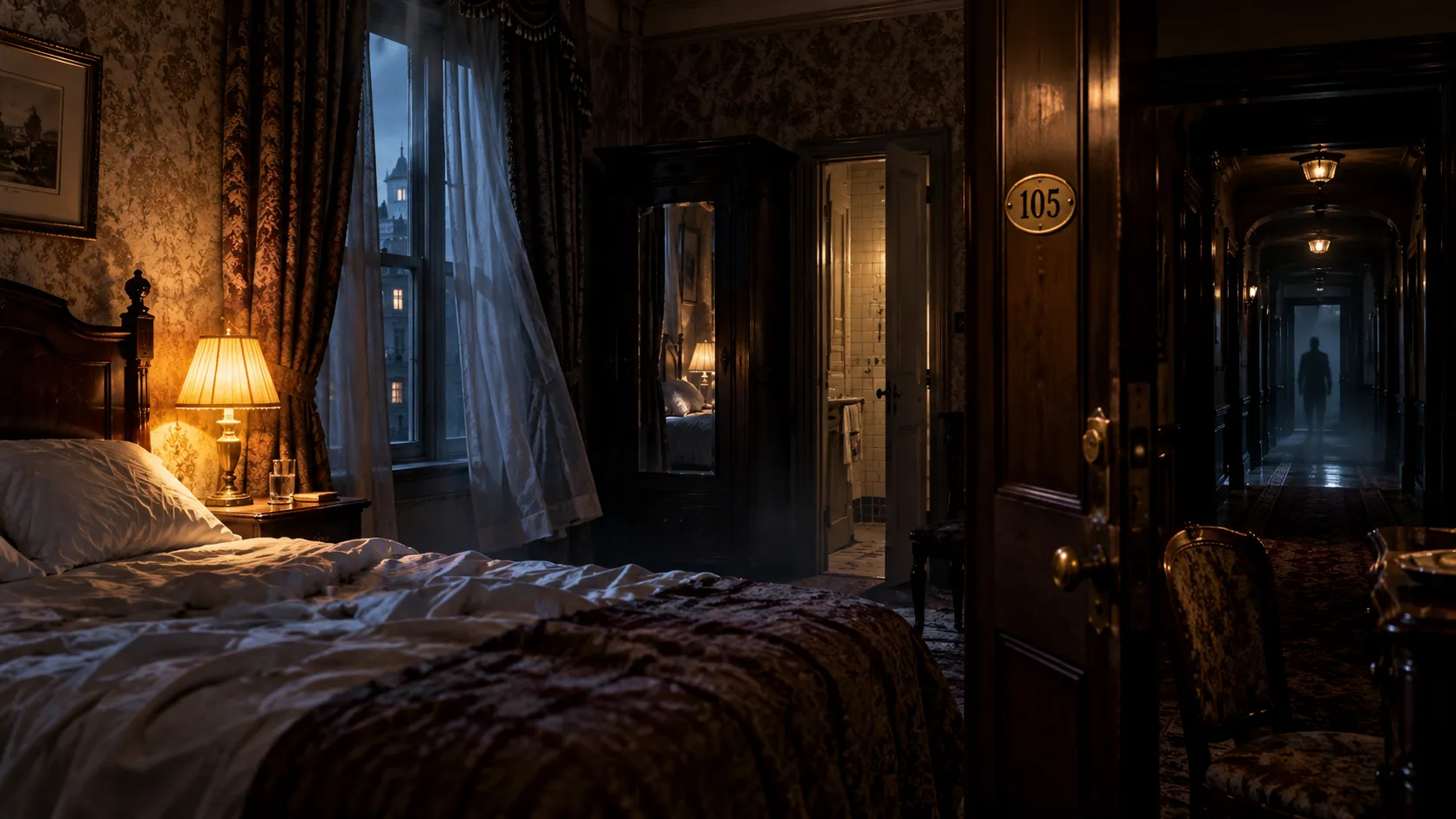
Room 105, as imagined. Illustrative image; AI-generated, not a photograph of the hotel.
None of that demonstrates that Room 105 is haunted.
It does demonstrate something interesting about how a haunted room is created.
First, somebody reports an experience.
Then another person books the room because of that experience.
They spend the night listening for unusual sounds.
If something happens, their investigation becomes another story about the room.
The next visitor now has two stories.
Then three.
Eventually nobody quite remembers where the reputation began.
That appears to be the problem with declaring any particular Adelphi bedroom the most haunted room in the hotel.
Different room numbers circulate.
The older stories often do not specify a room at all.
George's territory is a floor, not a door number.
Sometimes the uncertainty is more frightening.
It means there is no room to avoid.
The woman downstairs
Not every Adelphi ghost has been fortunate enough to receive a name.
One recurring figure is simply a woman.
She is described in different accounts as wearing Victorian or old-fashioned clothing.
Sometimes she is grey.
Sometimes white.
She has been associated with the lower parts of the hotel and basement areas.
Like George, details gather around her over time.
Eventually another familiar ghost story appears.
The jilted bride.
In that version, a woman was supposedly abandoned before her wedding, died by suicide and returned to haunt the hotel.
It is a compelling story.
It is also difficult to substantiate.
No consistent name accompanies her.
No reliable date.
No firmly identified historical woman.
And stories of abandoned brides and women in white appear in haunted buildings all over Britain.
That does not mean nobody ever saw a woman in the Adelphi.
It means that somewhere between a reported figure and the retelling of the story, a biography may have attached itself to her.
There are even accounts of another female apparition supposedly interfering with guests' clothes or belongings while they sleep.
A ghostly pickpocket.
She too remains unidentified.
The Adelphi seems to have produced ghosts faster than history can name them.
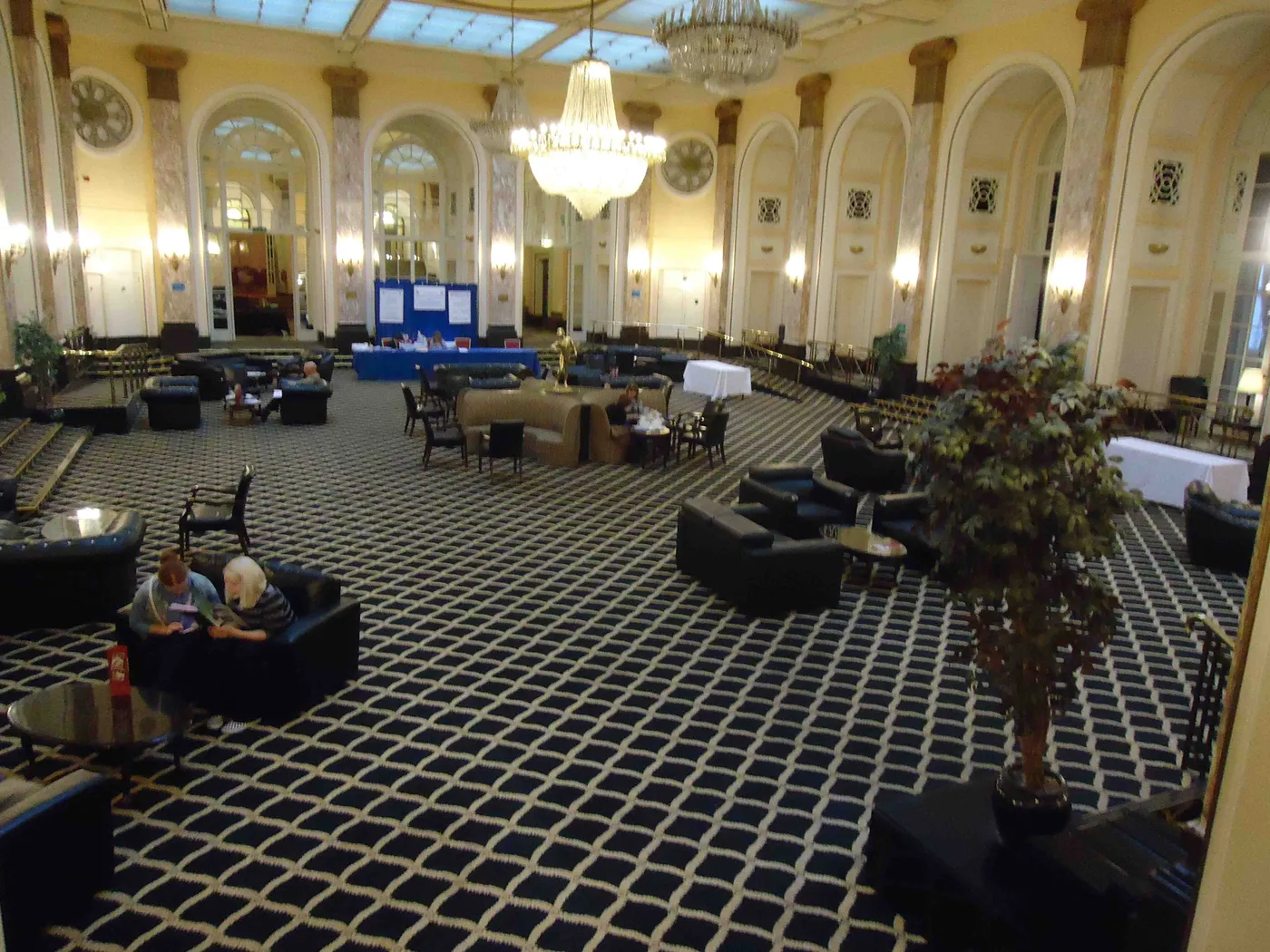
Three men enter the Sefton Suite
Then we reach perhaps the most cinematic of all the stories.
Three men.
Dark naval-style uniforms.
White caps.
Gold braid.
Standing together inside one of the hotel's grand rooms.
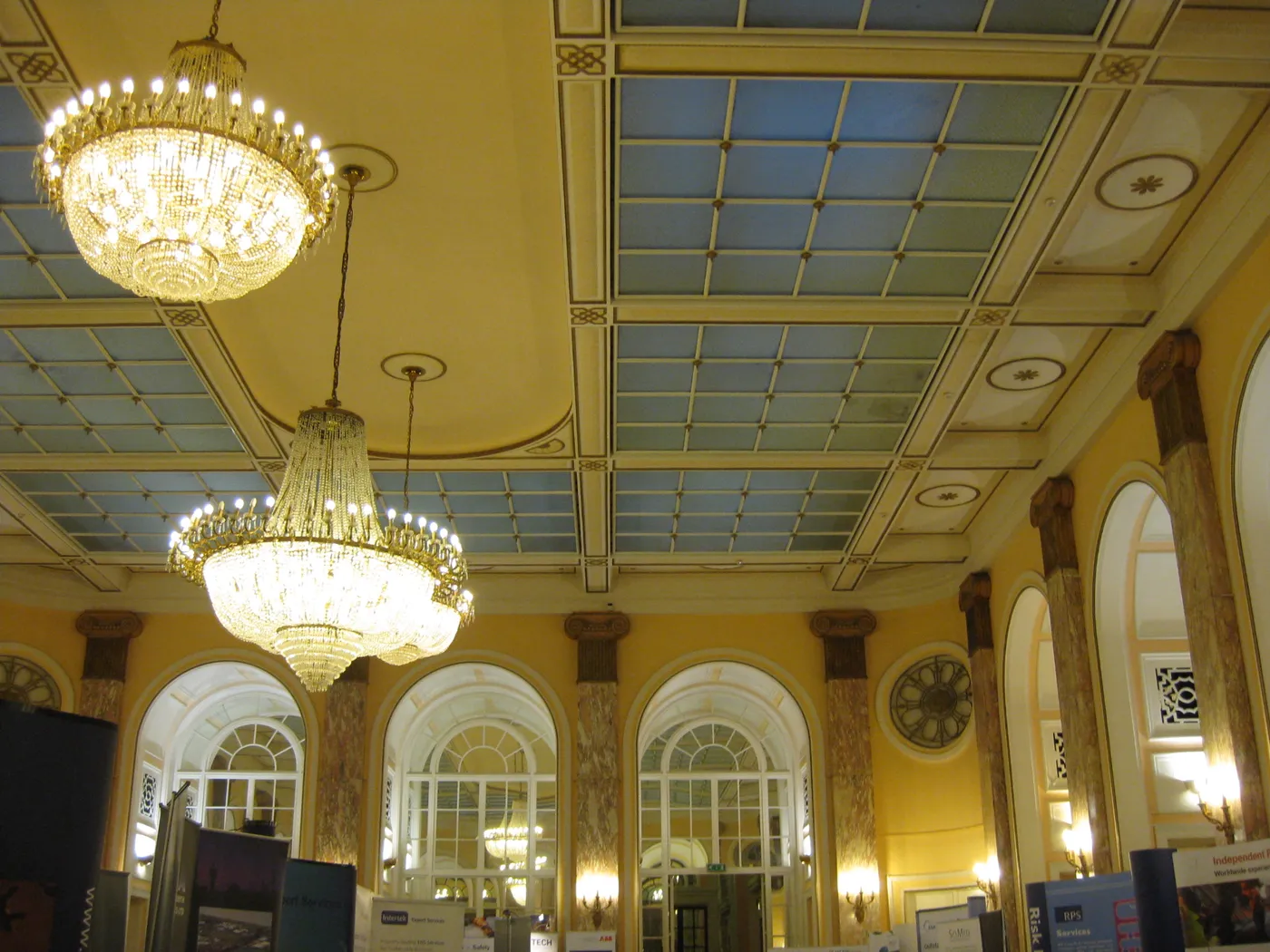
Chandeliers and a coffered ceiling in one of the Adelphi's public rooms. Photo: Chemical Engineer (CC0) via Wikimedia Commons.
Paranormal writer Tom Slemen has described an event at which he and other people allegedly saw three such figures.
One of them was older.
He had a white beard.
Then, according to the account, the men disappeared.
At some point, that older man became connected with Captain Edward Smith, commander of RMS Titanic.
For Liverpool, the connection almost writes itself.
The city.
The great ocean liners.
The enormous railway hotel filled with transatlantic passengers.
The naval uniforms.
Titanic.
And there was another detail that seemed to tie everything together.
For years, people claimed the Adelphi's Sefton Suite was an exact replica of Titanic's first-class smoking room.
It sounds perfect.
Perhaps too perfect.
Because it isn't true.
The Titanic room that wasn't
The Adelphi itself now acknowledges that the supposed architectural connection between the Sefton Suite and Titanic is false.
Its official history says the room was long rumoured to have been replicated aboard Titanic as the ship's first-class smoking lounge, but states that this has since been found to be incorrect.
That is important.
It does not disprove a reported sighting of three uniformed figures.
There is no way of establishing now what witnesses thought they saw.
But it removes one of the pieces that made identifying one of those figures as Captain Smith seem so irresistible.
There is a genuine maritime history here.
The Adelphi really did serve wealthy passengers travelling through Liverpool during the great age of the transatlantic liners. The hotel's own history describes its role as a stopping point for people travelling onwards to North America.
It does not need an invented Titanic room to be interesting.
But this is exactly how folklore grows.
Liverpool has a maritime hotel.
Somebody sees sailors.
The room becomes associated with Titanic.
One figure resembles an old sea captain.
Eventually, the ghost has a name.
Captain Smith has entered the building.
A real death inside the Adelphi
Strangely, while some of the hotel's most famous ghost biographies are difficult to verify, the Adelphi does contain genuine tragedy.
One documented death was that of Sir Jock Delves Broughton.
Broughton had been tried and acquitted in Kenya over the killing of Josslyn Hay, the Earl of Erroll, in a notorious case involving the wealthy Happy Valley set.
In December 1942, Broughton died at the Adelphi after taking an overdose.
The hotel's own historical account records his death there.
There is no need to turn that tragedy into another ghost story.
Its significance is almost the opposite.
Old hotels contain genuine deaths.
People become ill.
Accidents happen.
Lives end inside bedrooms that are subsequently cleaned, renumbered, redecorated and occupied by somebody else.
Over nearly two centuries of hotel use on one site, real human history inevitably accumulates.
The difficulty begins when documented history and folklore become tangled together.
How a ghost acquires a life story
Spend long enough researching the Adelphi's ghosts and a pattern emerges.
A simple story becomes complicated.
George begins as a man seen beside beds on the fifth floor.
Then he acquires clothes.
A window.
A death.
A decade.
A woman appears.
Eventually she becomes a bride.
Three uniformed figures appear.
One becomes Captain Smith.
A room feels strange.
It becomes "the haunted room".
No conspiracy is required.
Nobody necessarily sits down and invents the details.
Stories behave like this naturally.
Somebody forgets part of one.
Somebody else fills in a gap.
A possibility becomes a probability.
"Perhaps" disappears from the sentence.
A newspaper quotes a paranormal researcher.
Another website quotes the newspaper.
Another copies that website.
Twenty years later, ten sources seem to confirm the same story.
But follow them backwards and sometimes they all lead to one person standing in one corridor saying:
"I saw something."
So, is the Adelphi haunted?
There is no historical document capable of answering that question.
What can be established is more interesting.
There really has been an Adelphi on this site since 1826.
The present Grade II-listed building dates from the early 20th century and retains significant original interiors and fittings.
Photographs survive showing its bedrooms, kitchens, staircases and lifts more than a century ago.
A published-media tradition concerning a figure called George on the fifth floor can be traced to reported sightings dating to 1970.
After that, the shadows become longer.
George's history remains elusive.
Raymond Brown's supposed 1961 death needs stronger contemporary documentation.
The women seen around the building have no reliably established identities.
Modern claims surrounding particular bedrooms largely come from guest anecdotes and paranormal investigations.
And one of the best-known details linking the hotel to Titanic, the supposed replica smoking room, is acknowledged by the Adelphi itself to be false.
None of that kills the story.
It makes it better.
The last corridor
Perhaps the mistake is expecting every ghost story to end with an answer.
Old buildings rarely give us one.
The Adelphi has been standing in its present form for more than a century, on a site that has welcomed hotel guests for two.
Imagine how many nights that represents.
How many people have slept behind those doors.
How many suitcases have crossed the lobby.
How many weddings have finished downstairs while someone lay awake several floors above.
How many staff have walked the corridors when almost everybody else was asleep.
How many arguments, celebrations, illnesses, departures and deaths have taken place behind closed doors.
Most left no story at all.
A few became ghosts.
Outside, Liverpool keeps changing.
Buildings disappear.
Businesses close.
People leave.
The Adelphi remains.
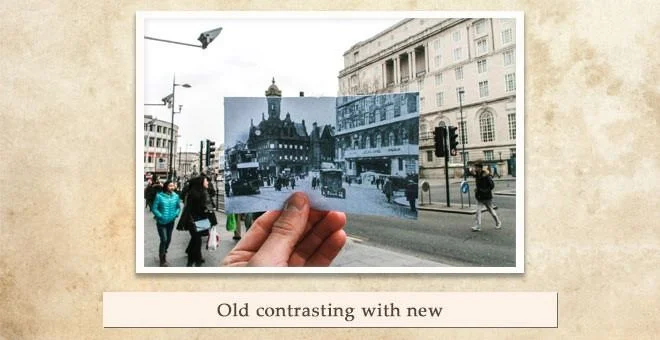
Old photograph held against the same view today. Image: Adelphi Hotel history archive.
Its Portland-stone frontage still faces the city centre. Its staircases still climb through the building. Its lifts still open onto long hotel corridors.
And late at night those corridors become quiet again.
Perhaps somebody hears a footstep.
A lift stops.
A door opens.
For a second, there seems to be somebody standing further down the corridor.
Then there isn't.
There may be a perfectly ordinary explanation.
There usually is.
But somewhere on the fifth floor of Liverpool's Adelphi, a man called George has supposedly been waiting for more than half a century.
And nobody has yet managed to tell us exactly who he was.
Comments
Join the conversation with your L1Local Community account. Keep it civil and on topic.