On 9 October 1826, three casks marked “Bitter Salts” arrived at Liverpool’s George’s Dock for shipment to Scotland. By the following morning, the men preparing to load them had stopped.
Three casks
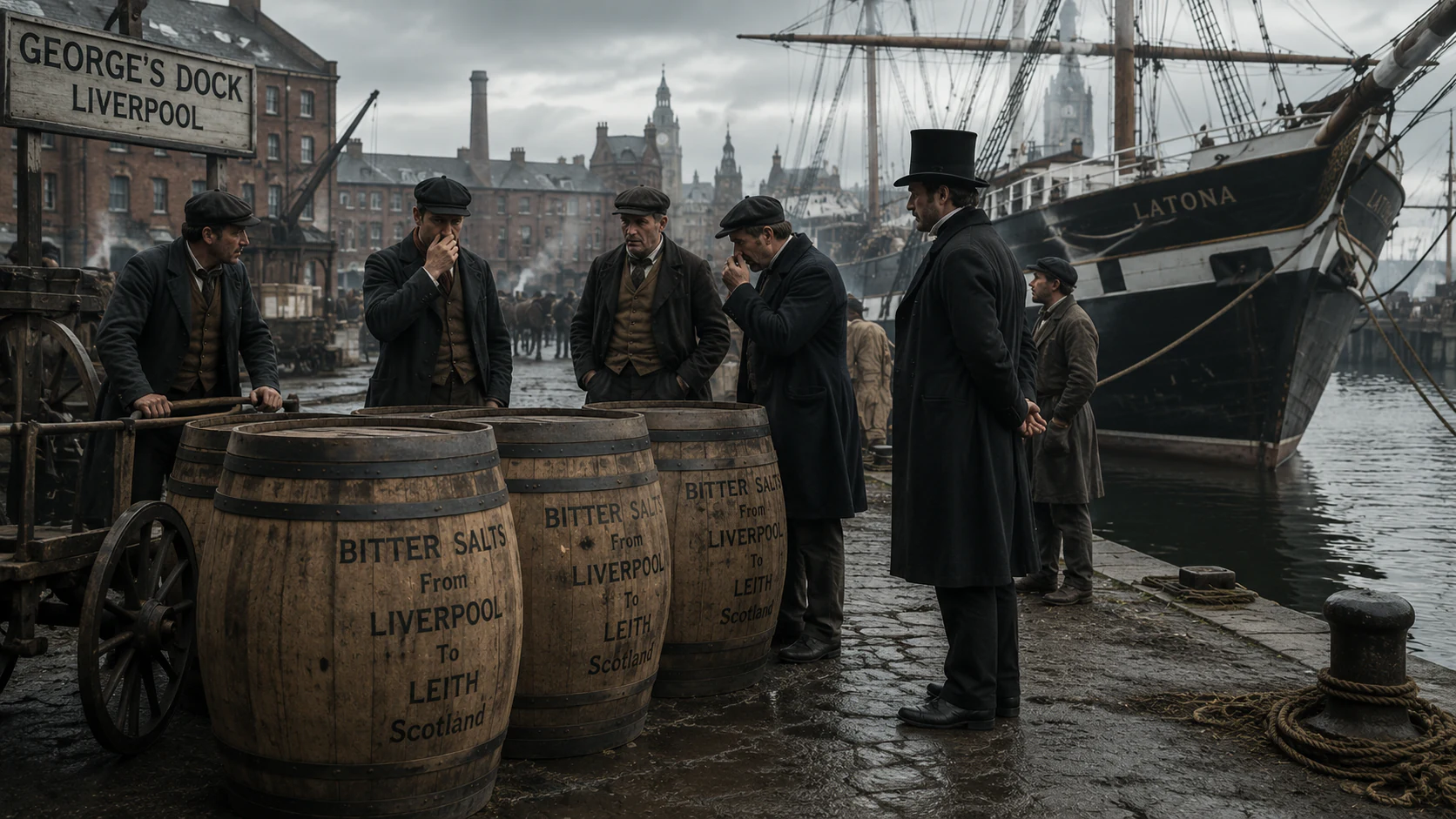
On Monday 9 October 1826, a carter brought three large casks down to George’s Dock in Liverpool.
The paperwork gave little reason to stop them. They were marked as “Bitter Salts”, meaning Epsom salts, and were due to travel aboard the Latona, bound for Leith in Scotland.
By the next morning, the mate of the Latona and others preparing the cargo for loading had noticed something was wrong.
There was a smell coming from the casks.
The mate reported his suspicions to the Carron Company’s agent. Police were called.
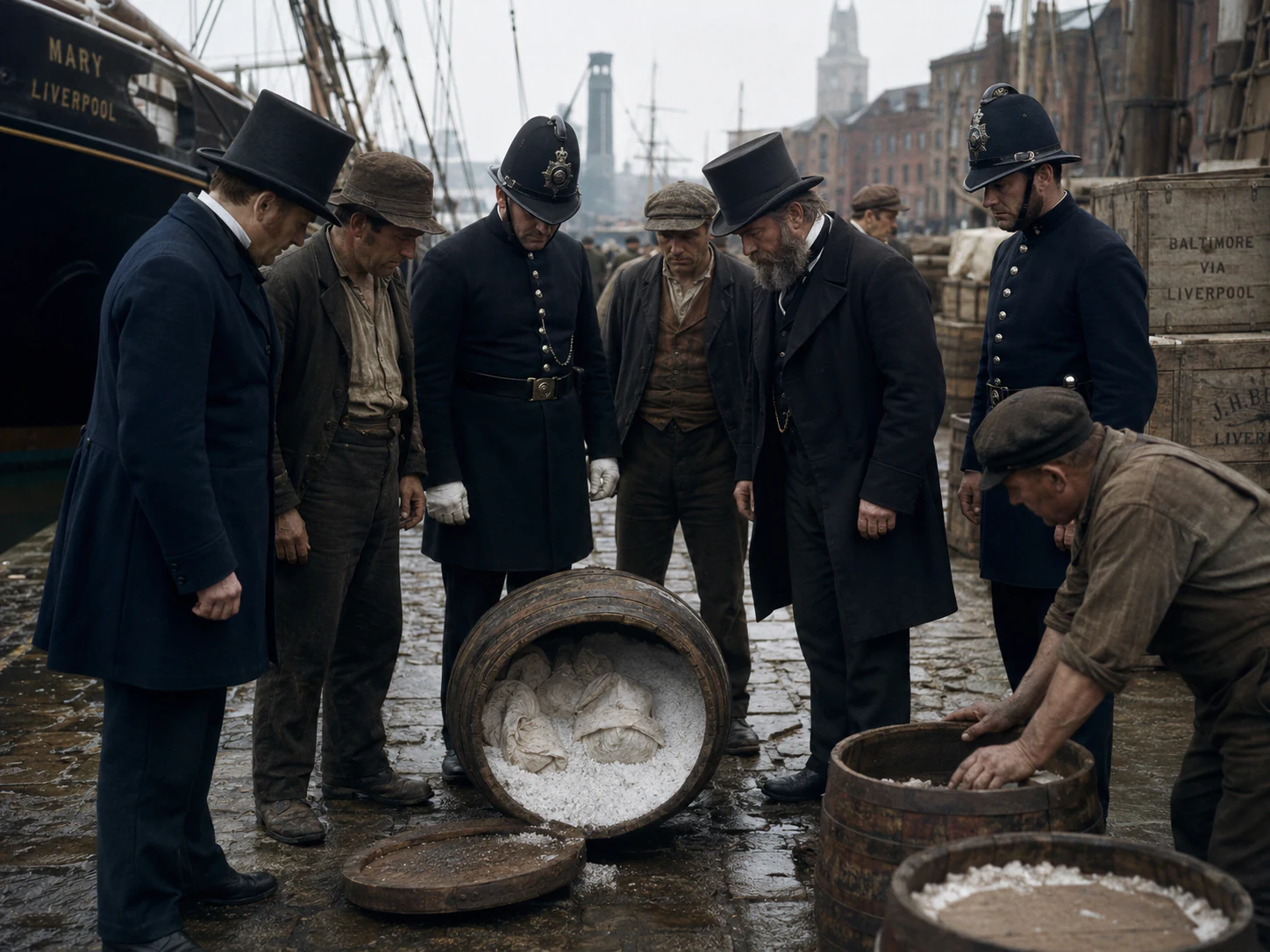
A constable named Socket had the casks opened.
They did not contain Bitter Salts.
Eleven bodies
Inside were human remains packed with salt.
When the three casks were fully examined, they were found to contain 11 bodies. The episode is recorded in a surviving 1826 broadside now held by the Wellcome Collection.
The discovery immediately created another question. The casks had not appeared at the dock by themselves.
Who had brought them there?
Police traced the delivery to the carter, George Leech.
Leech could tell them where he had collected the cargo.
It was not from a warehouse beside the river.
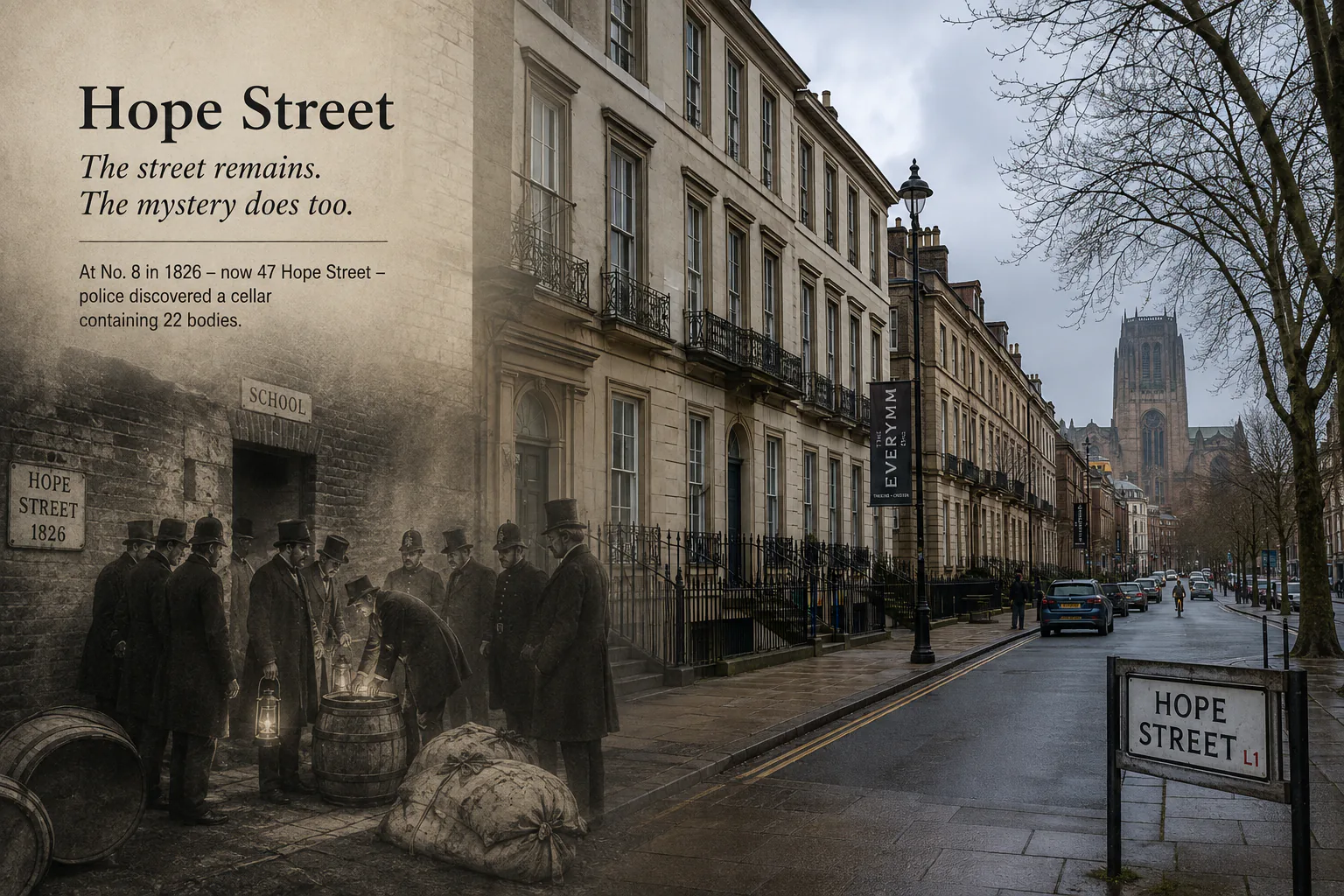
It was from Hope Street.
The carter
Hope Street in 1826 was a different street from the one Liverpool knows today. Neither of the modern cathedrals had been built.
One property there was occupied by the Reverend James MacGowan, who ran a boys’ school.
Research by Liverpool historian Marie McQuade, later summarised by David Bateman, places the property at No. 8 Hope Street under the numbering used in 1826. That research identifies it with present-day 47 Hope Street.
Historic England records 47 Hope Street as an early 19th-century Grade II-listed house with a basement.
The cellar beneath MacGowan’s schoolroom had been rented separately.
The tenant was a Scotsman named John Henderson.
Henderson was described as a cooper involved in the fish-oil trade. For a man working with barrels, a cellar containing casks would not necessarily have seemed unusual.
Police now wanted to see inside it.
The locked cellar
There was a problem.
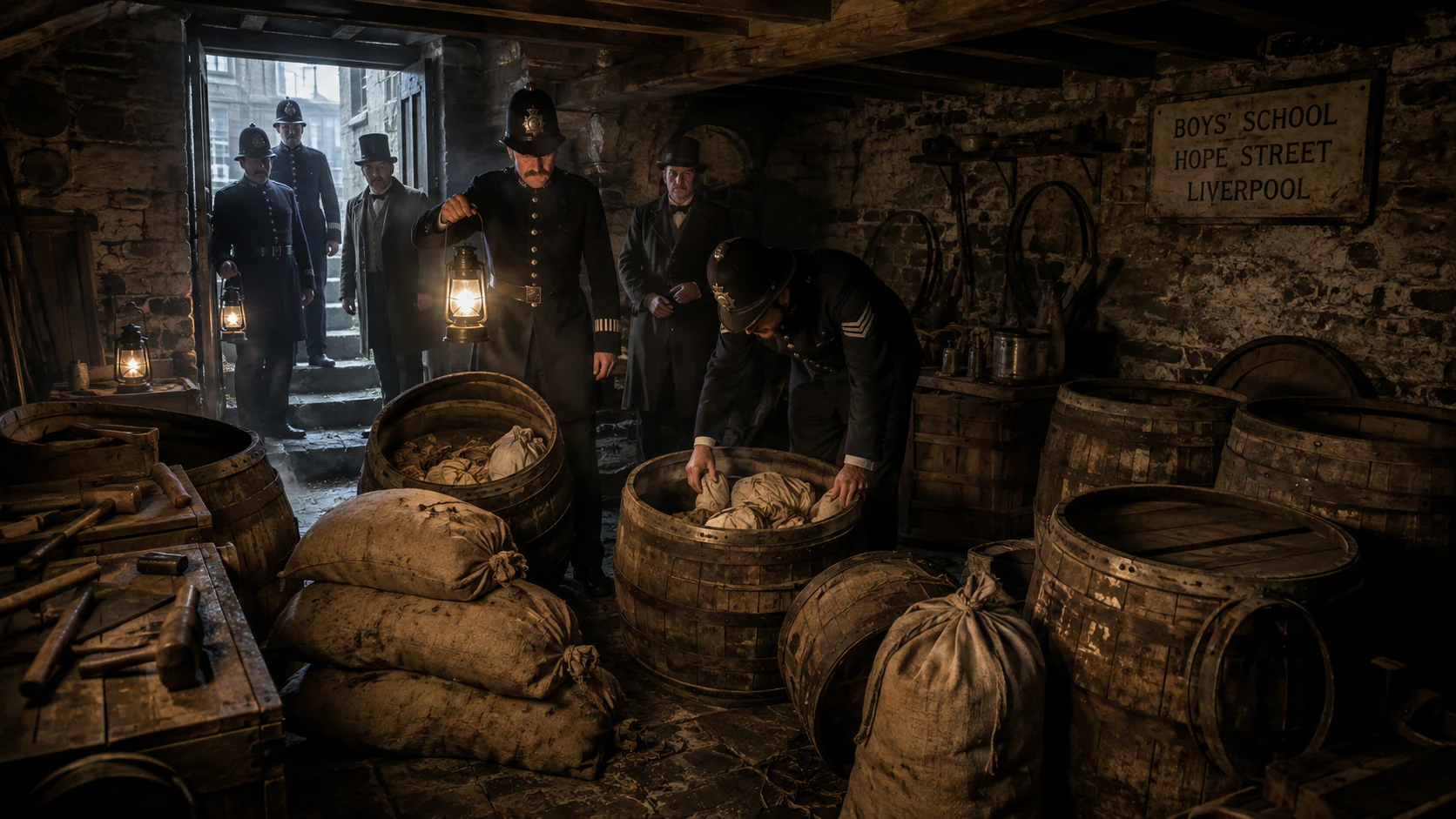
The cellar was locked.
MacGowan told officers that he did not have the key.
Detective Robert Boughey and other officers forced the door with a crowbar.
Inside they found casks and sacks.
Then they found the bodies.
There were 22 of them, adults and children, stored in the cellar.
Combined with the 11 already intercepted at George’s Dock, Liverpool police were now dealing with 33 human bodies, the total recorded in the surviving broadside and later reproduced in James Blake Bailey’s Diary of a Resurrectionist.
The obvious question was no longer simply who had filled the casks.
It was why anyone wanted so many dead bodies.
Why anyone wanted the dead
By the 1820s, British medical education had a supply problem.
Anatomy students needed human bodies for dissection. The legal supply was nowhere near large enough to meet demand.
The UK Parliament history of body snatching explains that the Murder Act 1752 allowed the bodies of executed murderers to be used for anatomical study. As medical schools expanded, that limited source could not keep pace.
An illegal market developed around the gap.
So-called resurrectionists stole recently buried bodies and sold them to anatomists and medical schools.
The Hope Street case shows how that trade could use ordinary shipping networks. The casks had been entered as commercial cargo and were bound for Leith, serving Edinburgh, one of Britain’s most important centres of medical teaching.
But finding 33 bodies raised another question.
Had these people been murdered?
Had they been killed?
Thomas William Dawes, a surgeon from St Paul’s Square, examined the bodies at the direction of the coroner.
Dawes reported no external marks of violence and said he had no reason to believe the people had died other than naturally.
One detail pointed particularly strongly towards burial.
A woman had thread tied around her toes, described in the historical account as a practice associated with preparing a body after death.
That shifted the investigation away from murder and towards grave robbery.
The bodies appeared to have been dead before somebody took them.
So where had 33 recently dead people come from?
The burial ground
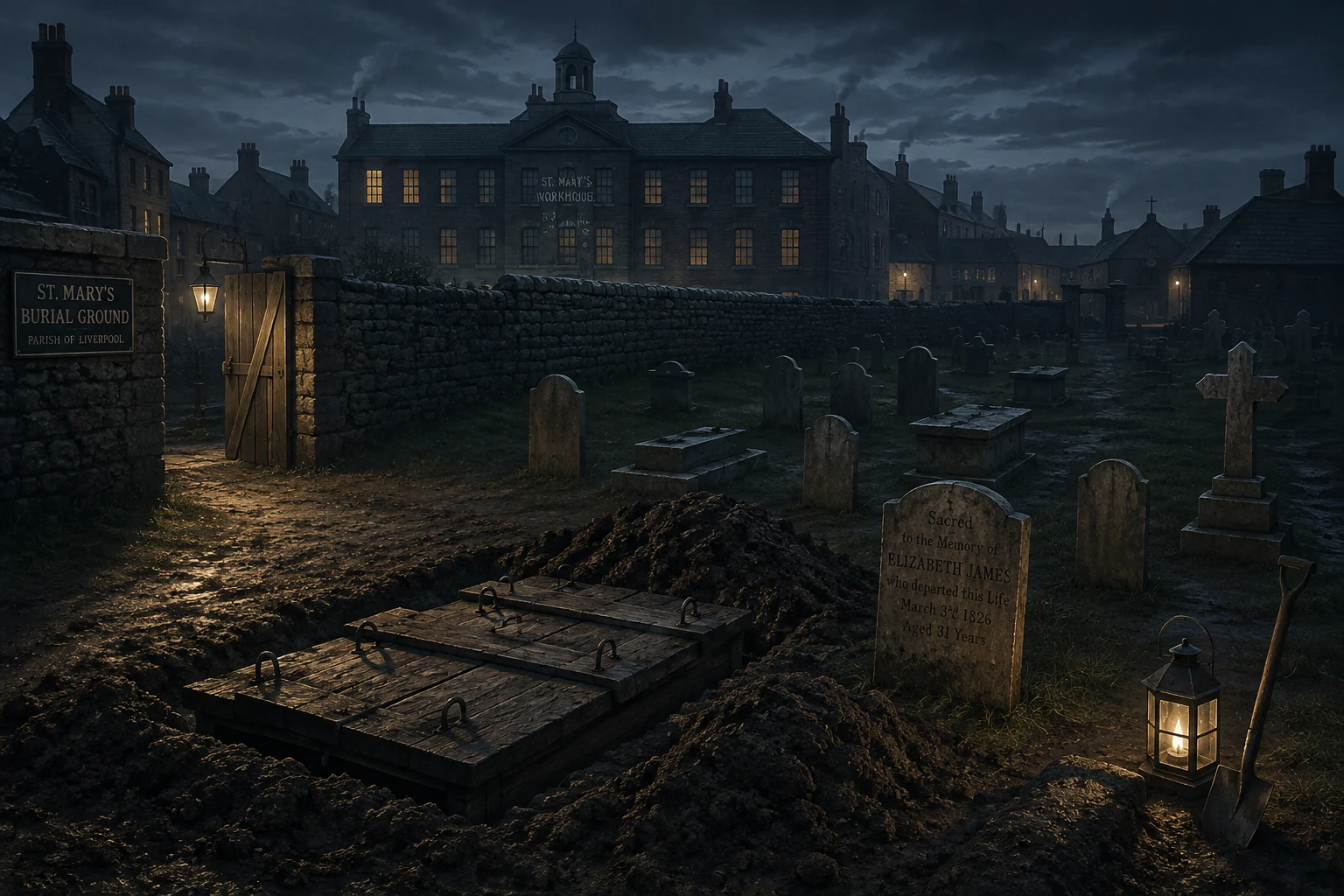
Contemporary reporting suspected that Liverpool’s workhouse burial ground had been targeted. Later research by Marie McQuade points more specifically to St Mary’s burial ground, around Cambridge Street and Mulberry Street.
McQuade’s research, summarised in David Bateman’s account of the Hope Street body snatchers, found that 20 bodies had been buried there during the first week of October 1826. Ten had died in Liverpool Workhouse.
The way some burials were managed helps explain how a gang could remove a large number of bodies.
Large communal graves could be prepared to hold around 30 people. They were not necessarily filled in after each burial. Until the grave reached capacity, it could be covered temporarily by a heavy wooden structure with locked doors.
According to the same research, the gang appears somehow to have acquired a key.
The burial records also point to workhouse dead among the likely victims, although the surviving evidence does not identify every body individually.
Who was John Henderson?
The police now had a cellar full of evidence and the name of the man who had rented it.
They needed to find Henderson.
There was another problem.
He had disappeared.
MacGowan was cleared of involvement. Bailey later described Henderson as the principal figure in the operation. Henderson escaped and was never brought to justice.
The search did not end with him.
Police attention moved to other Scottish men lodging in Liverpool, including people connected with Caroline Court, off Watkinson Street.
William Gillespie was remanded, but the case against him was dismissed.
Another man, James Donaldson, was caught.
Bailey records that Donaldson was sent to Kirkdale Gaol for 12 months and fined £50.
By then the Hope Street cellar had been exposed, bodies had been recovered, one man had been convicted and Henderson had vanished.
Anyone connected with the trade had every reason to stop.
They tried again
They did not.
In November, less than a month after the George’s Dock discovery, further attempts were made to send bodies from Liverpool to Edinburgh.
David Bateman’s summary of the archival research records attempts on 4 and 7 November, this time using coaches from Dale Street.
Peter MacGregor was caught following the second attempt.
John Ross remained at large for a few more days.
Then, on 10 November, someone recognised him around Pool Lane near Castle Street.
It was George Leech.
The same carter who had unknowingly delivered the original three casks to the Latona was now involved in identifying one of the men being sought.
Ross was arrested.
Donaldson, MacGregor and Ross were each sentenced to 12 months in prison and fined. The surviving secondary account gives fines ranging from £25 to £50.
Why the punishment looks so light
Twelve months can look surprisingly modest when the case involved dozens of stolen bodies.
The explanation lies partly in the law surrounding corpses.
Body snatching itself, where it was not accompanied by theft of property from the grave, was generally treated as a misdemeanour rather than a felony.
The law had also helped create the market it was trying to punish.
Medical schools needed bodies. The legal supply was too small. Resurrectionists supplied the difference.
Liverpool had encountered the trade before the Hope Street case. Bateman’s account notes convictions involving Robert Armstrong and Thomas Stewart in 1824.
On 14 November 1826, St Mary’s burial ground was authorised to raise its walls, add railings and take other steps to deter further body snatching.
The law changes
Liverpool’s case was part of a much wider British crisis over the supply of bodies for anatomical teaching.
Two years later, the Burke and Hare murders in Edinburgh demonstrated the most extreme consequence of a market in human bodies. Burke and Hare did not simply rob graves. They murdered people and sold the bodies.
Public pressure for reform intensified.
The Anatomy Act 1832 explicitly recognised that the legal supply of bodies had been insufficient and introduced a regulated system for anatomical examination.
The Act did not make public unease around dissection disappear, and its treatment of unclaimed bodies, especially those of poor people, remains an important part of its history.
But it changed the system in which professional resurrectionists had flourished.
Where George’s Dock is today
The first scene in the story is difficult to recognise in modern Liverpool because George’s Dock is gone.
George’s Dock was filled in during 1899, creating part of the land later used for the Port of Liverpool Building, Cunard Building and Royal Liver Building.
The research traced through Marie McQuade places the 1826 property at the site now numbered 47 Hope Street.
Historic England describes the surviving building there as an early 19th-century house with three storeys and a basement.
That does not prove that the cellar survives in exactly the form police entered in October 1826. The historical property identification is strong, but claims about the precise survival of the internal cellar should be made cautiously without further building evidence.
What can be said with confidence is that the body-snatching investigation was tied to a real property on a street Liverpool still knows.
The modern address gives little indication of what police found there in October 1826. The surviving record is clearer about the discovery than it is about every person involved: Henderson disappeared, the bodies cannot all be individually identified, and the present form of the cellar is uncertain.
The casks were supposed to leave Liverpool as ordinary cargo. The smell stopped them.
Research note
This article distinguishes between contemporary evidence, later historical research and conclusions that cannot safely be made from the surviving record.
The strongest contemporary source used here is the 1826 broadside preserved by the Wellcome Collection. James Blake Bailey later reproduced the Liverpool account in The Diary of a Resurrectionist. The location of the Hope Street property, burial-ground research and later arrests are drawn from Marie McQuade’s work as summarised by David Bateman. Historic England is used only for the current listed-building description of 47 Hope Street.
The article does not claim that the victims were murdered, that Reverend MacGowan was involved, or that the modern cellar at 47 Hope Street is unchanged from 1826.
Comments
Join the conversation with your L1Local Community account. Keep it civil and on topic.