News
The Liverpool Murder That Began With a Call to a Street That Did Not Exist
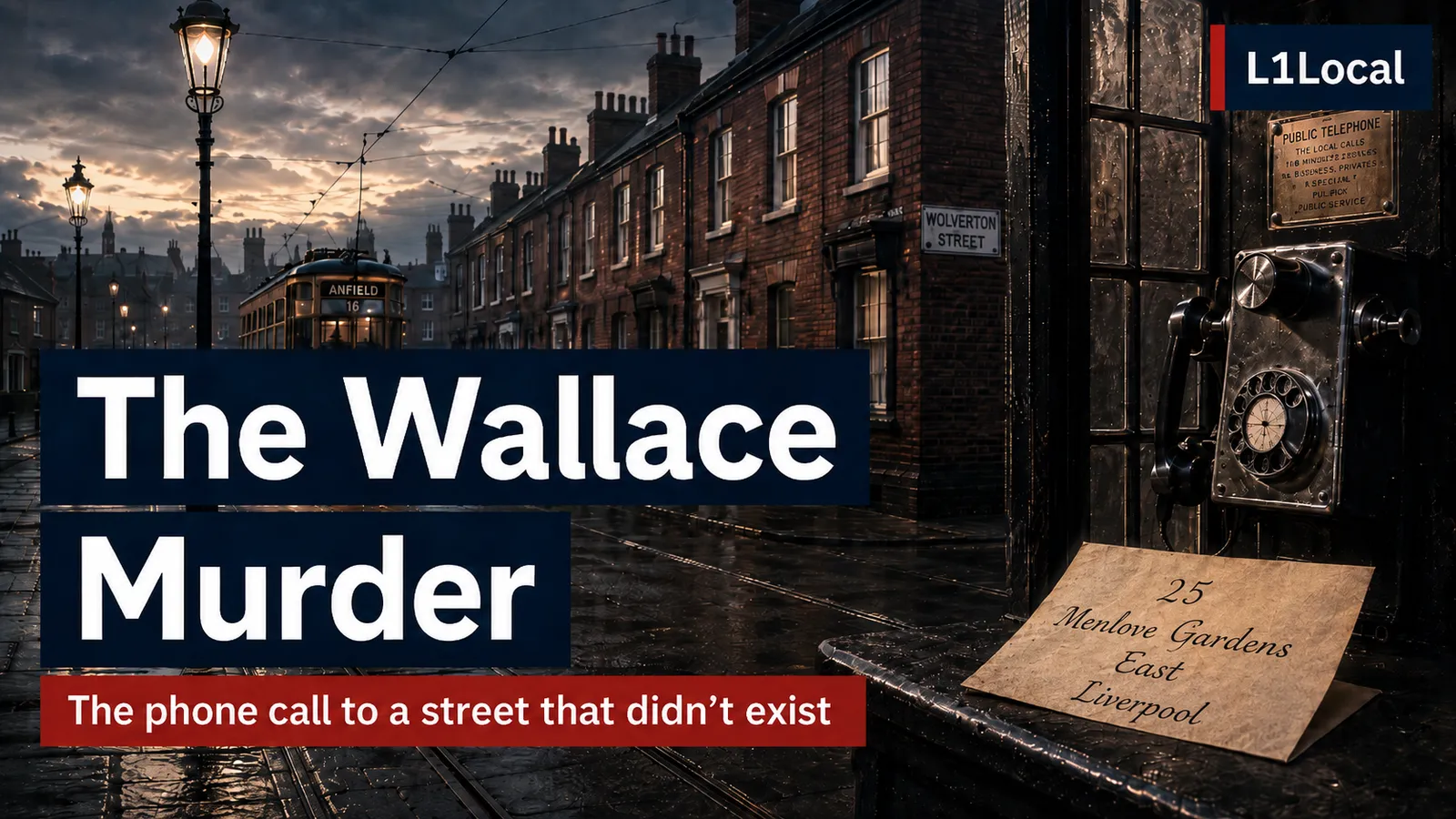
In 1931 a caller sent William Wallace to 25 Menlove Gardens East in Liverpool, a street that did not exist. What happened next was never settled.
On the evening of Monday 19 January 1931, a telephone rang inside the City Café on North John Street in Liverpool city centre.
The Liverpool Central Chess Club met there twice a week, and this was a club night. A waitress answered. A man on the line asked for one of the members, William Herbert Wallace.
Wallace had not arrived yet. The club captain, Samuel Beattie, took the call instead. The man said he wanted Wallace to visit him the following evening about insurance business, and gave his details for Beattie to write down.
R. M. Qualtrough
Beattie wrote three things on a piece of paper.
R. M. Qualtrough. 25 Menlove Gardens East. Tomorrow, 7.30pm.
Wallace turned up later that evening and was handed the message. He was a Prudential insurance agent, so a customer asking him to call round was ordinary work. But he did not know the name Qualtrough, and, on the evidence he later gave, he did not know where Menlove Gardens East was. He asked the other players. Nobody there could place it either.
The next evening he set off across Liverpool to find it anyway.
There was one problem with the address. Liverpool had a Menlove Gardens North, a Menlove Gardens South and a Menlove Gardens West, arranged around a junction off Menlove Avenue, out towards Mossley Hill.
There was no Menlove Gardens East.
29 Wolverton Street
William Wallace was 52. He and his wife Julia rented a terraced house at 29 Wolverton Street in Anfield, a short walk from Richmond Park and Breck Road. He worked a collecting round for the Prudential, calling door to door around Clubmoor and north Liverpool for weekly premiums.
His life outside insurance was quiet and a little studious. He played chess at the club in town on Mondays, read chemistry, and played the violin while Julia played the piano. The couple kept largely to themselves. There is not much on the record about Julia beyond that, which is part of why the case so often reduces her to the body at the centre of it. She had married Wallace in 1914 and ran the house on Wolverton Street.
On Tuesday 20 January, Wallace did his rounds as usual and came home. Some time after that, he left again for Menlove Gardens.
The last delivery
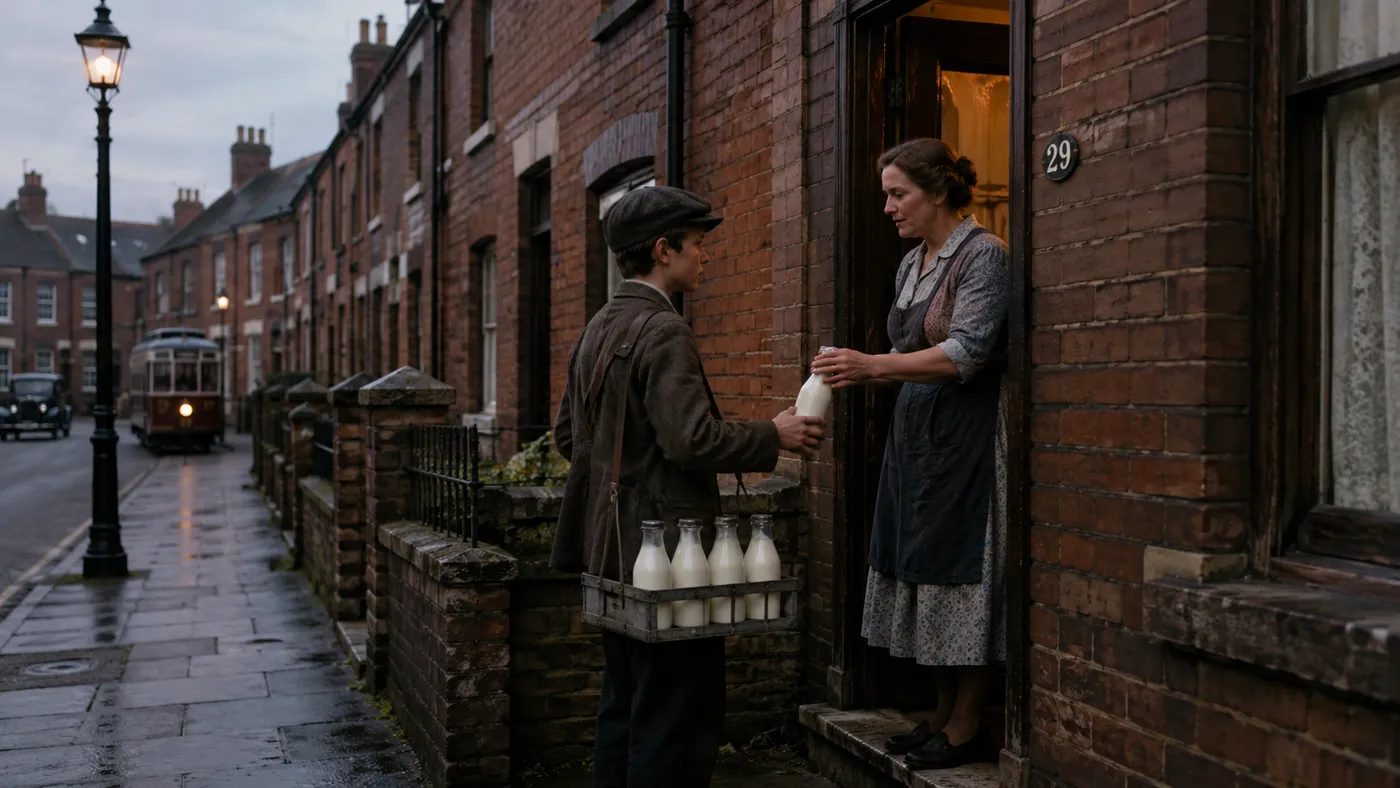
The last person known to have seen Julia Wallace alive was not a detective or a neighbour but a 14-year-old delivering milk.
Alan Croxton Close told the trial he called at number 29 that evening and that Julia came to the door and took the milk in herself. He put the time at around 6.30pm.
Wallace left the house at roughly 6.45pm to walk to the tram. He caught one, then changed to another heading south. On the way he mentioned the address to a conductor.
Somewhere in the window between Julia taking in the milk and Wallace boarding that tram, or shortly after, she was killed in the front room of the house.
25 Menlove Gardens East
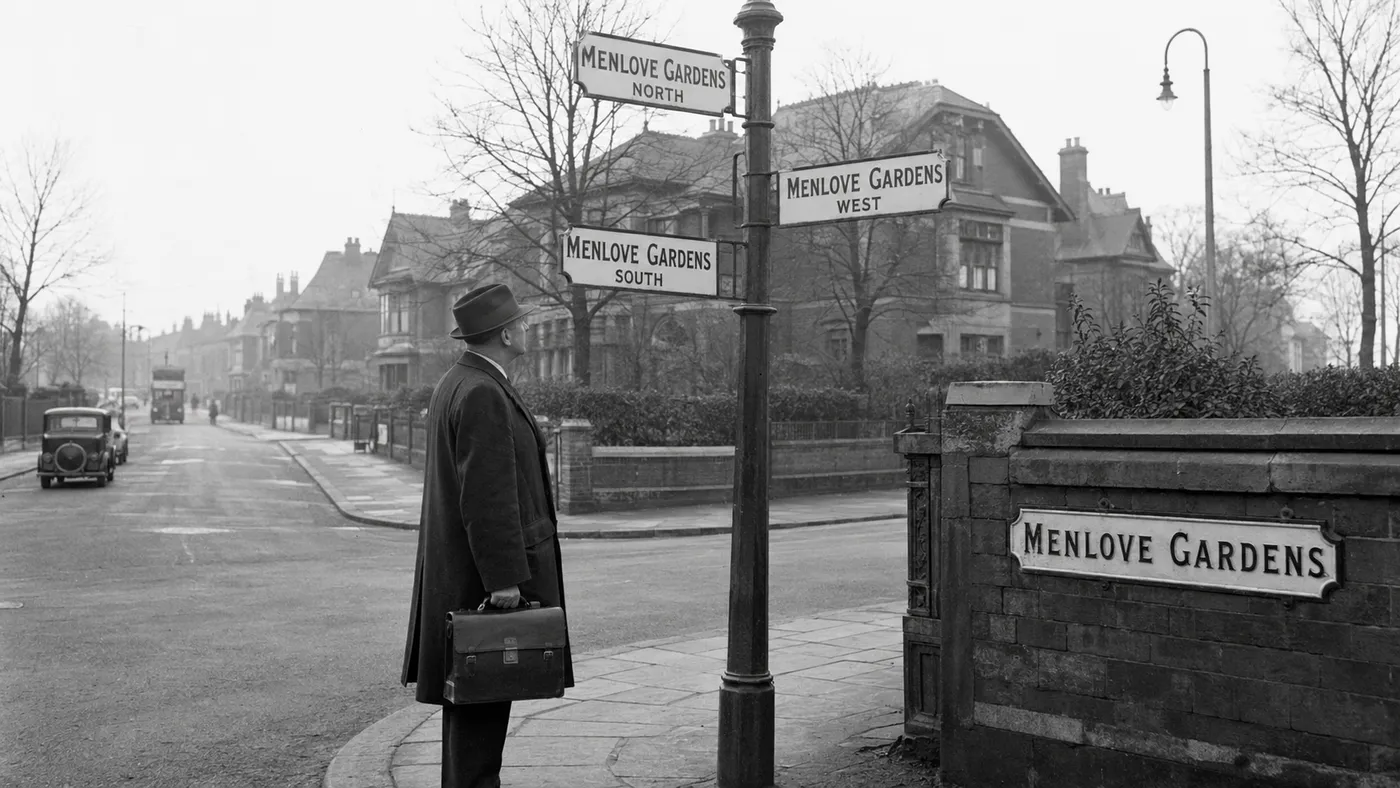
Wallace reached the Menlove Gardens area and began asking.
He asked people in the street. He asked a police constable. He went into a newsagent and checked a directory, looking not only for the road but for anyone named Qualtrough living nearby. He found neither.
One resident, Sidney Hubert Green, remembered Wallace asking him where Menlove Gardens East was. Green told him there was no such place. Another local gave the same answer.
He kept asking after he had been told. To the defence, that was a man doing whatever it took to find an address a customer had given him. To the prosecution, it was a man making sure he was seen and remembered, several miles from Wolverton Street, at exactly the time it mattered.
Nothing in the record settles which it was.
The locked door
Wallace got back to Wolverton Street at about 8.45pm.
He tried the front door. It would not open. He went round to the back. That would not open either.
As he stood at the back, his next-door neighbours, John and Florence Johnston, came out of their own house on their way somewhere. Wallace told them he could not get in. With the Johnstons standing there, he tried the back door once more.
This time it opened.
Julia was in the front room. She had been beaten about the head and was dead. No weapon was ever found that could be tied to the attack.
The trouble with the doors became part of the case. The prosecution said Wallace had faked it, to plant the idea that an intruder had been inside and shut the place up behind him. The judge would later tell the jury they had to decide for themselves whether the locks were genuinely stiff or the difficulty was an act.
Fifteen minutes
The case turned on a gap of about a quarter of an hour.
Alan Close had said 6.30pm. Under cross-examination he accepted that soon after the murder he had put it more loosely, between 6.30 and 6.45. Other boys who had been out on the street that evening remembered him saying nearer a quarter to seven.
Ten or fifteen minutes sounds trivial. In this case it was the whole argument.
Police walked and timed Wallace's route more than once. In one reconstruction, officers left 29 Wolverton Street at 6.45pm and reached a key tram stop at Smithdown Lane at about 7.03pm. If Julia was still alive close to 6.45, the time left for Wallace to kill her, deal with the blood, hide the weapon and still catch that tram was very short. If she had died earlier, the prosecution had room to work in.
The one witness who could fix the time had given it three slightly different ways.
Police turn towards Wallace
At first the evidence at the house did not point clearly at anyone.
There was no sign of a break-in. The doors and windows were not forced, which meant Julia had most likely let her killer in: someone she knew, or someone with a good enough reason to be on the step. A Prudential cash box had been gone through and Wallace put the loss at about £4, but around £5 in the house had been left where it was. As a robbery it did not quite hang together.
Wallace's own mackintosh was found beneath Julia's body, singed by the small fire in the grate. The prosecution said it could have been worn to keep the killer's clothes clean. The defence said Julia might have had it round her shoulders against the cold. Neither was ever proved.
And when officers examined Wallace shortly after the body was found, they reported no blood on his clothing, his boots or his hands. One told the court he had looked carefully and seen "no trace whatsoever".
Then the police established where Monday's phone call had come from.
The operator's records traced it to a public call box, Anfield 1627, at the junction of Rochester Road and Breck Road. A Liverpool Corporation surveyor measured the distance from that box to 29 Wolverton Street at about 400 yards.
The call that sent Wallace across the city had been made from the end of his own road.
It still cut both ways. If Wallace made the call himself, a box round the corner is exactly where he would have used. If someone else wanted him out of the house the next evening, a box in his neighbourhood also made sense, and let the caller watch for him. Nobody saw who was in the box. Nobody identified the voice.
Inside St George's Hall
Wallace was charged in February. His trial opened at the Liverpool Assizes at St George's Hall on 22 April 1931.
The prosecution laid out a single explanation that tied the odd evening together. Wallace had telephoned his own chess club as "Qualtrough". He had chosen a street that did not exist so that hunting for it would fill his evening and leave a trail of witnesses. He had killed Julia before he left, crossed Liverpool asking strangers for directions, come home and staged the discovery at the back door.
It was a tidy theory. It had one hole.
There was no direct evidence that Wallace had made the call. The whole account rested on the caller and Wallace being the same man, and nothing put him in that box or on that line.
The case was entirely circumstantial, and the judge told the jury that suspicion was not enough. They retired early on the afternoon of 25 April and came back within the hour.
Guilty. The sentence for murder was death, and it was passed.
Then the case changes again
Wallace appealed. Less than a month after the verdict, the Court of Criminal Appeal in London heard the case and quashed the conviction.
The court said the evidence was open to more than one explanation and that nothing proved Wallace was the caller. Its ruling drew a line that mattered well beyond this case: a jury's suspicion, however strong, and a prosecution theory, however clever, were not the same thing as proof. The verdict, the judges found, could not be supported by the evidence.
It was the first time an English murder conviction had been overturned on that ground. Wallace walked out. He was never retried, and no one else was ever charged.
The ruling did not name a killer and it did not declare Wallace innocent as a matter of history. It said something narrower: what the jury had been given was not enough to hang a man on.
Who was Qualtrough?
That is still the question at the centre of the case. If Wallace made the call, most of the prosecution theory falls into place. If he did not, someone knew enough about him to build an unusually precise trap and get him out of his house on a chosen evening.
The name later writers keep returning to is Richard Gordon Parry. He was younger than Wallace, a former Prudential man who knew both Wallaces, had covered part of Wallace's collecting round, and knew he spent Monday evenings at the City Café. Police questioned Parry in January 1931. He gave an account of his movements for that evening and told officers they were free to check it.
Decades later, the journalist Roger Wilkes gathered fresh claims: that Parry had called at a garage on the night of the murder and cleaned his car, and that a mechanic had noticed a glove soaked in blood. Those accounts are striking. They are also later testimony, not evidence tested at the time. Parry was never charged with anything and died in 1980. Accounts that simply name him as the killer go past what the record will carry.
What Liverpool still cannot answer
Who made the Qualtrough call. Why the caller picked Menlove Gardens. How they knew to reach Wallace through a chess club on a Monday. What the missing few pounds were really about. Exactly when Julia died. And whether the whole thing, the false name and the false street, was built to manufacture an alibi.
None of it has ever been settled.
You can still walk the case. 29 Wolverton Street stands, a terraced house in the L6 part of Anfield near Richmond Park. It is a private home and nothing marks it. Out towards Mossley Hill, the junction off Menlove Avenue still has a Menlove Gardens North, South and West, all in L18. It still has no East. The City Café is long gone from North John Street, and the chess club with it.
Whoever chose that address did not invent something absurd. They took a real Liverpool place and changed one word, and it was plausible enough to send a man across the city for an evening.
The address was invented. The uncertainty is real.
Research note
This account is drawn mainly from the surviving 1931 trial transcript, the reported Court of Criminal Appeal judgment in R v Wallace (23 Cr App R 32), and contemporary police and witness statements held in archive form. The trial was before Mr Justice Wright, with Edward Hemmerde KC prosecuting and Roland Oliver KC for the defence; the appeal was heard on 18 and 19 May 1931 before the Lord Chief Justice, Lord Hewart, whose judgment includes the often-quoted line that the court would "quash a conviction founded on mere suspicion". Sources disagree on some details, including exact timings and Julia Wallace's recorded age, and those points are not presented here as settled. The two period scenes above are L1 Local illustrations of documented events, not photographs.

Related links and FAQs
Useful links and sources
- R v Wallace, the Court of Criminal Appeal judgment (23 Cr App R 32)
- William Herbert Wallace, case overview and sources
- The Julia Wallace Murder Foundation, which hosts the full trial transcript and archive statements
- Liverpool mysteries: the tunnels, legends and strange stories that still cling to the city
- History of Liverpool: from 1207 to the modern city
Common questions
Was William Herbert Wallace guilty of murdering his wife?
A Liverpool jury convicted him in April 1931, but the Court of Criminal Appeal quashed the conviction a month later because the evidence was entirely circumstantial and did not prove the case to the required standard. He was not retried and nobody else was ever convicted. The historical record does not settle whether he did it.
Does 29 Wolverton Street still exist?
Yes. It is a terraced house in the L6 part of Anfield, near Richmond Park and Breck Road, and it is a private home. It is not a memorial or a visitor site and should be treated as somebody's house.
Is there a Menlove Gardens East in Liverpool?
No, and there never has been. The junction off Menlove Avenue near Mossley Hill has a Menlove Gardens North, South and West, all in L18. The address the caller gave, 25 Menlove Gardens East, was invented.
Comments
Join the conversation with your L1Local Community account. Keep it civil and on topic.