North Liverpool is the part of the city that runs from the edge of the centre up along the river and out towards the Sefton boundary. It covers Vauxhall, Kirkdale, Everton, Anfield, Walton, Fazakerley and Orrell Park, and the docks that sit alongside them.
It is the part of Liverpool most often written about through football, and 2025 changed that story more than any headline has in decades. Everton left Goodison Park after 133 years. What replaced the expected demolition is not what most people assume.

Where north Liverpool actually is
There is no legal boundary called north Liverpool, which is why the answer changes depending on who you ask. The most useful definition is the council's own, because it decides how services are organised.
Liverpool City Council splits the city into 13 neighbourhood areas. Three of them make up what most people mean by north Liverpool:
- North Docks: Waterfront North, Kirkdale West, Kirkdale East, County and Vauxhall.
- Stanley Park: Anfield, Everton North, Everton East and Everton West.
- Longmoor: Orrell Park, Fazakerley North, Fazakerley East, Fazakerley West and Walton.
Postcodes run roughly L3 and L5 nearest the centre, L4 through Anfield and Walton, L9 towards Orrell Park and Aintree, and L11 out at Norris Green and Croxteth. Bootle is often lumped in with north Liverpool in conversation, but it sits in the Borough of Sefton and has its own council.
If you are trying to place somewhere on a map, the river is the simplest anchor. North Liverpool follows the docks north from the city centre, then spreads inland up the hill through Everton and Anfield.
The football question, and what actually changed
Two grounds sit less than a mile apart here, on either side of Stanley Park. For 133 years both were in use every other week. That ended in 2025.
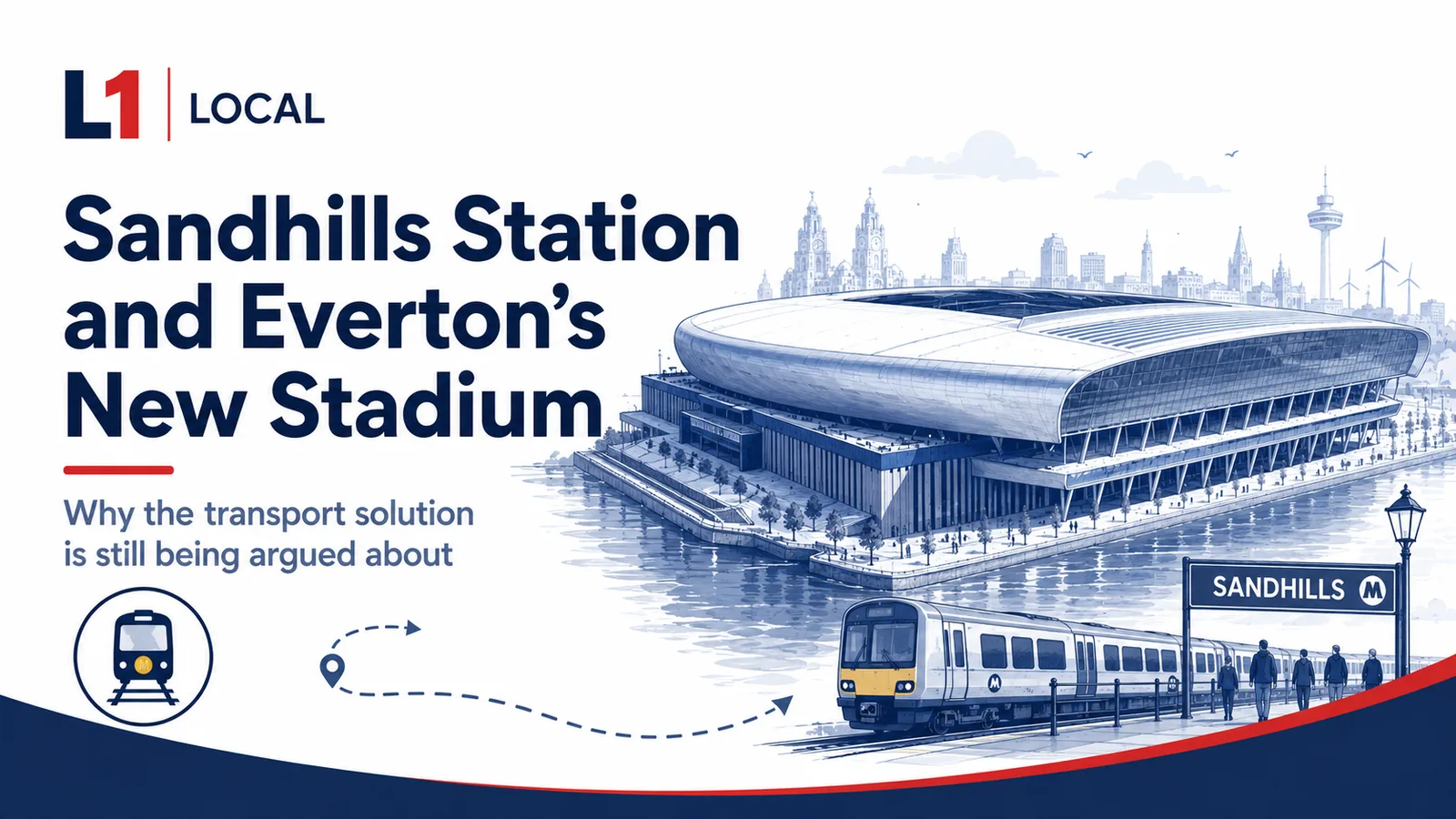
Everton moved out. The men's team left Goodison Park in Walton at the end of the 2024/25 season for a new 52,888-seat stadium at Bramley-Moore Dock, on the north docks. It carries naming rights as the Hill Dickinson Stadium. The move is only about two miles, but it shifts matchday footfall off the Walton and Anfield streets and onto the dock road.
Goodison Park was not demolished. This is the part most people get wrong. The original plan was to clear the ground for housing, offices and a care home. After The Friedkin Group took over the club, that plan was reviewed and dropped. In May 2025 Everton confirmed Goodison would be retained as the permanent home of Everton Women, who played their first match there in September 2025 after moving from Walton Hall Park.
So Goodison is still standing and still hosting football, at Women's Super League scale rather than Premier League scale. If you read an article written before mid-2025 saying the ground is coming down, it is out of date.
Anfield stayed and grew. Liverpool's ground now holds 61,276 after the Anfield Road Stand expansion, which received its safety certificate in April 2025. That makes it the fourth largest stadium in the Premier League. The club has said there are no plans to expand beyond that.
The practical read for anyone living nearby: Anfield matchday pressure is unchanged and slightly heavier, while Walton has swapped 39,000 people every other Saturday for a much smaller women's fixture crowd.
Stanley Park sits between the two

Stanley Park is the green space between Anfield and Goodison, and it is worth knowing about for reasons that have nothing to do with football. It has a lake, a boathouse, terraces and a restored Gladstone Conservatory.
On a non-matchday it is an ordinary park used by people who live around it. On a matchday it becomes a walking route and a car park, which is the single most useful thing to know if you are trying to cross the area at 2pm on a Saturday.
Everton Park, further towards town, is the other one worth the climb. It sits on the ridge above the city and gives you the view in the photograph at the top of this page. There is no charge and no gate, and on a clear day it beats most paid viewpoints in Liverpool.
Getting around
North Liverpool is better served by rail than most people expect, because the Merseyrail Northern Line runs straight through it.
Stations, heading out from the centre: Sandhills, Bank Hall, Kirkdale, then the line splits towards Walton, Rice Lane, Orrell Park, Aintree and Fazakerley.
The gap in the network is the one that matters most. Anfield has no station. Sandhills is the usual matchday railhead, with shuttle buses running from there to the ground, and Kirkdale is the nearest stop for the Walton end. Neither is a short walk. Anyone telling you Anfield is easy to reach by train is skipping a step.
Buses carry a lot of ordinary movement here, particularly along Scotland Road, County Road, Walton Road and Queens Drive. Check the Merseytravel timetables rather than trusting a route number from an old guide, because services through this part of the city have changed repeatedly.
Driving is straightforward outside matchdays and difficult on them. Residents' parking schemes operate around both grounds, and the restrictions are enforced.
Everyday north Liverpool
Away from the stadiums, this is mostly a residential part of the city with working high streets rather than destination ones.
County Road in Walton and Walton Vale further north are the main shopping strips, running on bakeries, barbers, takeaways, convenience stores, charity shops and long-standing family businesses. Great Homer Street market and the retail park around it serve Everton and Kirkdale. These are places people use weekly, not places anyone visits for a day out, and writing about them as if they were a food scene misses what they are for.
The area also carries some of the sharpest housing and regeneration questions in Liverpool. Vacant land around the north docks, long-running estate renewal in Anfield and Everton, and the redevelopment pressure that follows a new stadium all land here first.
What north Liverpool is good for
- A match, obviously, at either ground, with the transport caveats above.
- The view from Everton Park or Everton Brow, which is free and better than it has any right to be.
- Stanley Park on a day when nobody is playing.
- Aintree, for the Grand National meeting in April, with its own station on the line.
What it is not good for is a wandering afternoon with no plan. The distances between the interesting bits are real, the walking routes are not always pleasant, and the area rewards knowing where you are going before you set off.
Nearby areas
North Liverpool meets the city centre around Vauxhall and the top of Scotland Road, and the waterfront along the dock road. Kirkdale and Anfield have their own pages with more detail. Inland it runs towards Croxteth and West Derby, and north into Sefton at Bootle and Aintree.