On Hornby Road in Walton stands a building Liverpool has never quite left behind.
Its official name is HMP Liverpool.
To generations of local people, it has simply been Walton Jail.
The name belongs to another age. So does much of the place itself.
The original prison was built between 1848 and 1855, when Queen Victoria was on the throne and Liverpool was expanding at extraordinary speed. It was designed around nineteenth-century ideas about discipline, isolation and reform.
Within weeks of opening, parts of it were already overcrowded.
Over the next 170 years, Walton would hold men and women, suffragettes and hunger strikers, condemned prisoners and people awaiting trial. A German bomb would tear into one of its wings. Dozens of people would be executed behind its walls. One of those men would eventually have his conviction overturned 53 years after he had been hanged.
Walton would also become the site of one of Britain's final two judicial executions.
Yet this is not a ruined Victorian prison preserved as a museum.
In 2026, HMP Liverpool was still holding around 800 adult men. Inspectors were still reporting on the difficulty of running a modern prison inside buildings whose origins reach back to the middle of the nineteenth century.
That is what makes Walton different.
Its past is not sitting behind glass.
People are still living inside it.
Walton Jail timeline
1848 to 1855 The original Liverpool prison complex is constructed on Hornby Road.
1855 Liverpool Borough Prison opens at Walton with around 1,000 cells.
October 1855 The women's section is already overcrowded, only weeks after opening.
14 March 1887 Elizabeth Berry becomes the first person executed at Walton.
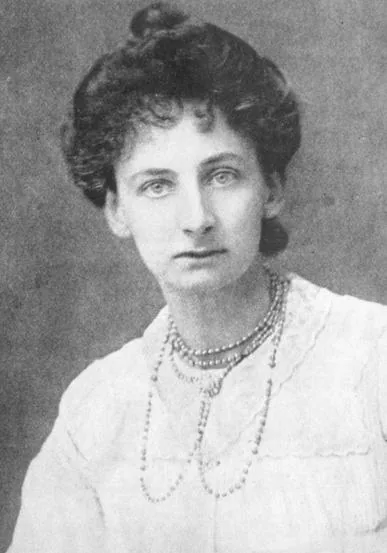
January 1910 Suffragette Lady Constance Lytton enters Walton under the name Jane Warton and is forcibly fed eight times.
4 February 1939 Accounts of the IRA's S-Plan campaign record an unsuccessful attempt to breach the prison wall with an explosive device.
18 September 1940 A German high-explosive bomb hits Walton Gaol. Twenty-two prisoners are killed.
19 March 1949 Leonard Thomas and John Catterall are murdered at the Cameo Cinema in Wavertree.
28 March 1950 George Kelly is executed at Walton for the Cameo murders.
13 August 1964 Peter Allen is executed at Walton while Gwynne Owen Evans is executed at Strangeways in Manchester. They prove to be the final two people judicially executed in Britain.
2003 The Court of Appeal quashes George Kelly's murder conviction.
2006 Kelly's remains are exhumed from the prison grounds for reburial.
2023 Artwork and writing produced by HMP Liverpool prisoners goes on display at the Museum of Liverpool.
2025 Inspectors report serious problems involving drugs, drones, living conditions and lack of purposeful activity.
May 2026 Inspectors return and find progress in some areas, but significant problems remain.
July 2026 The Ministry of Justice reports that 429 cells across three wings have been fully refurbished.
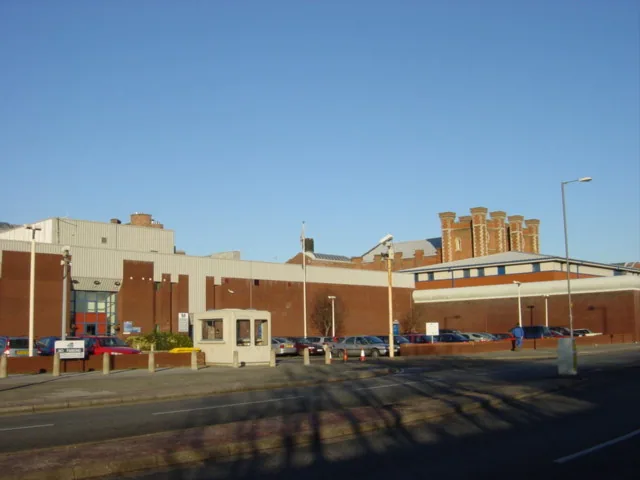
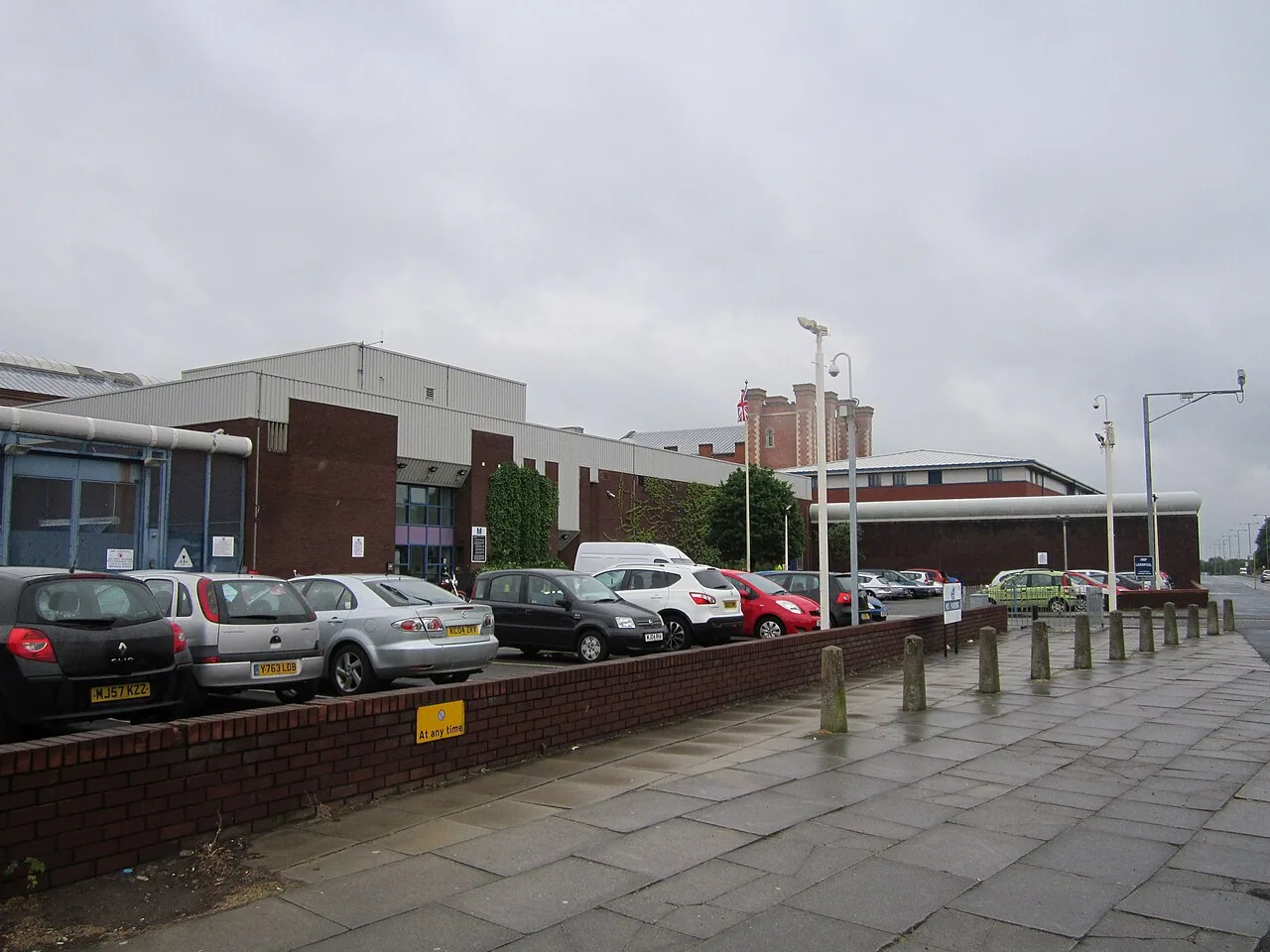
Walton Prison on Hornby Road. Photo: Ian Capper, CC BY-SA 2.0, via Wikimedia Commons.Lady Constance Lytton in 1908. Public domain, via Wikimedia Commons.Walton Prison in Liverpool. Photo: Ian Capper, CC BY-SA 3.0, via Wikimedia Commons.
A prison for Victorian Liverpool
Liverpool in the 1850s was growing at extraordinary speed.
The docks connected the city with trade across the world. Railway lines were spreading. Entire neighbourhoods were being built. Huge numbers of people had arrived in Liverpool during and after the Irish Famine.
The city's prisons had to deal with the consequences of that growth.
Liverpool Borough Prison opened at Walton in 1855.
The surviving chapel and administration block was built between 1848 and 1855 and is attributed by Historic England to John Weightman, Liverpool's borough surveyor.
The Grade II-listed building remains one of the most recognisable parts of the prison today.
The prison was designed around what became known as the separate system.
The theory was simple, even if the reality was not.
Prisoners would spend long periods isolated from one another. The architecture itself would help enforce discipline. Cells were arranged along multi-storey corridors, while male and female sections were kept apart.
Research into the history of Liverpool Borough Prison shows that it contained around 1,000 cells and was one of the largest local prisons in England built around this system.
Its governor, William Jameson, described Liverpool as:
"the largest in England, if not in Europe on the separate system"
He also claimed it was:
"the only prison in the world where the females exceed the males"
Those were Jameson's claims rather than independently established global rankings, but they tell us something about the extraordinary scale and unusual population of the new prison.
And almost immediately, the system started running into trouble.
Overcrowded almost from the beginning
The prison had barely opened before its principle of keeping people apart became difficult to maintain.
In October 1855, only around a month after the prison opened, the women's section had 407 cells.
There were already between 416 and 429 female prisoners.
Some women had to sleep together in cells or in the prison hospital.
By May 1857, straw beds were being issued so prisoners could double up.
By 1863, overcrowding had become so serious that cells intended for one person were sometimes being used for three men or two women.
The figures come from historical research into nineteenth-century Liverpool imprisonment.
This is one of the more revealing pieces of Walton's history.
The prison had been specifically designed to isolate people from each other.
Within weeks, there were too many people inside to make the system work properly.
The reasons tell their own story about Victorian Liverpool.
Historical research shows that many women repeatedly returned to Walton for offences including drunkenness, vagrancy and prostitution. Most received relatively short sentences.
One prison chaplain recorded a day on which 41 women arrived whose previous convictions, added together, totalled 467.
Behind the statistics was a city dealing with poverty, insecure work, alcohol, homelessness and a criminal justice system which repeatedly imprisoned people for behaviour closely connected with those conditions.
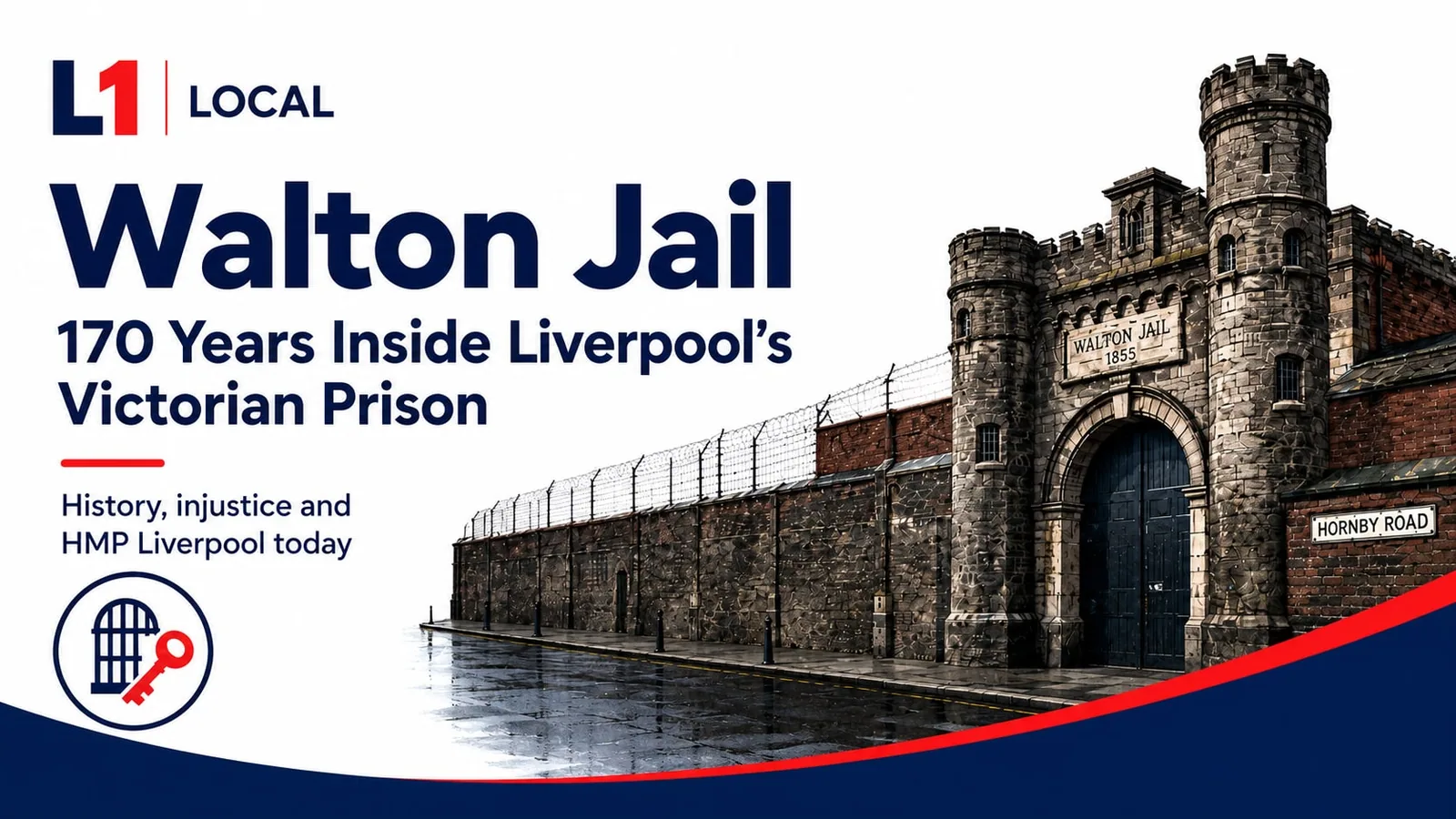
The gate on Hornby Road
One part of Victorian Walton remains particularly visible today.
The chapel and administration block facing Hornby Road dates from the original construction.
Historic England's official listing describes a four-storey brick and stone building with four square turrets, Romanesque detailing, round-headed windows and a central arched entrance.
It has been Grade II listed since 1975.
Generations of prisoners, officers, lawyers and families have passed through or alongside it.
Victorian Liverpool has disappeared from most of the streets surrounding Walton.
The prison entrance remains.
The gallows arrive at Walton
In 1887, another part of Walton's history began.
Executions.
Public executions in Britain had ended in 1868. From then on, executions were moved behind prison walls.
Walton became one of the places where they were carried out.
Specialist execution records list 62 judicial executions at Walton between 1887 and 1964, involving 60 men and two women.
On 14 March 1887, 31-year-old Elizabeth Berry was executed at Walton for murdering her 11-year-old daughter.
The executioner was James Berry.
Despite the identical surname, they were not related.
Specialist execution histories record an even stranger coincidence: the two had apparently met before and danced together at a police ball in Manchester.
That detail comes from specialist capital-punishment research rather than an official prison record, so it should be treated as an attributed historical account rather than established government fact.
Lytton continued to argue that her experience showed poorer suffragettes could receive harsher treatment than women whose social status was known to the authorities.
She later wrote about her experiences in *Prisons and Prisoners*.
More than a century later, the episode remains one of Walton's most important connections to the women's suffrage movement.
It also gives the prison an unusual place in the history of class.
Lytton deliberately gave up the protection of her own name to discover what happened when nobody important appeared to be watching.
Hunger strikes returned during the First World War
Lytton was not Walton's final political hunger striker.
Parliamentary records show that by 25 July 1918, 17 men were hunger-striking inside Liverpool Prison.
The circumstances were different from the suffragette struggle, but the record shows how hunger strikes and force-feeding remained part of prison life at Walton years after Lytton's imprisonment.
An IRA attempt on the prison wall
There is another episode in Walton's story which is much less well remembered.
During the IRA's S-Plan bombing campaign in Britain in 1939, accounts of the campaign record an attempt to blast through Walton's prison wall.
On 4 February 1939, an explosive device was placed against the prison.
The attempt failed to create the intended breach.
The surviving evidence for this episode is less complete than the documentation surrounding the bombing of the prison the following year, so it is best treated as part of the recorded history of the S-Plan rather than given the same evidential weight as the Blitz attack.
It creates a remarkable sequence in the prison's history.
An attempt to bomb through the wall failed in 1939.
In 1940, another bomb did get through.
This time it fell from the sky.
The night a German bomb hit Walton Gaol
18 September 1940
Liverpool's importance as a port made it a major German target during the Second World War.
On the night of Wednesday 18 September 1940, the air raid reached Walton.
At about 10.20pm, a high-explosive bomb scored a direct hit on the prison.
Part of the gaol was destroyed.
Inside were men who could not simply leave the building.
Their cells were locked.
Police officers and prison warders began trying to reach people trapped beneath the wreckage.
One of the prosecution's important witnesses had told police that Kelly had admitted involvement in the murders.
But that witness had previously made another statement.
In that earlier version, he said a completely different man had admitted the offence.
The earlier statement had not been disclosed to Kelly's defence team or to the court.
The CCRC concluded that the evidence seriously affected the witness's credibility.
Kelly's conviction was referred back to the Court of Appeal.
In June 2003, his murder conviction was quashed.
Charles Connolly's robbery and conspiracy convictions were also quashed after the CCRC concluded that the same non-disclosure had undermined the basis of his guilty pleas.
No one now stands convicted of the Cameo Cinema murders.
Kelly had been dead for 53 years.
The court could overturn the conviction.
It could not undo an execution carried out in 1950.
George Kelly finally leaves Walton
There is a final chapter to Kelly's story.
People executed inside British prisons were normally buried within the prison grounds.
Kelly's body remained at Walton long after his conviction had been quashed.
Eventually, arrangements were made to exhume his remains so that he could be reburied.
Then came another unsettling detail.
A Parliamentary answer in 2008 confirmed that the area containing the graves of executed prisoners at Walton had for many years been used as a car parking area.
The surface consisted of brick paving and sand which could be removed when an exhumation was necessary.
The same Parliamentary answer detailed payments associated with Kelly's exhumation and reburial.
More than half a century after Walton had executed George Kelly, his remains finally left the prison too.
The last execution at Walton
13 August 1964
Fourteen years after Kelly's execution, another condemned prisoner waited at Walton.
His name was Peter Anthony Allen.
Allen and Gwynne Owen Evans had been convicted of murdering John Alan West during a robbery.
Both received death sentences.
They were sent to different prisons.
Allen was held at Walton.
Evans was held at Strangeways in Manchester.
At 8am on 13 August 1964, the two men were executed simultaneously.
They proved to be the final two judicial executions carried out in Britain.
Walton's gallows were never used again.
The death penalty for murder was suspended by the Murder (Abolition of Death Penalty) Act 1965 and the abolition was made permanent in 1969.
Capital punishment technically remained available for a small number of other offences for longer, with its final remnants removed from British law in 1998.
Walton's history as a place of execution was over.
The prison itself carried on.
A Victorian prison reaches the twenty-first century
This is where Walton's story becomes unusual.
Many nineteenth-century prisons have closed, disappeared or been converted to other uses.
Liverpool kept using its Victorian prison.
Researchers studying the survival of Victorian prison buildings noted in 2023 that Liverpool was one of 32 Victorian prisons still operating in England and Wales at that point.
Some cells which should have been taken out of use were still housing prisoners.
The prison subsequently improved.
But the episode exposed a problem which remains central to Walton's modern story.
How long can buildings created for Victorian imprisonment continue to serve a completely different prison system?
Prisoners turn Walton's history into art
In 2023, the people living inside Walton were given an unusual opportunity to respond directly to that question.
Researchers from the Universities of Birmingham and Bath worked with prisoners and staff as part of a project called The Persistence of the Victorian Prison.
Prisoners produced artwork and poetry about living inside HMP Liverpool.
Their work was displayed at the Museum of Liverpool alongside photography and research into the prison's history.
The positive mandatory drug-testing rate had fallen from 46% to 35%.
But 35% was still the third-highest rate among reception prisons.
Reported drone sightings had also fallen.
Inspectors noted better work with law-enforcement agencies and continuing attempts to make the prison more difficult to target.
This is a security problem no Victorian prison architect could possibly have anticipated.
Buildings designed before powered flight existed are now being defended against remotely controlled aircraft capable of carrying contraband towards cell windows.
Changing patterns of drug use
The modern drug problem inside Walton is also changing.
During the 2026 review, inspectors found that the prison had responded to the appearance of ketamine in random drug tests by bringing in specific support for prisoners using the drug.
The broader picture remained difficult, but it shows how quickly the problems facing a modern prison can change.
Victorian architecture may be fixed.
The risks inside it are not.
Two hours outside a cell
One of the strongest criticisms in 2026 concerned what prisoners were actually doing with their day.
Around 200 prisoners were unemployed.
Inspectors found that unemployed men on the older accommodation could receive only around two hours outside their cells each day, plus time needed to collect meals.
Ofsted found insufficient progress across all four areas it reviewed relating to education, skills and work.
It would be easy to tell Walton's history almost entirely through its darkest episodes.
The gallows.
The Cameo case.
The Blitz.
Victorian punishment.
Those events deserve to be remembered.
But they are not the whole story.
Walton also tells us something about Liverpool itself.
A prison built to enforce solitary confinement was overcrowded almost as soon as it opened.
Its unusually large female population reflected poverty and repeated short sentences for offences closely connected with the social conditions of Victorian Liverpool.
A suffragette entered under a false name to test whether class changed the treatment she received.
Prisoners died there during the Blitz because there was nowhere for them to run.
A man was executed there following a conviction eventually declared unsafe.
His body remained inside the prison long enough for the land above the burial area to become a car park.
One of Britain's final executions then took place behind the same walls.
Decades later, prisoners living inside the surviving Victorian complex produced art about what it felt like to inhabit that history.
And now the prison is dealing with drones, changing drug markets, mental health pressures, modern security systems and the enormous task of refurbishing nineteenth-century buildings while hundreds of men remain inside.
The past has not disappeared.
It has simply acquired new plumbing, new windows, cameras, electronic locks and drone defences.
The prison Liverpool never stopped using
Imagine someone entering Walton in 1855.
Outside was a Liverpool of horses, sail and steam, overcrowded courts, expanding docks and streets still being built.
The prison itself represented the latest thinking in punishment.
Within weeks, reality had already overtaken the design.
There were too many prisoners.
More than 170 years later, Liverpool has changed almost beyond recognition.
The docks work differently.
Neighbourhoods have spread for miles.
Women can vote.
Public executions are history.
The death penalty is gone.
The Cameo conviction has been overturned.
The bombs stopped falling generations ago.
But the prison is still there.
Around 800 men were being held there when inspectors returned in 2026.
Some were living in newly refurbished accommodation.
Others were still on ageing wings where inspectors found conditions below the standard they expected.
And that may be the most important thing to understand about Walton Jail.
Liverpool did not preserve its Victorian prison as a museum.
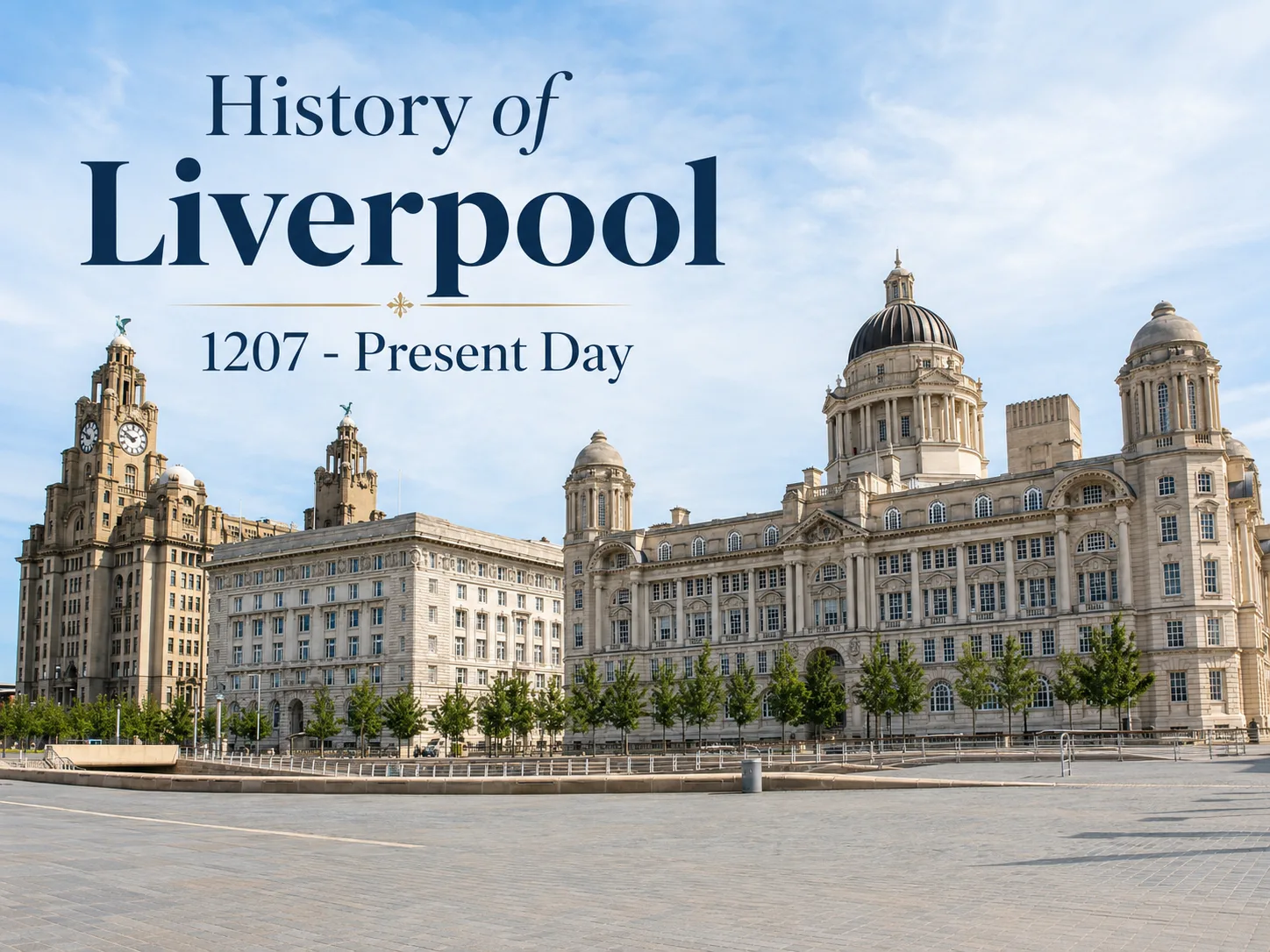
Liverpool from its 1207 charter through the docks, the slave trade, Irish migration, the Blitz, decline and regeneration, and how each period shaped the city.
Comments
Join the conversation with your L1Local Community account. Keep it civil and on topic.