Liverpool residents have until midnight tonight, Wednesday 30 September, to submit formal comments on the city's proposed Local Plan to 2043. The document will influence where thousands of homes and workplaces can be built, but it also contains policies that could affect HMOs, short-term lets, takeaways, parking, trees and open spaces on individual Liverpool streets.
Liverpool's final formal Local Plan consultation before government examination closes at midnight tonight.
It sounds like one of the more remote parts of local government: a 400-page planning document, policies maps, evidence papers and something called a "Regulation 19 consultation".
But buried inside it are rules that could eventually influence whether another HMO is approved on a residential street, where new takeaways can open, how much affordable housing larger developments provide, whether city-centre schemes include parking and how trees and open space are treated when land is developed.
The consultation began on 10 August and closes at midnight on Wednesday 30 September. Liverpool City Council says this is the final formal public consultation before it submits the plan to the government for independent examination.
This is not a vote on whether Liverpool should adopt the plan. At this stage, formally known as Regulation 19, people are being asked whether the proposed plan is legally compliant and "sound".
A Local Plan is effectively the main planning rulebook for a council area.
It does not give automatic planning permission to every development shown on a map. Instead, it sets the policies against which future planning applications are assessed, identifies land for particular uses and shows areas where special policies apply.
Liverpool's proposed plan includes policies covering housing, employment land, shops, transport, open space, heritage, climate change, community facilities and the design of new development. It also contains allocations for individual housing, employment and mixed-use sites across the city.
Liverpool already has an adopted Local Plan, covering 2013 to 2033. That existing plan remains in force while the new one goes through examination. The 2043 plan would replace it only if it completes that process and is formally adopted by the council. (Current adopted Local Plan)
That makes an important difference when looking at sites near your home.
A site appearing in the Local Plan is not the same thing as a planning application. A planning application is not the same thing as permission. And permission does not necessarily mean construction will happen immediately.
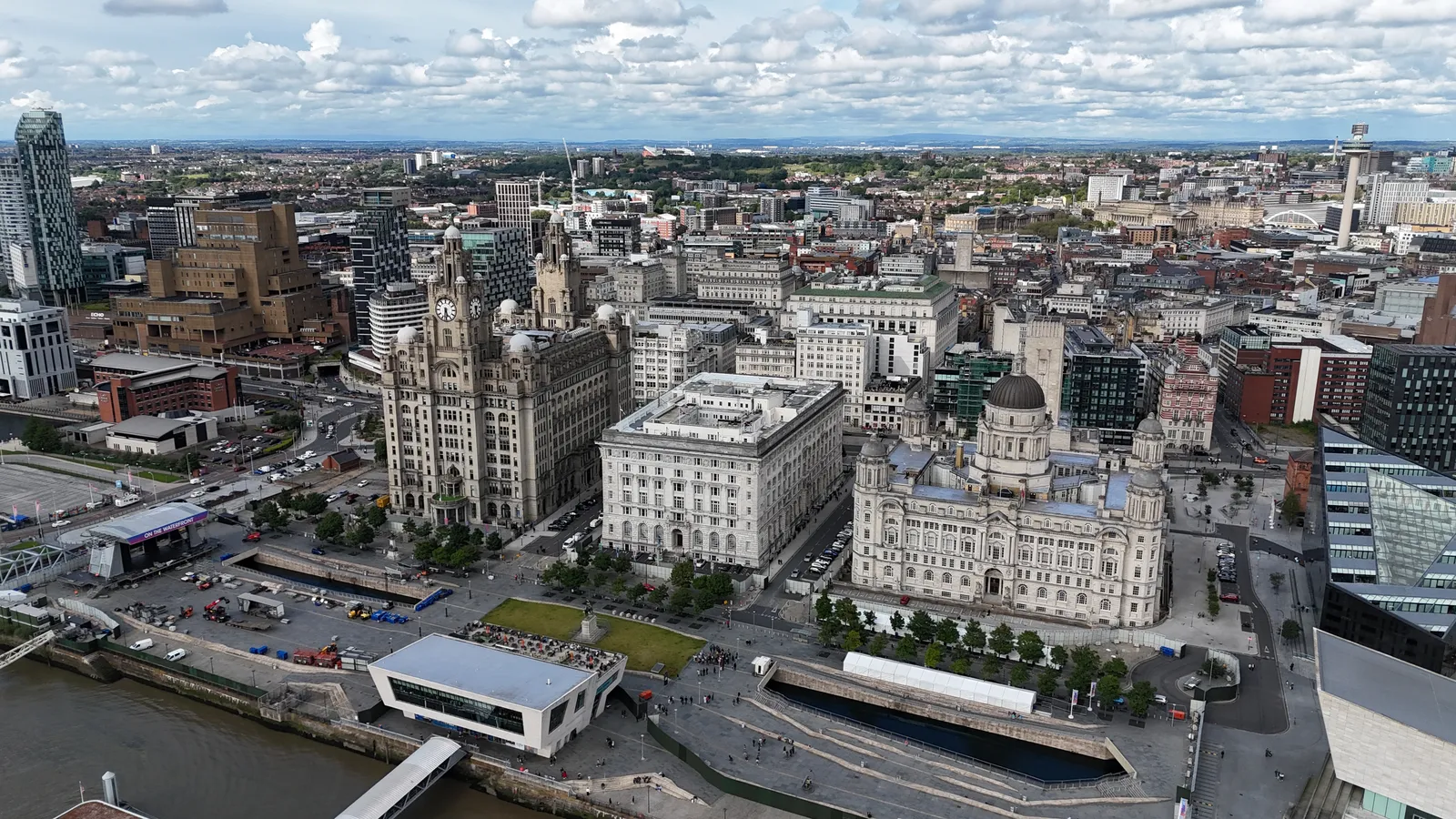
Liverpool's proposed Local Plan would guide development across the city through 2043. Photo: 瑞丽江的河水, CC BY-SA 4.0, via Wikimedia Commons. Cropped and resized.
The plan now provides for at least 33,750 homes
One of the biggest numbers in the new document is the housing requirement.
The Regulation 19 plan proposes a minimum of 33,750 net additional homes by 2043, equivalent to at least 1,875 homes a year. It also provides for a minimum of 543,400 square metres of employment floorspace, including industrial, office and research and development space.
There is a small but relevant change from what people may have read earlier this summer.
Liverpool City Council's 20 July announcement said the plan would provide for a minimum of 33,552 homes, which our guide to where the new homes could go used before it was updated. The Regulation 19 document subsequently published for consultation says 33,750. L1Local is using the figure contained in the formal consultation plan.
Neither number means the council intends to construct that many council houses itself.
The plan establishes how much housing Liverpool is planning for and provides the land and policy framework needed to accommodate it. Individual schemes can still depend on land ownership, planning permission, infrastructure, funding and developers actually building them.
What it could mean on an individual Liverpool street
The citywide housing number is only part of the story.
Some of the policies further into the plan could have a much more immediate effect when future planning applications are submitted in existing neighbourhoods.
New limits on concentrations of HMOs
For Houses in Multiple Occupation, or HMOs, the proposed policy says that where planning permission is required to convert a house into an HMO, permission would not be granted if it pushed the concentration above 10% of all dwellings within a 100-metre radius of the application property.
The policy would also seek to prevent a continuous frontage of three or more HMOs and prevent a non-HMO home being "sandwiched" between HMOs. Separate restrictions are proposed within the Canning Georgian Quarter.
That means the pattern of properties already in use as HMOs close to an application could become directly relevant to whether another conversion is approved. For the tenant's side of the picture, see our guide to renting in Liverpool after the 2026 rule changes.
Short-term lets could also face local concentration tests
The plan contains a separate policy for short-term let accommodation.
For proposals requiring planning permission, the council says it would not support a conversion in an area where 10% or more properties within 100 metres are already HMOs. It would also consider whether short-term lets were becoming over-concentrated and whether a proposal would harm residential amenity or the balance of the community.
Proposals would be expected to include a management plan covering matters such as maximum occupancy, the property manager's contact details and waste arrangements.
The planning position of an individual short-term let can depend on the particular use and whether a material change of use has occurred, so the Local Plan should not be read as meaning every holiday let automatically requires a new planning application.
Takeaways near schools would face tighter restrictions
The proposed plan would also change the tests applied to new hot-food takeaways outside the city centre.
Within district, local and neighbourhood centres, a proposal should not result in more than 10% of units being hot-food takeaways, more than two adjoining takeaway units, or fewer than two non-takeaway units separating individual takeaways or groups of them.
More strikingly, the policy says planning applications for hot-food takeaways within 400 metres walking distance of a pupil entrance to a school, or within 400 metres of another facility where children and young people congregate, would be refused.
For centres such as County Road, Great Homer Street, Garston, Old Swan, Walton Vale and Allerton Road, the Local Plan therefore deals not only with redevelopment but with the future mix of everyday businesses along the high street. The council has specifically identified those centres in its explanation of the proposed high-street policies.
Larger developments would face a 20% affordable housing policy
Housing developments of ten homes or more would be expected to provide at least 20% affordable housing.
The proposed tenure split is 50% social rent, 25% affordable rent and 25% intermediate or shared-equity housing.
Developers could seek a different level where they argue the requirement makes a scheme unviable, but the policy says they would be expected to provide a viability assessment and development appraisal to support that case. On-site affordable housing is preferred.
Again, this is proposed policy rather than an automatic guarantee that every qualifying development will ultimately contain exactly 20% affordable homes.
Trees would become part of the development calculation
Tree cover gets its own detailed policy.
Residential proposals, and non-residential developments on sites of 500 square metres or more, would be expected to increase Liverpool's tree canopy. The plan says applications should achieve at least 25% projected canopy cover within the site over 50 years.
Where that cannot reasonably be achieved, other green infrastructure or off-site contributions could be required. The policy also says retaining existing trees should be preferred to removing them and planting replacements.
Open space is dealt with separately. The plan says development resulting in the loss of parks, playing fields, allotments, green corridors, recreational routes and other open space would normally be unacceptable unless specified tests are met.
Some city-centre developments could have very little parking
Transport policy could make another visible difference.
The plan says development should prioritise walking, wheeling and cycling over private vehicle use. In the city centre, new developments in locations with high public transport accessibility would have to be designed as car-free or car-light schemes and provide alternative transport options.
City-centre residential schemes would prioritise disabled parking and electric vehicle provision, while new developments more generally would also have to meet proposed cycle-parking and EV-charging standards.
These requirements would not remove cars from existing Liverpool streets. They would influence the design and assessment of future development proposals.
Where Liverpool expects much of the growth
The Local Plan continues to prioritise previously developed, or brownfield, land.
It identifies the North Docks, Ten Streets and Pumpfields and Limekilns as major areas of growth around the northern side of the city centre, alongside regeneration across North Liverpool.
Elsewhere, the plan identifies development opportunities around Speke and Garston, Festival Gardens, Wavertree Technology Park, the former Littlewoods site, the ports and the airport.
It also explicitly says brownfield land should be prioritised across Liverpool, particularly land close to transport hubs.
Festival Gardens is one example of how an allocation can go beyond simply putting houses on a map. The plan describes a 10.79-hectare site, with around 7.97 hectares of remediated development land, intended to accommodate a mixture of homes alongside public space and supporting community and retail facilities.
The exact effect of the plan therefore varies considerably by neighbourhood. For one street it may be an HMO policy. Somewhere else it may be a housing allocation, protection of nearby open space, a change in parking expectations or the redevelopment of a large former industrial site.
Not everyone has argued for the same approach
The earlier Regulation 18 consultation shows some of the competing views behind the document now reaching its final pre-submission stage.
Redrow argued that Liverpool's brownfield-focused strategy restricted opportunities to provide larger family homes and promoted a strategy involving greenfield land and cross-boundary development.
North Liverpool charity Rotunda supported the brownfield emphasis and called for the 20% affordable housing requirement to be retained, alongside tighter HMO controls and greater support for community-led housing.
The Woodland Trust supported the emphasis on green infrastructure but called for the city's biodiversity net gain requirement to be increased to 20%.
Those are representations made by those organisations, rather than findings by the council or independent inspector.
The Regulation 19 plan continues to prioritise brownfield land and includes the 20% affordable housing policy. Its biodiversity policies largely follow the national minimum 10% biodiversity net gain requirement rather than the 20% requested by the Woodland Trust.
How to find out what the plan says about your street
Rather than attempting to read the entire Local Plan, residents can check their address or neighbourhood on the map and then identify any site allocation or designation covering the property or surrounding area.
For a specific site, check whether it is an allocation in the Local Plan, an existing planning permission, a current planning application, or a combination of those things.
Current applications can be checked separately through the council's planning application search. An allocation in a Local Plan does not by itself mean a development already has planning permission. For background on who decides what, see how Liverpool local government works.
How to comment before midnight
Regulation 19 is more formal than an ordinary public survey.
The council is asking whether the plan is legally compliant and whether it passes the government's tests of soundness.
A sound plan should be positively prepared to meet identified needs, justified by appropriate evidence, effective and deliverable, and consistent with national planning policy. Legal compliance includes whether the correct plan-making procedures and assessments have been followed.
So a representation about a particular site or policy is more useful at this stage when it identifies the policy or allocation concerned, explains the evidence or problem and relates that concern to one of those tests, rather than simply stating support or opposition.
The deadline is midnight tonight, Wednesday 30 September 2026. The council warns that comments received after the closing date may not be submitted to the Planning Inspectorate.
There is also a privacy point to know before submitting. Anonymous representations are not accepted. The council says the submitter's name, and organisation where applicable, will be published alongside the representation. Representations themselves will be publicly available and cannot be treated as confidential.
What happens after midnight
Closing the consultation does not mean the Local Plan comes into force tomorrow.
Liverpool City Council will review the representations and intends to submit the plan and supporting documents to the Secretary of State for independent examination.
A planning inspector will then assess whether the plan is legally compliant and sound. The inspector can hold public hearing sessions and people who have submitted representations can request to participate, although the inspector decides how the examination is conducted.
The inspector can also require "main modifications" before finding the plan sound. If that happens, the council says those modifications would be subject to another period of consultation.
Only after the examination, any required changes and a decision by full council could the new Liverpool Local Plan be adopted and replace the existing 2013 to 2033 plan.
For anyone trying to work out what Liverpool might look like by 2043, the housing target is the headline number.
For someone trying to work out what might happen at the end of their own road, the more useful place to start is the policies map.
The formal opportunity to comment on that plan closes at midnight tonight.

Comments
Join the conversation with your L1Local Community account. Keep it civil and on topic.