Liverpool City Council has approved a package of taxi and private hire licensing changes, including a new system that will require QR codes to be displayed in licensed vehicles so passengers can send feedback directly to the council.
Decision made Thursday 24 September 2026
The QR codes will link passengers to the council's Have Your Say system. Detailed start dates have not been confirmed because the written decision record and minutes had not been published at the time of writing.
The General Purposes Licensing Committee approved the measures on Thursday 24 September 2026. L1Local watched the meeting live as councillors considered changes covering the city's Inclusive Service Plan, drug and alcohol testing policy, licensing fees and arrangements affecting existing licence holders.
For passengers, the most visible change is likely to be the QR code. For drivers, the meeting also clarified an important point: easier reporting does not mean every minor complaint automatically becomes disciplinary action. The system gives the licensing team a clearer record of feedback and can help identify repeated concerns involving the same driver, vehicle or operator.
The council's formal written decision record and minutes had not been published at the time of writing. Where this article refers to discussion during the meeting, L1Local is reporting what it observed on the live broadcast rather than quoting unpublished minutes.
24 SepCommittee approval, 2026
5Merseyside councils, each licensing its own vehicles
What Liverpool councillors approved
The committee considered several separate licensing items during Thursday's meeting.
Liverpool's new Inclusive Service Plan for taxi and private hire services.
The mandatory display of QR codes in licensed vehicles, linking to Liverpool City Council's Have Your Say system, where passengers can submit comments, compliments, concerns or complaints.
Changes to the city's drug and alcohol testing policy for licensed drivers.
Changes to taxi and private hire licensing fees.
Arrangements affecting existing licence holders.
Because the final written decision notice and minutes were not yet available when L1Local published this update, we are not attributing detailed commencement dates or implementation wording to the committee until those records are released.
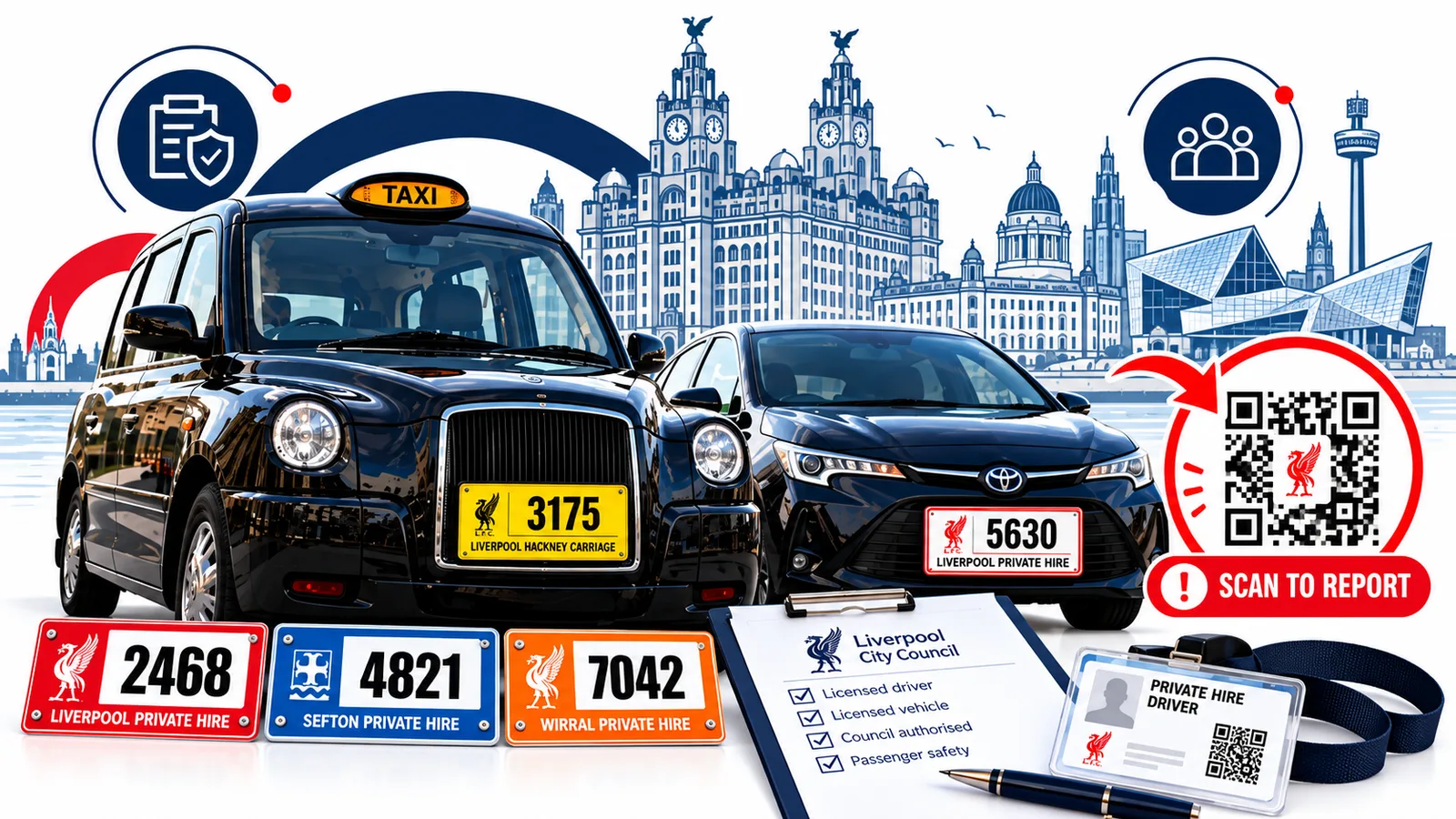
Illustration of the licensed vehicle identifiers passengers can check. Plate numbers and designs are for illustration only. L1 Local illustration.
Under the new system, QR codes will be displayed in licensed taxis and private hire vehicles and will take passengers to the council's Have Your Say system.
That gives someone sitting in the vehicle a direct route to the council without having to search for the correct licensing page afterwards. It can be particularly useful for disabled passengers, people with additional needs and other vulnerable passengers who may already face barriers when trying to report a problem.
The Department for Transport's taxi and private hire licensing guidance says councils should maintain Inclusive Service Plans and provide straightforward, accessible ways for disabled passengers to raise concerns. It also says authorities should use complaints and passenger feedback when deciding whether regulatory intervention is needed.
Liverpool already has a separate online form for complaints about taxi drivers and vehicles. The council asks people to provide as much identifying information as possible, including the registration number, driver badge number and taxi plate details.
One minor complaint does not automatically mean a driver is punished
One concern raised around easier reporting is whether drivers could face licensing action because of a single low-level grievance.
What was said in committee
Feedback is information, not proof
During the committee discussion watched live by L1Local, the point was made that the feedback system should not be treated as a mechanism where one minor complaint automatically leads to punishment. A central reporting system also allows licensing officers to see whether similar complaints are being made repeatedly about the same driver, vehicle or operator.
That is one of the practical differences between collecting structured feedback and treating every submission as an established breach. A complaint is information for the council to assess. It is not, by itself, proof that misconduct occurred.
Repeated complaints can, however, help establish a pattern that may justify a closer look. Equally, a serious allegation does not need to be repeated several times before it can be investigated. The Department for Transport says licensing authorities should investigate allegations, seek relevant evidence and take proportionate action where the evidence supports it.
For drivers, this means the new system creates a more accessible feedback route, not an automatic penalty system. For passengers, it creates a clearer way to make sure an experience is recorded by the authority responsible for the licence.
Why the taxi plate and driver badge matter
A QR code may make the form easier to reach, but the council still needs to know which driver and vehicle a passenger is reporting.
Liverpool's current complaint form asks for the vehicle type, registration number, driver badge number, taxi plate details, distinguishing marks, a description of the driver and details of the incident.
The council-issued taxi or private hire plate is separate from the ordinary UK registration plate. It identifies the vehicle as licensed by a particular local authority and normally carries a unique licence or plate number. The driver's badge identifies the licensed driver.
If you have a concern
Note or photograph the council plate number and the driver badge number, where it is safe and appropriate to do so. It makes it much easier for the correct licensing authority to identify the journey involved.
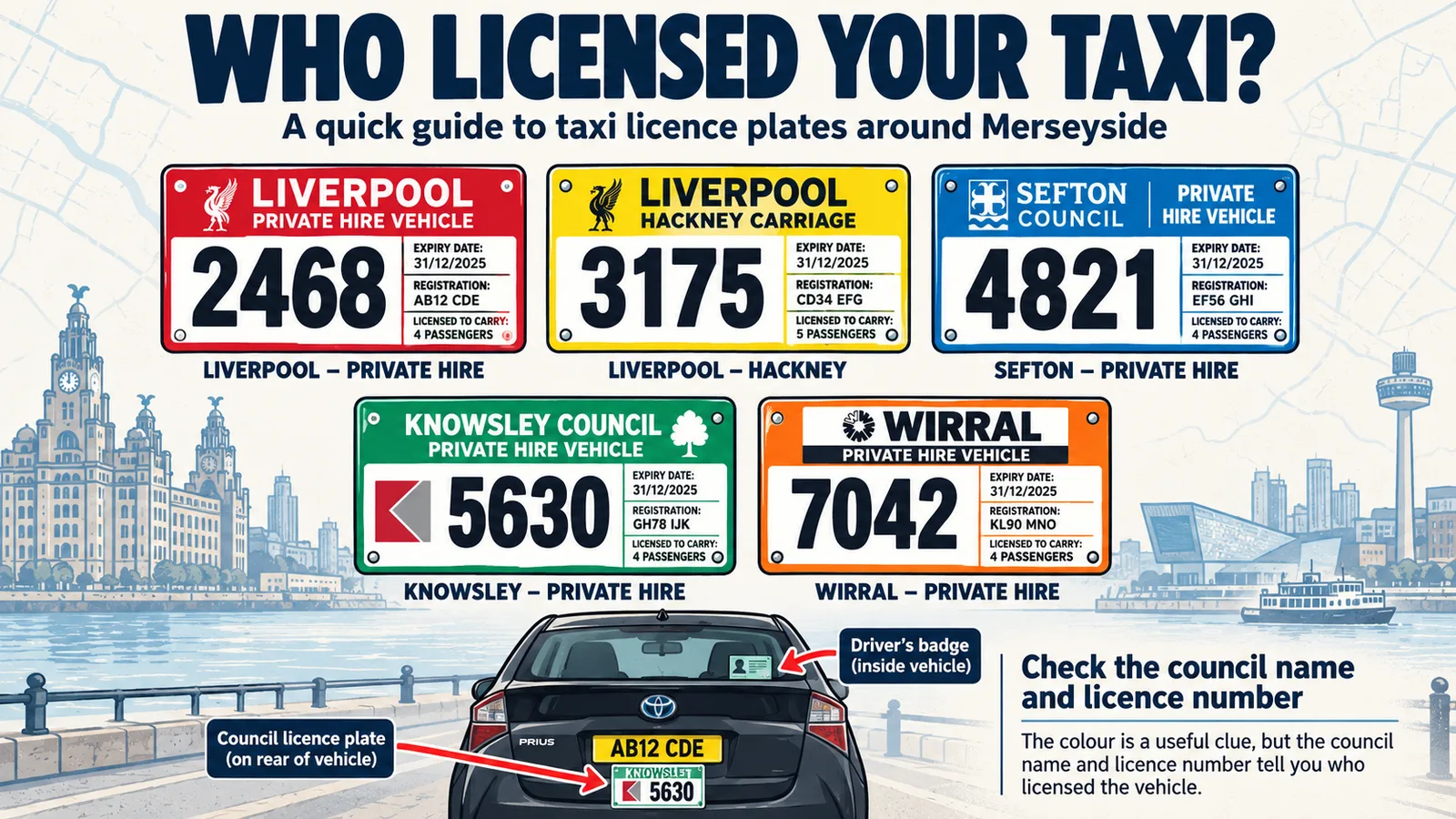
There is no single Merseyside-wide colour for taxi licence plates. Each of the five metropolitan councils licenses its own vehicles and uses its own identification system.
Merseyside taxi plate colours and driver identification
The colour coding is clearest on the council-issued vehicle licence plates. Driver badges use council-specific designs and should be checked for the issuing authority, photograph and licence or badge number rather than relying on colour alone.
An illustrative guide to Merseyside licence plates. Plate designs, numbers and dates are examples, not official artwork. The table below sets out what each council publishes. L1 Local illustration.
Licensing authority
Hackney carriage identification
Private hire identification
Driver identification
Liverpool
Yellow council licence plate at the front and rear, plus a yellow illuminated internal sign showing the plate number. Hackney cabs also have a TAXI roof light.
Red and white council plate at the rear and another displayed in the windscreen. Private hire vehicles should also show operator door signs.
A personal driver ID badge should be displayed inside the vehicle.
Wirral
White council licence plate at the front and rear, carrying the Wirral Council logo and unique plate number.
Orange council licence plate at the front and rear, also carrying the council logo and plate number. Operator identification must be shown on both sides.
Wirral says drivers are issued two badges. One should be worn and the other clearly displayed in the vehicle.
St Helens
Council licence plate with a red background. A matching identification disc is also displayed in the top-left of the windscreen.
Council licence plate with an orange background, with a corresponding windscreen identification disc.
St Helens licensing policy requires the council-issued driver badge to be worn so it is plainly visible to passengers while the driver is working.
Sefton
Sefton council-published taxi guidance describes a white rear plate with blue and black lettering, with a smaller internal plate.
The same published guidance describes a blue rear plate with white and black lettering, plus an internal plate.
Sefton guidance says the driver's identification badge must be worn or displayed in the vehicle and visible to the public. The colour guidance available online is from an older council safety publication, so passengers should rely on the council name and licence number as well as colour.
Knowsley
Knowsley issues separate Hackney driver badges and vehicle plates.
Green council licence plate carrying the Knowsley Council name and unique plate number. Knowsley issues separate private hire driver badges and vehicle plates.
Knowsley's complaint process asks for the driver's ID badge number or taxi plate number where available.
Liverpool's plate identification is also set out in University of Liverpool safety guidance produced for people travelling in the city. It describes Liverpool-licensed Hackney cabs as carrying yellow front and rear licence plates, while Liverpool-licensed private hire vehicles use red and white plates and operator door signs.
Wirral Council's passenger guide provides current examples of its white Hackney plates and orange private hire plates. St Helens Council's passenger safety guidance similarly explains its red Hackney and orange private hire plates.
The practical rule is simple: do not use plate colour on its own to decide which council licensed a vehicle. Look for the council name or logo and the unique plate number, then check the driver's displayed badge.
The licensing council is the one that needs the complaint
This becomes particularly relevant in Liverpool because a private hire vehicle working in the city may be licensed by another local authority.
If the vehicle carries a Liverpool City Council plate, Liverpool's licensing team is responsible for the licence. If it carries a Wirral, Sefton, Knowsley or St Helens plate, the complaint may need to go to that authority instead.
That is why the plate number and issuing council can be more useful than the name of the booking app or operator. Knowsley, for example, specifically asks complainants for the driver's ID badge number or taxi plate number where they have it. St Helens also tells passengers that it can investigate St Helens-licensed drivers and vehicles, but does not have the same licensing powers over vehicles licensed elsewhere.
What the Inclusive Service Plan is trying to change
The council report says the new plan is intended to make Liverpool's licensed taxi and private hire services more accessible to everyone, particularly disabled passengers and people with additional needs.
This goes beyond complaints. An Inclusive Service Plan is intended to identify barriers experienced by passengers, collect evidence about how services are working and set out actions the licensing authority can take to improve access.
The Department for Transport recommends that every licensing authority maintains such a plan. Its guidance says disabled passengers should have confidence both that services will meet their needs and that concerns will be understood and investigated when something goes wrong.
Liverpool's approved plan therefore gives the QR system two roles. It is a practical reporting route for an individual passenger, and it can give the council a larger body of feedback to identify recurring accessibility or service problems across the licensed fleet.
What happens next
The committee approved the proposals on Thursday 24 September, but the council's formal written decision record and full minutes had not appeared online when this article was prepared.
L1Local will check those documents when they are published for the final implementation dates, any amendments agreed during the meeting and the precise wording attached to the drug and alcohol testing, fee and existing-licence changes.
Passengers do not need to wait for the QR system to report an existing problem. Liverpool City Council's current taxi complaint form remains available online and asks for the badge and plate details needed to identify the licensed driver and vehicle.
Comments
Join the conversation with your L1Local Community account. Keep it civil and on topic.