L1 Local editorial illustration, based on Mersey Ferries' published information
News
Royal Daffodil: Inside Liverpool's New £26m Mersey Ferry
Liverpool's new £26m Royal Daffodil Mersey Ferry has made her maiden voyage. See inside, compare it with Snowdrop and find out when passenger services begin.
Liverpool's newest ferry is finally sailing on the Mersey.
On Tuesday 22 September 2026, the £26m Royal Daffodil was formally welcomed into the Mersey Ferries fleet at a ceremony at the Gerry Marsden Ferry Terminal. There was a traditional blessing, a bottle broken against the hull and a tugboat salute before the ferry headed out for her official maiden voyage.
A second milestone follows almost immediately. On Saturday 26 September, people picked through a public ballot will take the first public cruise, leaving the Gerry Marsden Ferry Terminal at 11.30am and returning at 12.30pm. Ordinary scheduled sailings are expected to start in October, though Mersey Ferries has not yet published a first date or a vessel-specific timetable for Royal Daffodil.
The ferry is now officially part of the fleet. That is not the same as being able to turn up and assume you'll get her for your crossing.
Royal Daffodil at a glance
Royal Daffodil Mersey Ferry key facts
Detail
Royal Daffodil
Cost
£26 million
Built
Cammell Laird, Birkenhead
Length
Around 50 metres
Weight
Around 750 tonnes
Speed
Around 12 knots
Passenger capacity
Up to around 500
Propulsion
Diesel-electric, hybrid-ready
Accessibility
Lift between passenger decks
Maiden voyage
22 September 2026
First public cruise
26 September 2026
Scheduled passenger service
Planned for October 2026
Cammell Laird described the vessel during sea trials as around 50 metres long and 750 tonnes, with testing expected to take her to about 12 knots. She is built for the direct commuter crossing, River Explorer sightseeing trips, cruises, education, functions and private hire.
What's actually inside Royal Daffodil
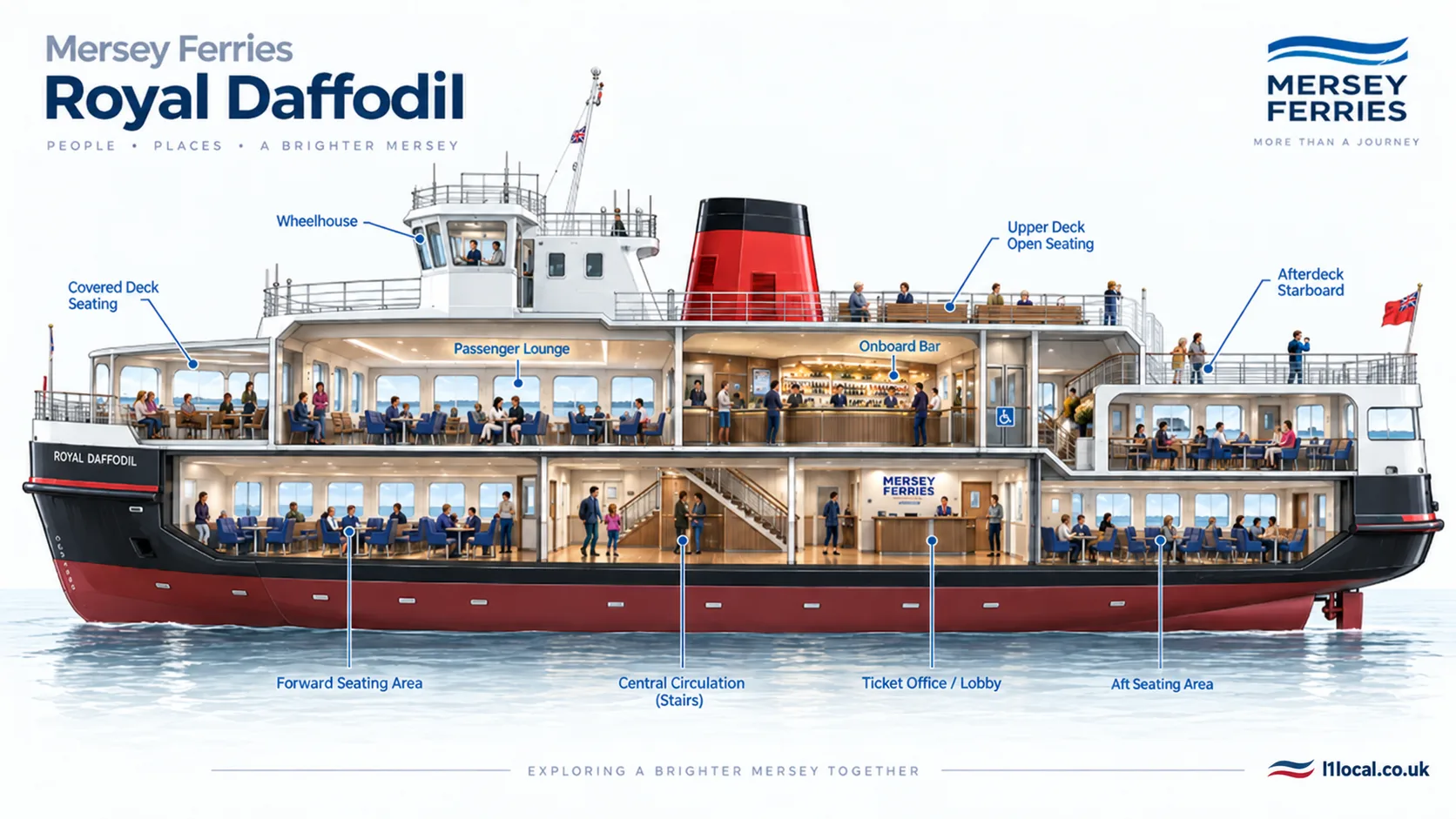
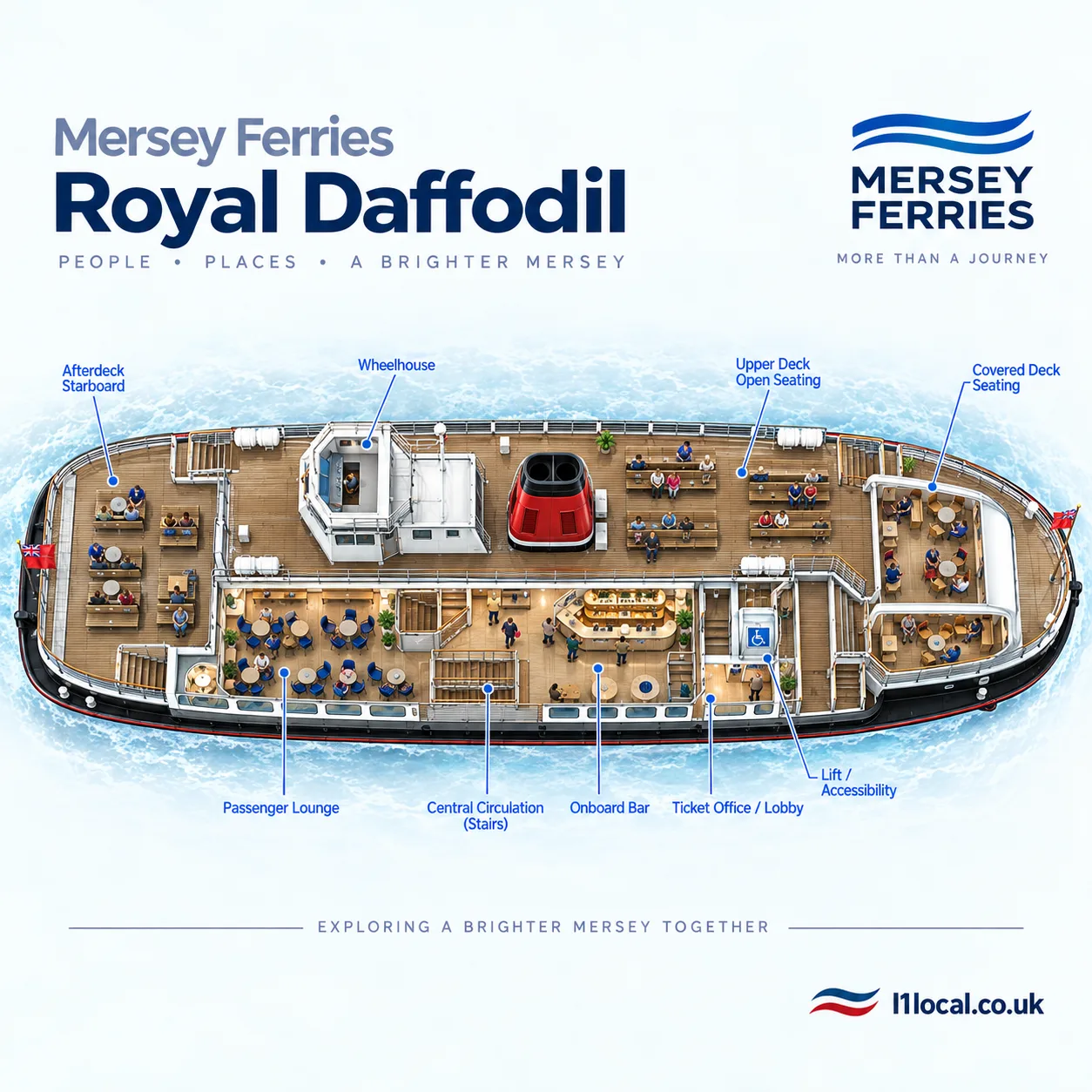
Today's ceremony gave the clearest official description yet of what passengers will find aboard. The main deck has a passenger lounge, a bar and large windows across the river, some of them adjustable, with USB charging points around the seating areas. There's dedicated cycle parking, baby-changing provision and onboard interpretation telling the story of the ferries.
Two staircases connect the passenger areas, but the bigger change from the older ferries is a lift between decks. The upper level is an open viewing deck with traditional-style timber bench seating, and a lounge towards the stern can convert into an event space.
An L1 Local illustration of Royal Daffodil's layout, based on Mersey Ferries' published information and virtual tour. This is not an official Mersey Ferries diagram, and the entrance lobby is shown here rather than a ticket office.A top-down view of the same illustrated layout. Mersey Ferries' own virtual tour of Royal Daffodil is the source for the actual fit-out.
Royal Daffodil vs Snowdrop: what's actually changing
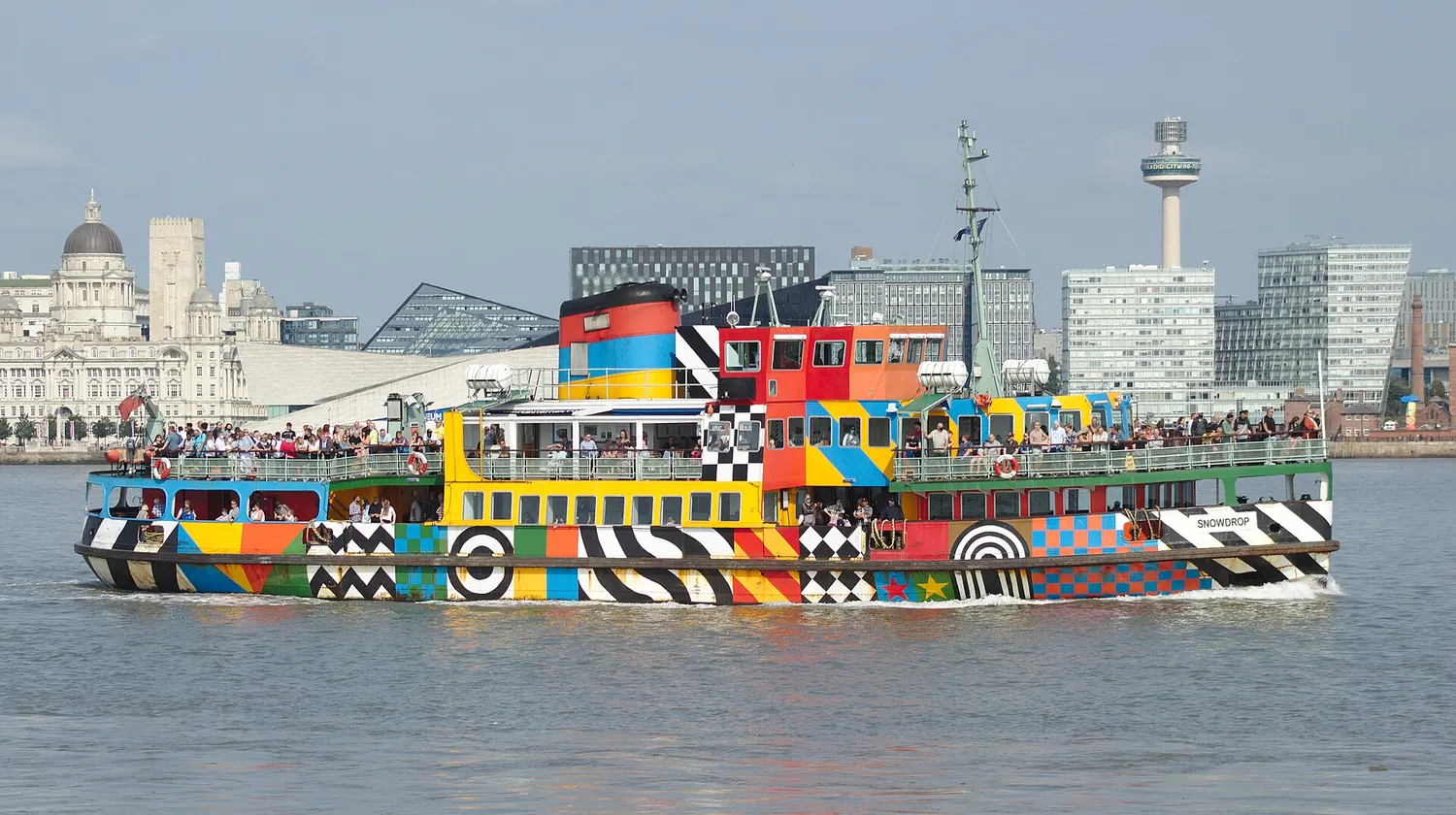
The more interesting comparison isn't with another new ferry. It's with Snowdrop, the ferry that has been doing the everyday work on the Mersey. Snowdrop began life as Woodchurch, built in 1959 and entering service around 1960, so Royal Daffodil represents a jump of roughly six and a half decades of ferry design.
Snowdrop, in Sir Peter Blake's dazzle paintwork, has been carrying the everyday service while Royal Daffodil completed testing. Photo: Rodhullandemu (CC BY-SA 4.0) via Wikimedia Commons.
Comparison of Royal Daffodil and Snowdrop
Royal Daffodil
Snowdrop
Generation
2020s purpose-built ferry
Late-1950s design
Original name
Royal Daffodil
Woodchurch
Entered service
2026
c.1960
Approx. length
50m
46m
Propulsion
Diesel-electric, hybrid-ready
Conventional diesel, twin screw
Upper-deck access
Lift and stairs
Adapted over its life
Cycle provision
Dedicated storage
Adapted provision
Charging points
USB throughout
Not part of original design
Snowdrop isn't going anywhere. The current plan is for Royal Daffodil and Snowdrop to form the working fleet together, so anyone at the Pier Head could soon see two very different generations of British passenger ferry operating side by side.
Don't expect it to be dramatically faster
One surprise: all that new technology doesn't make the crossing itself much quicker. Royal Daffodil's expected operating speed is around 12 knots, broadly similar to the older ferries. The change is underneath the deck rather than on the stopwatch.
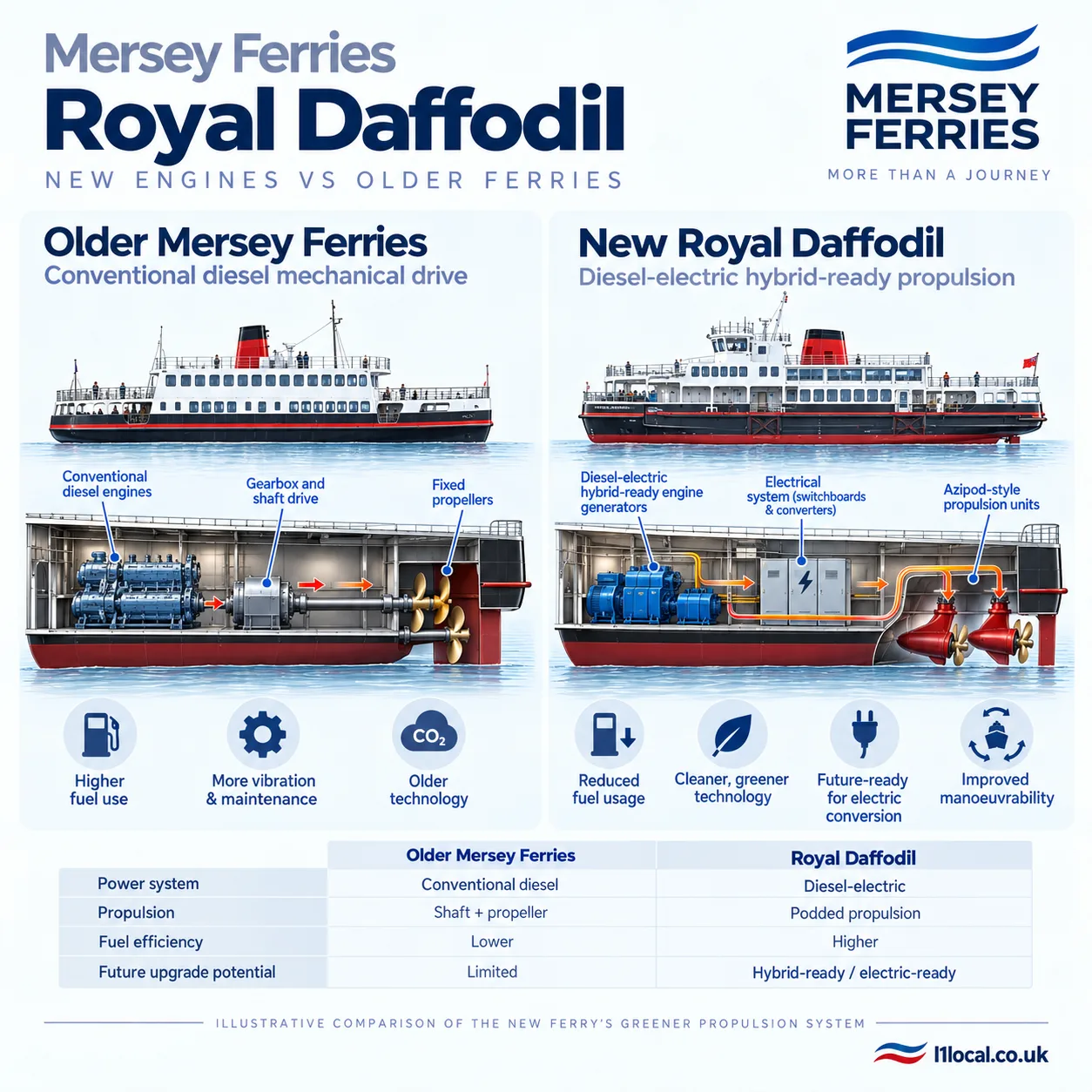
Royal Daffodil uses a diesel-electric, hybrid-ready propulsion system with azimuthing propulsion intended to cut fuel use and improve manoeuvrability. That matters on a tidal river where a ferry repeatedly has to approach and leave landing stages, often in strong winds: fine control at low speed counts for as much as top speed. The system is also designed so the vessel could move further towards full electric propulsion later, as battery technology and shoreside infrastructure develop. She enters service as a diesel-electric vessel, not an electric one.
An L1 Local illustration comparing conventional diesel drive with Royal Daffodil's diesel-electric, hybrid-ready system. Illustrative only, not an engineering drawing.
Why build a leisure ferry as well as a commuter ferry?
The interior points to a bigger change in what Mersey Ferries expects the crossing to be. A traditional ferry moved as many people as practical from one bank to the other. Royal Daffodil is built as transport, visitor attraction and floating venue at once, with proper bar facilities, event space and viewing decks rather than rows of seats. Mersey Ferries is already advertising Royal Daffodil for private hire, alongside Snowdrop. Commuting hasn't disappeared: the new ferry is specifically intended to run the direct Liverpool–Seacombe crossing as well as River Explorer cruises.
Why is it called Royal Daffodil?
This is where the story gets more interesting than a naming exercise. The original Daffodil was a Wallasey ferry built in 1906. In 1918, she and another Mersey ferry, Iris, were requisitioned for one of the more remarkable operations of the First World War.
Daffodil and Iris II at Dover, soon after returning from the Zeebrugge Raid of 22 to 23 April 1918. Photo: Lt C H Parnall, Royal Navy official photographer, public domain, via Wikimedia Commons.
On 23 April 1918, the two ferries took part in the British raid on Zeebrugge in German-occupied Belgium, an attempt to block the canal system German U-boats used. Royal Museums Greenwich records that their shallow draught, double hulls, passenger capacity and manoeuvrability made them useful for carrying troops into a heavily defended harbour. Daffodil used her bow to push against the cruiser HMS Vindictive and help hold her against the Zeebrugge mole while Royal Marines went ashore. Both ferries were damaged, took casualties and returned home under their own steam.
The raid's strategic success has been debated ever since: some of the blockships intended to obstruct the canal ended up in less effective positions, and the blockage proved temporary. What's not in doubt is what happened next. King George V authorised the ferries to carry the word Royal. Daffodil became Royal Daffodil, Iris became Royal Iris, and Mersey ferries still carry those names today. The full story, from medieval Birkenhead monks to this new ferry, is in L1Local's history of the Mersey Ferry, and the wider wartime picture is in our guide to the River Mersey in two world wars.
This isn't the first Royal Daffodil
The Combined Authority describes the new ship as the sixth Mersey Ferry to carry the Royal Daffodil name. A Royal Daffodil II, built at Cammell Laird in 1934, was bombed and sunk at Seacombe during the Liverpool Blitz on 8 May 1941, then raised, repaired and returned to service. The vessel most Liverpudlians remember began life in 1962 as Overchurch before being renamed Royal Daffodil after a rebuild.
That 1962 ferry hasn't vanished. It's now moored in Canning Dock as the Daffodil floating venue, so Liverpool now has an old Royal Daffodil sitting in the dock while a new Royal Daffodil operates on the Mersey nearby.
Why Liverpool needed a new ferry
The Royal Iris of the Mersey retired in March 2026 after more than 60 years of service, its last passenger sailing on 29 March and formal decommissioning on 31 March. Mersey Ferries kept normal services running on Snowdrop while Royal Daffodil completed testing and crew training, which briefly left a ferry designed at the end of the 1950s carrying much of the responsibility for one of Liverpool's best-known transport services.
When can you actually travel on it?
The Gerry Marsden Ferry Terminal at Pier Head, where today's ceremony and Saturday's public cruise both start. Photo: Peter Tarleton (CC BY-SA 2.0) via Wikimedia Commons.
The ferry has sailed, but there's still no ordinary Royal Daffodil timetable. Today's maiden voyage was tied to the ceremony rather than normal service. Saturday's first public cruise was allocated by ballot. The Combined Authority says Royal Daffodil is planned to enter normal passenger service in October 2026, with an exact date still to be announced.
There were no ordinary commuter or River Explorer sailings on Tuesday 22 September because of today's event; normal services resume on Wednesday 23 September. On Saturday 26 September, the regular 10am, 11am and noon River Explorer departures from Liverpool won't operate, to make way for the launch celebrations.
Outside those two dates, the direct commuter ferry normally runs every 20 minutes during weekday peaks between Seacombe and the Gerry Marsden Ferry Terminal, a crossing of about 10 minutes. Anyone specifically wanting to travel on Royal Daffodil herself, rather than whichever ferry happens to be running, should wait for Mersey Ferries to publish her first normal operating date. Our Mersey Ferry times and fares guide covers the day-to-day timetable and ticket types.
How much does it cost?
Fares are attached to the service rather than to Royal Daffodil specifically. The direct commuter crossing costs £3.10 single or £4.20 return for an adult. A River Explorer Cruise costs £14 for an adult and £9 for a child aged 5 to 15, with concessions and family tickets also available. There's been no announcement of a separate premium fare for Royal Daffodil on ordinary scheduled sailings.
Built on the river it will serve
Royal Daffodil was built on the Wirral bank of the Mersey at Cammell Laird, Birkenhead. She first touched the river on 6 November 2025, when the incoming tide was used to lift her before tugs moved her into the wet basin for fitting out. Sea trials began in April 2026, testing propulsion, manoeuvring, navigation, communications and lifesaving equipment, with crews practising berthing at Seacombe and the Pier Head. The finished ferry was formally handed over to the Liverpool City Region in June, followed by months of crew training.
From the outside, the ferry deliberately looks familiar: black hull, white upper structure, large red funnel. Underneath that traditional appearance is a different kind of Mersey Ferry, one built to work as transport, tourist attraction, accessible public transport and event venue at once, with room to adopt cleaner propulsion later in its life. The crossing itself may still take roughly the same ten minutes. The ferry making it is not the same boat at all.
Royal Daffodil made her maiden voyage on Tuesday 22 September 2026. Her first public cruise, allocated by ballot, is on Saturday 26 September 2026 at 11.30am, returning at 12.30pm. Ordinary scheduled passenger sailings are expected to start in October 2026, though Mersey Ferries has not yet published an exact date.
How much did Royal Daffodil cost?
Royal Daffodil is a £26 million vessel built at Cammell Laird in Birkenhead, the first newly built Mersey Ferry in more than 60 years.
What's different about Royal Daffodil compared with Snowdrop?
Royal Daffodil is a 2020s purpose-built ferry with a lift between decks, diesel-electric hybrid-ready propulsion and USB charging throughout. Snowdrop began life as Woodchurch, built around 1959, with conventional diesel propulsion. Both are expected to run together as the working fleet.
Why is it called Royal Daffodil?
The original Daffodil was a Wallasey ferry requisitioned in 1918 to help storm the German-held Zeebrugge mole in the First World War. King George V awarded her the Royal prefix afterwards, a name Mersey ferries have carried ever since.
Is the new Royal Daffodil wheelchair accessible?
Yes. Unlike some older Mersey Ferries, Royal Daffodil was purpose-built with a lift between passenger decks in addition to two staircases.
Liverpool this week
New places, local news, things to do and our latest guides. Weekly.