Moving into halls is the easy bit. The first few weeks are when you find out that Liverpool Central is not the same station as Lime Street, that Smithdown is much longer than it looks on a map, that your bin can be left unemptied because someone put the wrong thing in it, and that the rules for renting a student house changed substantially in 2026.
This guide is for students who have arrived, or are about to arrive, at the University of Liverpool, LJMU, Liverpool Hope, LIPA or another Liverpool college. It is the "I've moved in, now what?" companion to our Liverpool Student Guide 2026, which covers start dates, student finance, accommodation and the pre-arrival checklist. This page is about the local knowledge you normally pick up over your first term.
Why there is no single Freshers Week
Liverpool has no single Freshers Week. Universities start on different dates, so check who is running an event before buying a ticket.
The city centre is walkable. Learn the four central railway stations and you rarely need a bus in town.
Private student renting changed on 1 May 2026. Advice from older students may be out of date.
Do not panic-book a second-year house in October. There is more time than the rush suggests.
Merseyrail reaches well past the student areas. The same card taps you in and out, and it opens up the coast, Southport and the Wirral.
The five things worth sorting in your first week are listed at the end. Most of the rest can wait until you need it.
1. Liverpool does not have one Freshers Week
Different universities start at different times. For 2026, University of Liverpool Welcome Week runs from 21 to 27 September, with teaching from 28 September, according to its published term dates. LJMU's induction week runs from 14 to 18 September, with teaching from 21 September. LIPA also runs induction from 14 to 18 September and starts its undergraduate term on 21 September.
An event advertised as a "Liverpool Freshers" night is not necessarily tied to your university or your students' union. Check who is actually organising it before you pay.
2. The city centre is smaller than it first looks
Do not assume you need a bus for every journey. The main shopping streets, Lime Street, Ropewalks, the Georgian Quarter and much of the university district are all within walking distance of each other. The University of Liverpool puts its main campus about ten minutes on foot from Lime Street and about ten minutes from the city centre.
You will spend your first week following maps for journeys that feel obvious by October.
3. Learn the four city-centre railway stations
Liverpool Lime Street is the main station for longer-distance trains to Manchester, Birmingham, London and beyond. For local Merseyrail journeys, the central stations you will use most are Liverpool Central, Moorfields, James Street and Lime Street Low Level.
Central is the handiest for Bold Street and Ropewalks. James Street is closest to the waterfront. Moorfields serves the business district and the northern end of the centre. Our guide to getting around Liverpool without a car explains the network in more detail.
A Merseyrail Class 777 at Liverpool James Street, one of the four underground city-centre stations. Photo: Geof Sheppard (CC BY-SA 4.0) via Wikimedia Commons.
4. You can now tap your bank card on Merseyrail
A useful 2026 change: Merseyrail's Tap & Go now accepts contactless bank cards, phones and watches. Tap in at the start of the journey and tap out at the end, and the system works out the cheapest applicable fare.
The catch is consistency. Use the same card or device at both ends. Tapping in with a physical card and tapping out with the same card through Apple Pay reads as two different cards, which leaves two unfinished journeys and a higher charge.
5. Being a student does not make every bus fare cheaper
Merseyside has several ticket types, and the discount depends on the ticket and your age. Merseytravel's Solo tickets work on participating buses across Merseyside regardless of operator, with daily, weekly, four-weekly and term-time options. Young-person products have age limits: MyTicket, for example, is for passengers aged 18 and under.
If you commute most days, compare a season ticket against paying per journey rather than assuming your student ID gets you the lowest fare.
6. If you live at Greenbank, learn the 699
University of Liverpool students at Greenbank Student Village will get to know the 699, which links Greenbank with campus during term time. The university estimates about 20 minutes between Greenbank and Brownlow Hill. If that is your daily commute, save the route and timetable rather than searching for it every morning.
7. Smithdown is a road, not one small neighbourhood
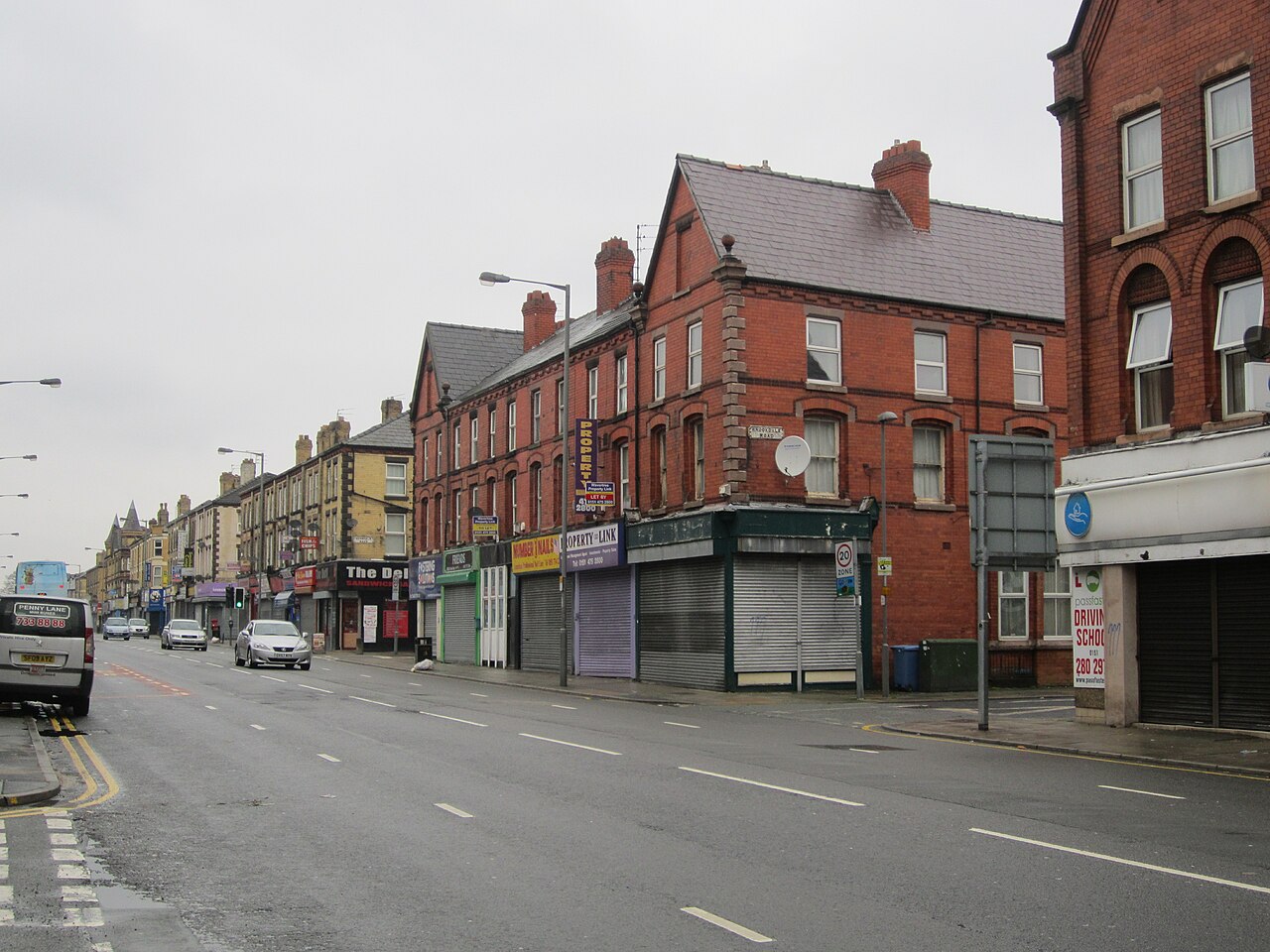
People will tell you they live "on Smithdown", which is not very precise. Smithdown Road runs a long way through south Liverpool, and the section near Penny Lane feels different from the northern end near Upper Parliament Street. It threads through areas known as Wavertree, Picton, Greenbank and Penny Lane, so two houses both advertised as "Smithdown" can be a long walk apart.
Check the actual postcode when you view a place. Our Smithdown Road guide covers the shops, food, transport and the different stretches of the road.
Smithdown Road runs for well over a mile through south Liverpool, so two addresses both called "Smithdown" can be a long way apart. Photo: Rept0n1x (CC BY-SA 3.0) via Wikimedia Commons.
8. Learn the names of the smaller parts of the centre
Liverpool city centre makes more sense once you stop treating it as one place. You will hear:
Ropewalks: Bold Street, Slater Street, Wood Street and much of the nightlife.
Georgian Quarter: Hope Street, the two cathedrals and the streets around the university.
Baltic Triangle: south of the shopping centre, around Jamaica Street and the old warehouses.
Waterfront: Pier Head, the Royal Albert Dock and the riverfront.
Commercial District: around Castle Street, Old Hall Street and the northern end of the centre.
Knowing the names makes directions, events and nights out much easier to follow. Our city centre guide breaks the centre into these smaller areas.
9. Register with a Liverpool GP before you need one
Do this early. Brownlow Health runs several practices around central Liverpool and welcomes students from any university. Its Student Health practice is on the University of Liverpool campus, and it suggests its Marybone practice may suit LJMU students better.
You do not have to use Brownlow. You can register with any GP taking patients in your area. The point is to register before you are ill or run low on repeat medication. Our first week in Liverpool guide covers the other admin worth clearing early.
10. Check your meningitis vaccinations
This matters for new students in 2026. NHS England opened pharmacy access to the MenB vaccination in July 2026 for eligible young people, including students under 25 starting at university or residential college for the first time. Also check your MenACWY and MMR status. If you are not sure what you have had, contact your GP rather than assume.
Meningitis can get worse fast. Do not wait for a rash before seeking urgent help if the symptoms point to it.
11. Most full-time students do not pay Council Tax, but do not ignore the letter
If everyone in a household is a qualifying full-time student, the property is exempt from Council Tax. In halls this is usually arranged for you. If one adult in the house is not a student, the bill normally gets a 25% reduction. With two or more non-students, the student exemption does not remove the bill.
If a bill lands on the mat, deal with it rather than assuming the council already knows your status.
12. Student renting changed in May 2026
Be careful with housing advice from older students, because some of it is now wrong. From 1 May 2026, many private student houses and flats use rolling assured periodic tenancies rather than fixed-term assured shorthold tenancies.
Liverpool Student Homes says these tenancies normally have no fixed end date, that tenants generally give two months' written notice to leave, and that providers cannot ask for more than one month's rent in advance under the new rules. University halls and some private halls run on different agreements, so check what you are actually signing.
13. Do not panic-book your second-year house in October
Shortly after everyone moves into halls, a wave of conversations starts about next year's houses. Liverpool Guild of Students tells students plainly not to rush, and warns that people feel pushed to start looking in November when there is still plenty available. Liverpool Student Homes says the same: take time to work out who you actually want to live with before signing a legally binding agreement.
Knowing someone for six weeks and living with them for twelve months are different tests.
14. Liverpool Student Homes is not just another letting site
Liverpool Student Homes is funded by the city's universities and gives advice on private accommodation. It can help with accredited landlords, contract checks, deposits, disputes, disrepair, finding housemates and understanding your rights as a tenant. It is connected with the University of Liverpool, LJMU, Liverpool Hope and LIPA, not a commercial letting agency.
15. Check whether your house needs an HMO licence
If five or more unrelated people share a rented property and facilities such as the kitchen or bathroom, it normally needs a mandatory House in Multiple Occupation licence. Liverpool City Council keeps a licensing register you can check before you rent, and also runs selective licensing across parts of the private rented sector.
A licence check will not tell you everything about a landlord, but it is a basic step worth knowing about.
16. Photograph your room when you move in
Before you rearrange furniture or fully unpack, photograph the walls, flooring, furniture, appliances, windows, any existing stains or damage, and the meter readings. Keep the photos somewhere with a date attached, and do the same when you leave. Ten months later, nobody reliably remembers whether that mark was already on the wall.
17. Find your bin day straight away
This matters more than you would expect once six people share a house. Liverpool City Council has a postcode checker for collection dates. Bins normally need to be out before 6.30am, and the council can refuse a bin that has the wrong material in it, is too heavy, or has extra waste left beside it. Separate weekly food-waste collections are being rolled out street by street, so your neighbours' setup may not match yours yet.
Your university library is not the only option. Liverpool Central Library on William Brown Street has four floors of seating, computers, free Wi-Fi and quiet study space in the Picton Reading Room. Anyone who lives, works or studies in Liverpool can join the city library service, which includes online ebooks, magazines and audiobooks.
The Picton Reading Room at Liverpool Central Library, open to anyone who lives, works or studies in the city. Photo: John Bradley (CC BY-SA 3.0) via Wikimedia Commons.
Check opening times before travelling. The council began consulting on library opening hours in August 2026, so published times may change during the year.
19. You may be able to register to vote in Liverpool and at home
Students with both a home address and a term-time address can often register at both. You still cannot vote twice in a UK parliamentary election or referendum, and you choose which address to use for that vote. Liverpool City Council says online registration takes about five minutes and usually needs your National Insurance number. Update your registration when you move house.
20. Some of the biggest museums are free
When money gets tight, Liverpool has several substantial free options. National Museums Liverpool venues include the Museum of Liverpool, World Museum and Walker Art Gallery, with free general admission to the main permanent collections, though some temporary exhibitions charge.
One note if you are following an older online guide: Tate Liverpool's main Royal Albert Dock building is still being redeveloped and is preparing to reopen in 2027.
21. Nightlife is not just Concert Square
Concert Square gets most of the Freshers attention, but different parts of the centre suit different nights out. Ropewalks covers the cluster around Concert Square, Wood Street, Slater Street and Seel Street. Mathew Street has its own concentration of late venues. The Baltic Triangle sits further south, and Hope Street and the Georgian Quarter work differently again. Find out where a venue actually is before agreeing that everything is "in town".
22. Learn what a Halo Point looks like
New for 2026: Merseyside Police and city partners set up nine Halo Points around the city centre in May. They are visible, designated spots where someone who feels unsafe can get help, linked to City Watch CCTV and emergency support. Locations include areas around Concert Square, Wood Street, Seel Street, Mathew Street, Stanley Street and Victoria Street. Knowing they exist before you need one is the useful part.
23. Lock the windows, even when someone is home
Merseyside Police reported a rise in burglaries at student properties in areas including Greenbank and Arundel in the run-up to the academic year. Many opportunistic burglaries involve a door or window that was simply left unsecured rather than forced. Do not leave laptops next to open ground-floor windows, and do not assume a housemate locked the back door.
24. Liverpool John Lennon Airport is not in the city centre
The airport is at Speke in south Liverpool, which is easy to underestimate when you book an early flight. The University of Liverpool currently puts the bus from Liverpool ONE to the airport at around 40 minutes, before traffic. Check the actual first bus rather than working backwards from a normal daytime journey, and for very early departures sort your transport before the night before.
25. Liverpool gets much bigger once you understand Merseyrail
Do not spend three years treating Liverpool ONE as the edge of the map. Merseyrail makes places well outside the student areas easy to reach: the University of Liverpool gives typical journeys to Liverpool Central of around 27 minutes from New Brighton, 34 from West Kirby and 45 from Southport. That opens up the Wirral coast, Southport, beaches, parks and neighbourhoods that rarely come up during Freshers Week.
A lot of what makes living here work starts when you stop treating the city centre as the whole city.
The five things to sort first
If most of this list can wait, start with these:
Register with a GP.
Check your Council Tax exemption.
Find your bin collection day.
Learn the route between home and university.
Read your accommodation agreement rather than assuming the renting rules have not changed.
Then explore. Liverpool gets a lot easier once you see how the transport, neighbourhoods and basic services connect.
Liverpool university start dates, moving in, where to live, council tax, the 2026 renting law change, student finance and transport, checked for 2026/27.




Comments
Join the conversation with your L1Local Community account. Keep it civil and on topic.