Photo: Ruth Sharville (CC BY-SA 2.0) via Wikimedia Commons
News
Could the Mersey Ferry Return to New Brighton? What the Feasibility Work Has to Solve
Steve Rotheram says a Liverpool-New Brighton ferry is being examined. We look at landing-stage costs, Victoria Road businesses and what must happen next.
Liverpool City Region Mayor Steve Rotheram says work is under way to examine whether Mersey Ferries could return to New Brighton, more than 50 years after the last regular crossing. The idea could create a new direct link between Liverpool's waterfront and one of Wirral's main visitor areas, but a new ferry terminal would require substantial marine infrastructure before any route could operate.
A ferry between Liverpool and New Brighton is being looked at again.
Liverpool City Region Mayor Steve Rotheram said in a BBC Radio Merseyside interview that feasibility work is taking place on what could be done with the ferry network, including whether new terminals could be built.
That does not mean a Liverpool to New Brighton ferry has been approved.
No route, timetable, terminal location, construction budget or opening date has been published. There is also no announcement that the new £26m Royal Daffodil has been allocated to a New Brighton service.
What has changed is that the idea has moved beyond nostalgia and is now being examined as a transport proposition.
The Birkenhead-built vessel is the first new Mersey Ferry in more than 60 years. It has been designed to operate cross-river services as well as River Explorer cruises, events and private functions, with features including an accessible lift, cycle storage and modern passenger spaces.
The Liverpool City Region Transport Committee was told in September that the vessel was expected to enter passenger service in October, subject to certification. The same update described continuing investment in the existing ferry infrastructure at Seacombe, Woodside and the Gerry Marsden Ferry Terminal at Pier Head. Mersey Ferries currently carries around half a million passengers a year.
Rotheram then revealed that the authority was examining whether the network itself could expand.
On New Brighton, he said:
"We are genuinely looking at the feasibility of what we can do on the ferry."
The crucial word is feasibility.
There is no funded New Brighton terminal project yet and no published business case showing what a route would cost or how many people would use it.
New Brighton has been without its ferry since 1971
A ferry connection would restore a route that disappeared more than half a century ago.
New Brighton's first wooden ferry pier opened in the 1830s. A much larger iron pier designed by Eugenius Birch followed in 1867 and became part of the resort's transport infrastructure.
Ferry services ended in 1971, with the final crossing generally recorded as 26 September that year. As detailed in our history of the Mersey Ferry, the ferry landing infrastructure was subsequently removed and the main pier was eventually demolished in the late 1970s.
The closure means there is no dormant ferry terminal waiting to be reopened.
A 2020s service would require new infrastructure to connect the shore to a vessel operating on one of Britain's most tidal rivers.
That is likely to be the biggest obstacle.
The difficult part is the landing stage, not finding a ferry
Rotheram highlighted the engineering problem himself.
The Mersey has a tidal difference approaching 11 metres between high and low water at its extremes. A passenger terminal therefore cannot simply consist of a fixed platform at the water's edge.
A modern Mersey Ferry terminal typically uses a floating landing stage connected to shore by a linkspan or gangway, allowing the boarding level to rise and fall with the river.
Rotheram said any New Brighton option would need something that floats and is secured to the riverbed, describing both the engineering and potential cost as substantial.
Existing terminals show what that can involve.
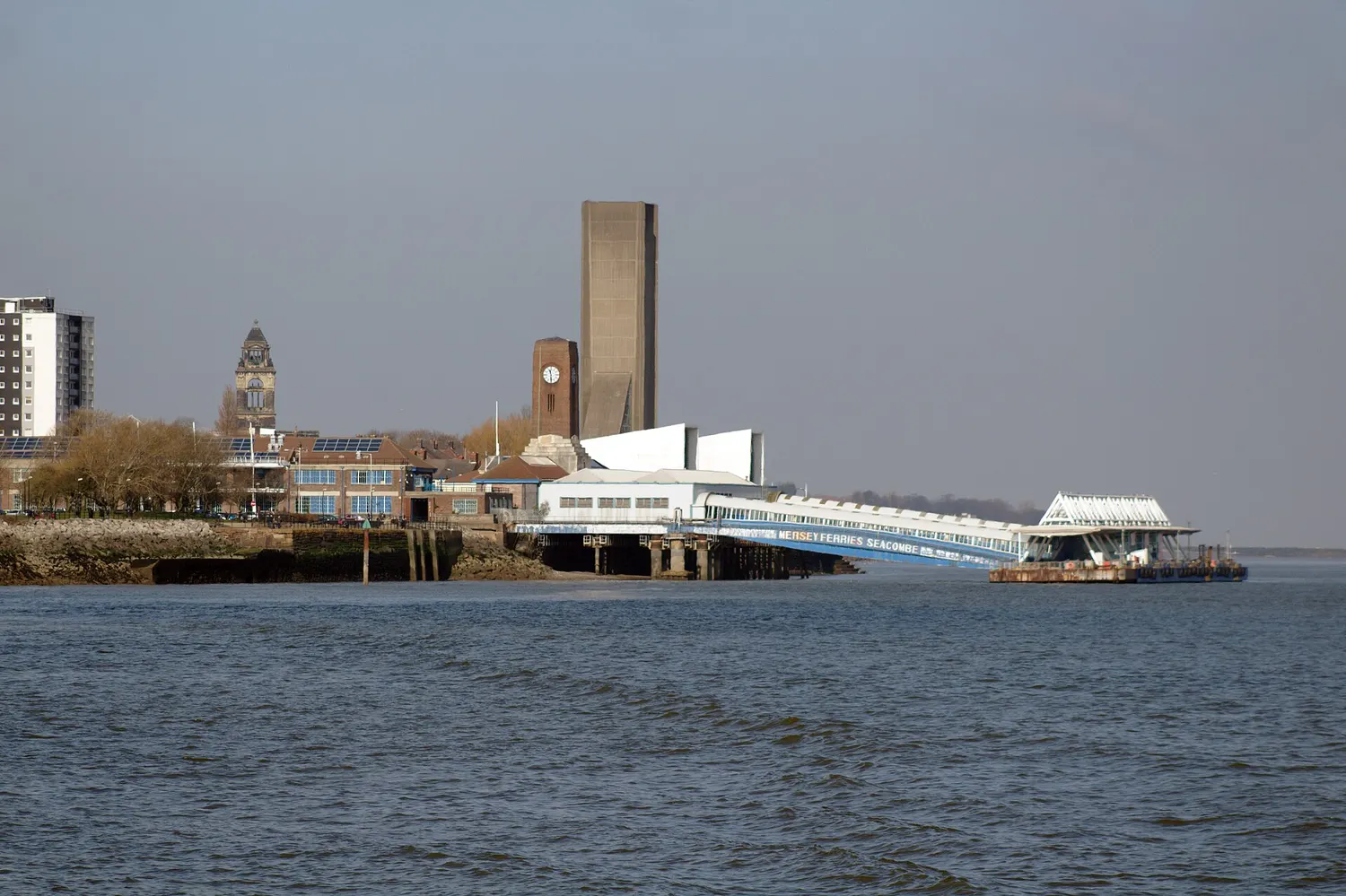
At Seacombe, a £7m programme replaced two linkspan bridges that had been in place for more than 130 years, refurbished the landing stage, upgraded mooring equipment and installed powered passenger gangways. The terminal reopened to passengers in October 2022.
Seacombe Ferry Terminal on the Wirral bank. A £7m upgrade replaced Victorian linkspan bridges and refurbished the landing stage. Photo: Rodhullandemu (CC BY-SA 4.0) via Wikimedia Commons.
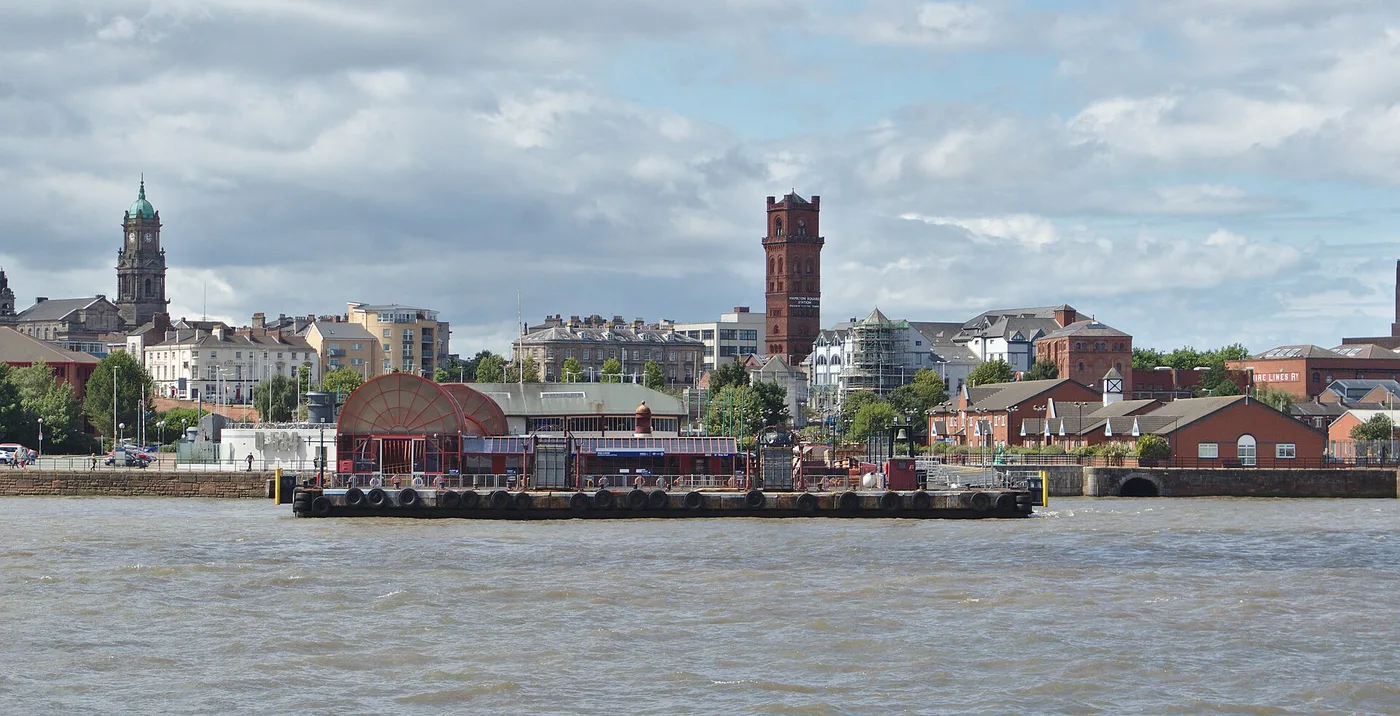
At Woodside, the Combined Authority has recently installed a 52-metre, 350-tonne landing stage and a 120-tonne linkspan bridge as part of a project reported at around £9m.
Woodside waterfront in Birkenhead, where a new 350-tonne landing stage and linkspan bridge were installed. Photo: Rodhullandemu (CC BY-SA 4.0) via Wikimedia Commons.
Those figures are not estimates for New Brighton. Building on a new site could present completely different engineering, ground, wave, environmental and access conditions.
They do, however, show why a new ferry stop is considerably more complicated than installing a conventional bus stop or railway platform.
A terminal would also need approvals beyond the transport authority
Any preferred location would have to go through technical and regulatory work before construction.
Marine Management Organisation guidance says marine licensing can apply to construction in tidal rivers and estuaries, including work over the water or on or under the seabed. Projects may also require permissions involving the local planning authority and other relevant bodies.
Depending on the eventual design, studies could therefore need to examine matters including:
tidal and wave conditions
seabed and foundation conditions
safe ferry approaches and manoeuvring
passenger access from shore
step-free accessibility
marine licensing
environmental effects
connections with walking, cycling, buses and rail
operating costs and maintenance
expected passenger demand
No public New Brighton terminal design has yet been released.
Where would a New Brighton ferry terminal go?
That question remains unanswered.
Rotheram's comments referred to the possibility of new terminals but did not identify a location for New Brighton.
Wirral Council's adopted New Brighton Marine Promenade Masterplan covers the waterfront from around the Floral Pavilion towards Union Terrace and looks at ways of connecting the promenade more effectively with the Victoria Road area.
The council's plans include greater public activity along the waterfront, improved pedestrian connections and closer links between Marine Promenade and the Victoria Quarter.
That does not make any part of the masterplan a proposed ferry site.
A feasibility study would still have to determine whether a workable marine location exists and how passengers could move between it, the promenade, New Brighton railway station and Victoria Road.
Why Victoria Road makes the economics more interesting
A New Brighton ferry would not arrive in the same local economy that existed when the route disappeared in 1971.
Victoria Road has developed a substantial independent food, drink and creative sector.
Wirral Council's Marine Promenade Masterplan describes the street as New Brighton's traditional high street and recognises its concentration of food, drink and community uses. The council wants stronger physical connections between the waterfront and the Victoria Quarter.
That creates an obvious economic question for any ferry business case:
Would passengers arriving by water stay around the promenade, or would they move uphill into Victoria Road and spend money in independent businesses?
There is evidence that additional visitors already affect trading on the street, although it should not be mistaken for evidence specifically about a ferry.
In 2025, Local Democracy Reporting Service interviews with Victoria Road businesses found traders describing increased visitor numbers and busier summer periods as the area's independent hospitality offer expanded.
Becky Edwards, who runs Becky's Brekky, told the service that changes in the area had "brought more people down here 100%". Other traders described visitors staying at hotels nearby and moving between businesses along the street.
Those comments pre-date the ferry proposal.
What has not yet been published is a proper estimate of how many additional visitors a ferry could generate rather than simply transferring journeys currently made by train, car or bus.
The ferry could change how Liverpool visitors reach New Brighton
New Brighton is already connected to Liverpool by Merseyrail.
That means a ferry would not be restoring access to somewhere currently cut off from public transport. New Brighton remains part of the Wirral Line network and the current Merseyrail system continues to serve the town, as outlined in our guide to getting around Liverpool without a car.
The case for a ferry would therefore have to be broader than simply getting people from A to B.
Its appeal could lie in creating a direct waterfront-to-waterfront visitor journey.
Someone staying in central Liverpool could walk to Pier Head, board a ferry and arrive directly at the New Brighton waterfront rather than travelling underground from Liverpool city centre and walking from the railway station.
That could make the journey itself part of a day out.
There is already a small-scale example of this approach.
During summer 2026, Mersey Ferries passengers could travel from Seacombe to New Brighton using Stagecoach's seasonal Coastal Breezer bus, with River Explorer ticket holders receiving the connecting journey free. The service linked the existing ferry terminal to Kings Parade in New Brighton.
A direct ferry would remove that intermediate bus leg.
Whether enough passengers would value that convenience to support the cost of new marine infrastructure is precisely the kind of question the feasibility work needs to answer.
Would New Brighton gain at Pier Head's expense?
Not necessarily.
Transport investment can redistribute spending between places, but it can also generate trips that otherwise would not have happened.
A ferry passenger might buy food or drink around Pier Head before departure and then spend again in New Brighton. Visitors staying in Liverpool could add New Brighton to an existing trip rather than substitute it for time in the city centre.
Equally, some spending could shift.
A visitor who would otherwise spend an entire afternoon around Liverpool's waterfront might instead cross the river for food, drinks or entertainment in New Brighton.
There is no published passenger-demand or economic-impact study for this proposed route yet, so claims that it would either damage Pier Head businesses or deliver a major windfall to New Brighton would be premature.
The wider market is substantial. Liverpool City Region recorded more than 61.5 million visitors in 2025, with visitor-economy spending estimated at £6.834bn.
The relevant number for a New Brighton ferry, however, would be much narrower: how many additional trips the service could generate, how often passengers would travel, what they would spend and whether the resulting benefits justify the capital and operating cost.
A seasonal ferry could produce very different results from a commuter route
Another unanswered question is what kind of service is being considered.
There are at least three fundamentally different possibilities:
A seasonal visitor service could concentrate on weekends, school holidays and warmer months when New Brighton's beach, attractions and hospitality businesses experience their strongest demand.
An all-day visitor route could potentially become part of Mersey Ferries' tourism offer, alongside the River Explorer Cruise.
A regular transport service would need a more intensive timetable and would have to demonstrate how it complements the existing Merseyrail connection.
Each model changes the economics.
A seasonal service might generate concentrated visitor spending while requiring fewer sailings. A frequent scheduled service would offer greater usefulness to residents but would require more vessel and crew time.
The Combined Authority has not publicly said which model is being studied.
Royal Daffodil gives the ferry network more capability, but it is not a spare boat
The arrival of Royal Daffodil makes expansion easier to imagine.
The vessel has been designed for commuter crossings, sightseeing services and events, and can carry substantially more passengers in modern accessible accommodation than the ageing vessels it is replacing.
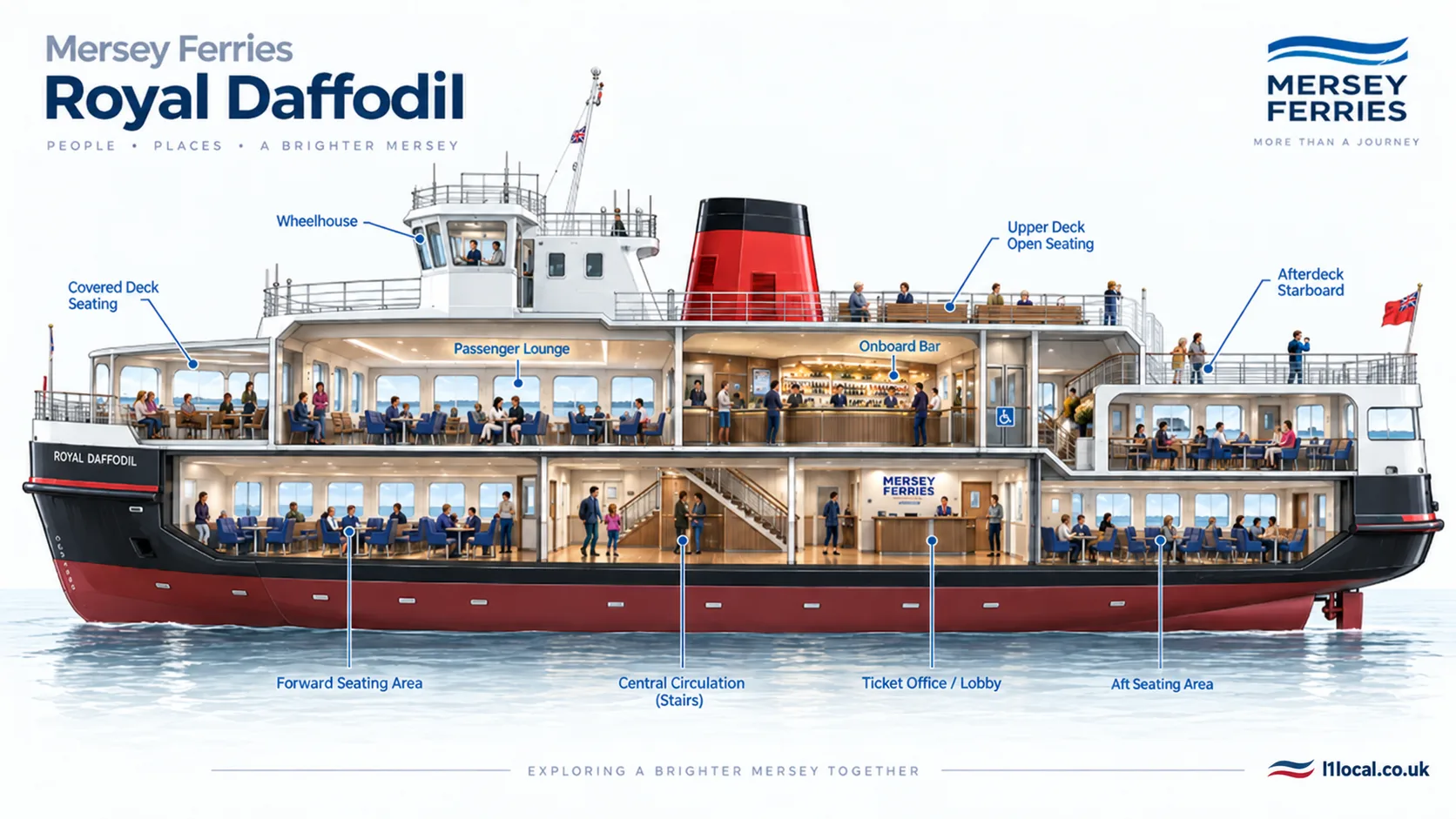
L1 Local illustration of Royal Daffodil's layout. While the new vessel expands fleet capability, it already has scheduled commuter and cruise commitments. Illustration: L1 Local.
But the new ferry already has jobs to do.
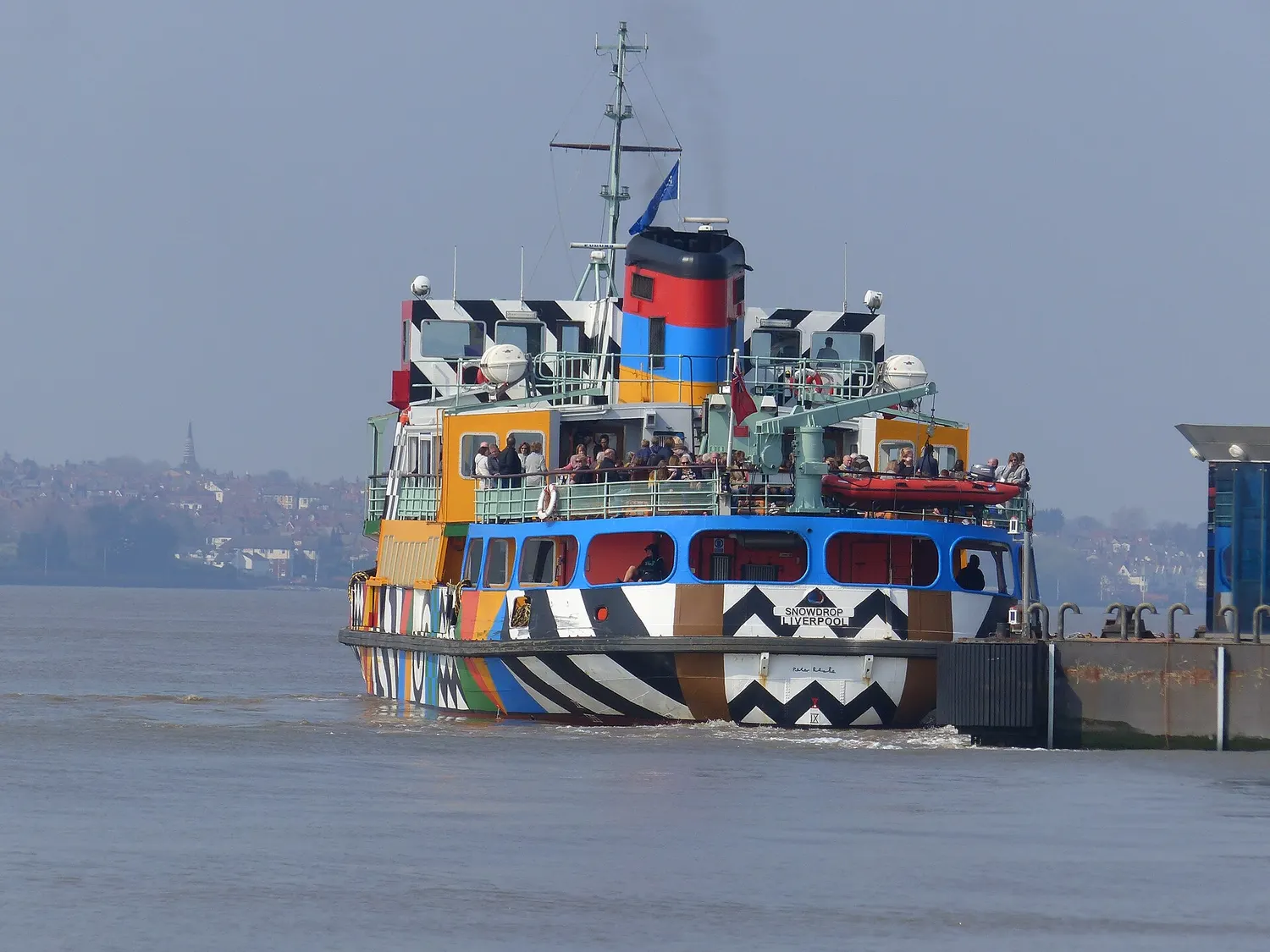
The current network includes the direct Seacombe crossing, River Explorer services and leisure sailings. Snowdrop is also being retained and upgraded as part of the working fleet.
A New Brighton route would therefore need to fit into the wider operating programme rather than simply making use of a ferry that would otherwise be idle.
The September Transport Committee update said the Combined Authority expects the new vessel to help increase passenger numbers and income across Mersey Ferries.
How a New Brighton service would contribute to that has not yet been published.
The New Brighton masterplan already wants stronger links to Victoria Road
The ferry proposal also intersects with Wirral Council's wider plans for New Brighton.
The council adopted its Marine Promenade Masterplan as planning strategy in July 2024. It envisages a mix of cultural, leisure, hotel, residential and commercial development and explicitly looks at how waterfront regeneration can support neighbouring areas including Victoria Road and Seabank Road.
The detailed masterplan describes Victoria Road as a street where independent food, drink and community businesses have already been driving regeneration.
Proposals include improving public space and strengthening the connection between the road and the promenade.
A ferry terminal could therefore only be assessed properly as part of a wider pedestrian and transport system.
Delivering hundreds of people to the waterfront has much less value to Victoria Road businesses if visitors cannot easily see where the independent quarter is or reach it comfortably.
Wayfinding, public realm and the location of the terminal could influence the economic effect almost as much as the ferry timetable.
The Woodside investment offers a useful comparison
Woodside also demonstrates why the business case cannot stop at passenger numbers.
The new Woodside landing stage forms part of a wider regeneration strategy intended to reconnect the waterfront with Hamilton Square and central Birkenhead.
The Combined Authority has explicitly linked ferry infrastructure there with housing, hotels, leisure development and public-space improvements.
New Brighton presents a similar question in a different setting.
Is a landing stage simply transport infrastructure, or could it also function as an arrival point that directs visitors towards independent businesses, the Floral Pavilion, Marine Point, the beach and Victoria Road?
That is something a detailed business case can test rather than assume.
What needs to happen before a New Brighton ferry becomes realistic
The immediate development is relatively simple: feasibility work is taking place.
Before residents should expect to see ferries calling at New Brighton again, considerably more information would need to emerge.
The key questions are:
Where would the terminal be built?
Can a safe landing stage operate there throughout the required tidal conditions?
How much would construction cost?
What marine, environmental and planning permissions would be required?
Would the service run year-round or seasonally?
Would it be a direct Pier Head service or part of a wider ferry circuit?
How many additional passengers would it generate?
Would another ferry be required to sustain the wider timetable?
How would passengers connect with Victoria Road and the rest of New Brighton?
Where would the capital funding come from?
Until those questions are answered, the most accurate description is that a Liverpool to New Brighton ferry is being investigated, not reinstated.
The idea is considerably more credible than simply reopening an old route on a map. Liverpool City Region now has a new ferry, recent experience building and replacing landing stages and a New Brighton regeneration strategy that already seeks stronger links between the waterfront and Victoria Road.
It also has an unavoidable engineering problem beneath the water.
The next useful information will therefore not be another expression of support for the route. It will be a site, an engineering option, a cost and evidence of how many people would use it. In the meantime, passengers can check day-to-day services via our Mersey Ferry times and fares guide or explore the network's backstory in our history of the Mersey Ferry.
No decision has been made. Liverpool City Region Mayor Steve Rotheram confirmed that feasibility work is underway to examine whether a route could return, but no terminal location, budget or timetable has been approved.
When did the New Brighton ferry stop running?
Regular Mersey Ferry services to New Brighton ended in 1971, with the final crossing on 26 September 1971. The ferry landing stage was subsequently removed and the pier demolished in the late 1970s.
Why is building a New Brighton ferry terminal difficult?
The River Mersey has a tidal range approaching 11 metres, requiring a floating landing stage and linkspan bridge secured to the riverbed rather than a simple fixed platform.
Will the new Royal Daffodil run to New Brighton?
There is no announcement allocating Royal Daffodil to a New Brighton service. The vessel is committed to existing cross-river commuter sailings, River Explorer cruises and events.
Comments
Join the conversation with your L1Local Community account. Keep it civil and on topic.
Liverpool this week
New places, local news, things to do and our latest guides. Weekly.
Comments
Join the conversation with your L1Local Community account. Keep it civil and on topic.