Photo: Rodhullandemu (CC BY-SA 4.0) via Wikimedia Commons
Guide
History of the Mersey Ferry: 875 Years on the River
The Mersey Ferry from Birkenhead monks in 1150 to the Zeebrugge Raid, The Beatles, Gerry Marsden and the new Royal Daffodil, plus today's fares and times.
By Brian K · 26 Aug 2026 · Updated 22 Sep 2026 · 12 min read
In this guideKey dates in the Mersey ferry's history
The Mersey Ferry was carrying people across this river before Liverpool had a charter, before the docks, and about 760 years before anyone thought of tunnelling underneath it.
Mersey Ferries dates the crossing to around 1150, when monks at Birkenhead Priory rowed travellers over on market days. That is roughly 875 years of the same basic transaction: pay on one bank, get carried to the other.
This is how it survived steam, two railway tunnels, two road tunnels and the motor car, and what is happening to it now. Fares, times and the new ferry were checked against Mersey Ferries and Merseytravel on 26 August 2026.
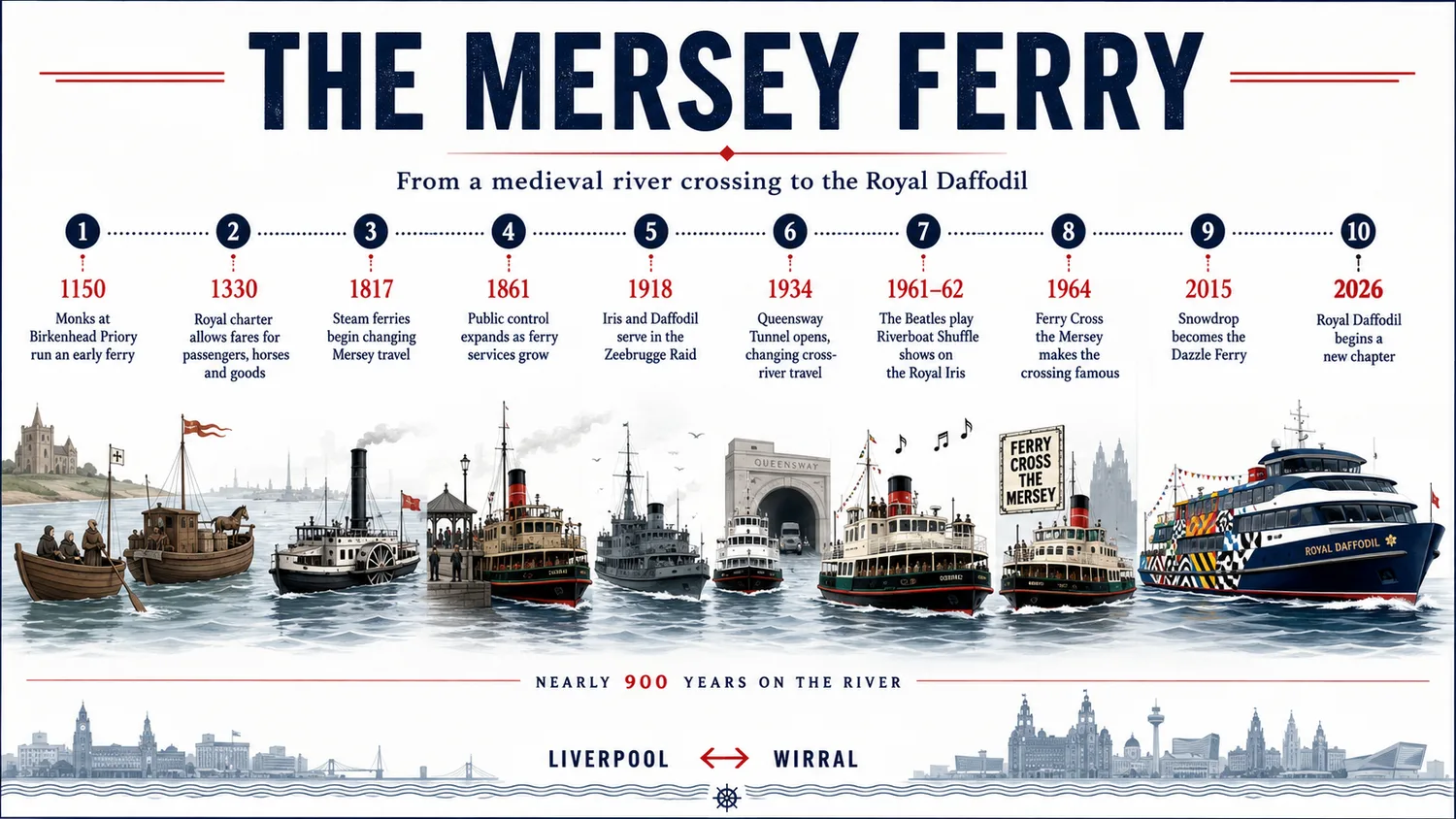
Key dates in the Mersey ferry's history
c.1150: Benedictine monks at Birkenhead Priory run a ferry to Liverpool. Liverpool is not a borough until 1207.
1330: Edward III lets the priory charge tolls for passengers, horses and goods.
1918: the ferries Iris and Daffodil fight at Zeebrugge, and George V gives them the Royal prefix.
1961 to 1962: The Beatles play four Riverboat Shuffles on the Royal Iris.
1964: Gerry and the Pacemakers record Ferry Cross the Mersey.
March 2026: the Royal Iris of the Mersey retires after more than 60 years.
26 September 2026: the new £26m Royal Daffodil, built at Cammell Laird, makes its first public cruise.
It is still real transport: £3.10 single, every 20 minutes at peak, about 10 minutes across.
L1 Local illustrated timeline. The vessels are drawn for the period rather than as portraits of specific ships.
It started on the Wirral side
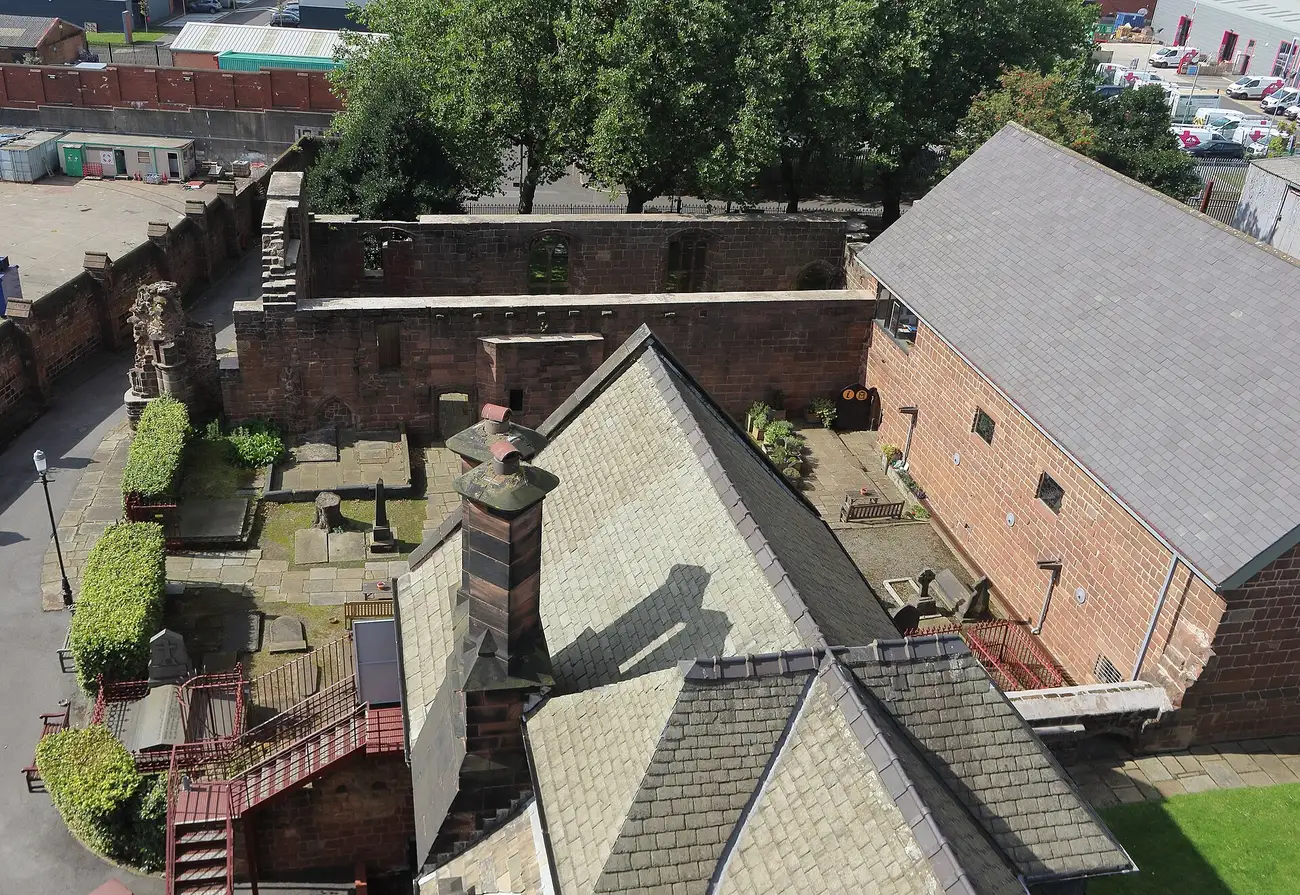
Birkenhead Priory, where the crossing began. Photo: Rodhullandemu (CC BY-SA 4.0) via Wikimedia Commons.
Birkenhead Priory was founded in the twelfth century, close enough to the water to be useful to anyone trying to reach Liverpool. Around 1150 the monks were carrying travellers over on market days.
Crossing was not the ten minutes it is now. The Mersey is tidal with strong currents, shifting channels and a nasty temper in a northerly, and research from the University of Liverpool notes currents reaching around five knots. So the priory offered more than a boat: it offered food and somewhere to wait when the river said no.
Royal charters in 1318 and 1330 put the arrangement on a legal footing. Edward III's 1330 charter let the monks charge tolls for carrying passengers, horses and goods, which turned a favour into a franchise.
There was more than one Mersey ferry
Calling it "the Mersey Ferry" flattens something much messier. For centuries there were many crossings, run by different owners, serving different places: Woodside, Seacombe, Tranmere, Egremont, New Brighton, Rock Ferry, New Ferry and Eastham.
As Wirral filled up, those routes carried people to work in Liverpool and Liverpool people out to the coast. Most of them are gone now, which is why the surviving service can feel like a remnant rather than what it is: the last two or three of a dozen.
Steam, and then public ownership
Rowing and sail gave way to steam early. The Princess Charlotte was working Eastham by 1816 and the Etna was at Tranmere in 1817, and by the mid-1820s steam packets were listed at Woodside, Seacombe, Birkenhead and Eastham.
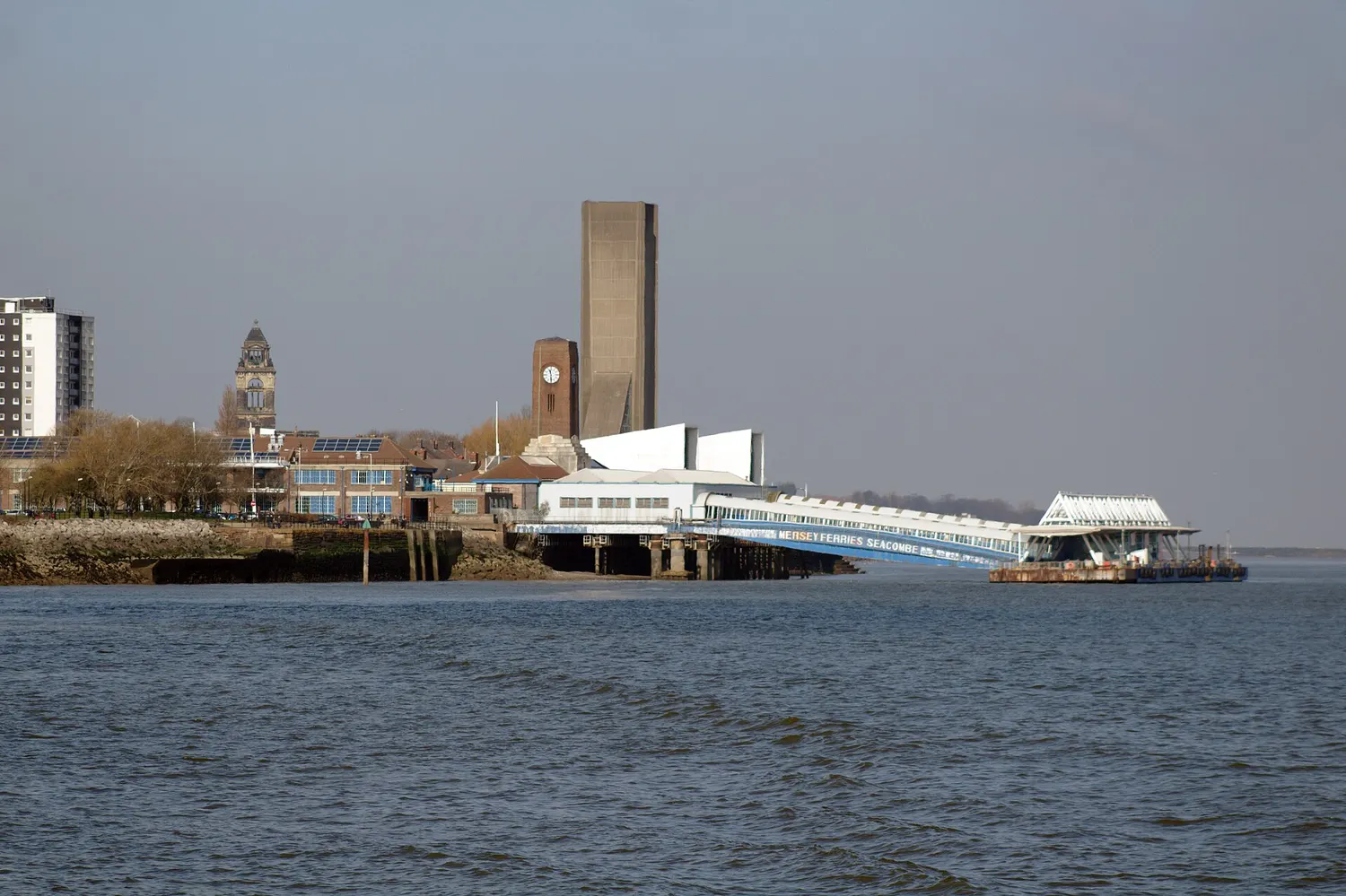
The other change was who owned it. Wallasey's ratepayers voted in 1857 to bring Seacombe, Egremont and New Brighton under municipal control, and the Wallasey Local Board took over on 1 August 1861. The argument then is the argument now: a river crossing this important is not something to leave entirely to whoever fancies running it.
Seacombe, under municipal control since 1861 and still running today. Photo: Rodhullandemu (CC BY-SA 4.0) via Wikimedia Commons.
Thirty-two million passengers a year
Before the tunnels, if you wanted to get from central Liverpool to Birkenhead or Wallasey, the river was in the way and the ferry was the answer.
The Mersey Railway tunnel opened in 1886 and gave the ferries their first serious competition. Even so, the scale stayed extraordinary. In the year to March 1920 the Seacombe, Egremont and New Brighton services between them are reported to have carried around 32 million passengers.
That is the part that is hard to picture now. This was not a day out. It was mass transit, at rush hour, in all weathers.
When two Mersey ferries went to war
This is where the "Royal" comes from, and it is worth knowing before you next get on one.
In the First World War the Wallasey ferries Iris and Daffodil were requisitioned by the Royal Navy. On 23 April 1918 they took part in the Zeebrugge Raid, an attempt to block the German-held Bruges canal system used by U-boats.
Ferries were chosen for unglamorous reasons: shallow draught, manoeuvrable, and able to carry a lot of people. Daffodil's job was to push the converted cruiser HMS Vindictive against the Zeebrugge Mole and hold her there while troops went ashore under fire.
Both survived and came home to the Mersey on 17 May 1918. King George V ordered that they be renamed Royal Iris and Royal Daffodil. Every ferry since that has carried those names carries them because of one morning in Belgium.
Then they dug underneath it
The Queensway Tunnel opened to Birkenhead in 1934, and the Kingsway Tunnel to Wallasey in 1971. Between them they did to the ferry what the ferry had done to nothing at all.
The ferries had carried vehicles and goods as well as people, on vessels known locally as luggage boats. Once a lorry could simply drive under the river, that trade was finished. Foot passengers followed as buses, cars and rail took over, and the network shrank back from Eastham, Rock Ferry, Egremont and New Brighton to the crossings that survive.
Something that had been essential had to find another reason to exist.
The Beatles played on it
Part of that reason turned up in the early 1960s, when the Royal Iris hosted Cavern Club Riverboat Shuffle cruises.
The four Beatles performances aboard the Royal Iris
Date
Note
25 August 1961
Riverboat Shuffle, Pete Best on drums
6 July 1962
Riverboat Shuffle
10 August 1962
Riverboat Shuffle
28 September 1962
Final ferry performance, with Ringo Starr
The last one came days before Love Me Do was released on 5 October 1962. That Royal Iris was nicknamed the Fish and Chip Boat, because it had a fish and chip saloon on board.
Worth being clear about which ship: that is not the Royal Iris of the Mersey that retired this year. Different vessel, reused name.
Gerry Marsden made it famous
Then in 1964 Gerry and the Pacemakers recorded Ferry Cross the Mersey, followed by the film in 1965, and the crossing stopped being only a commute.
For people here it stayed the way you got to work. For everyone else it became a thing you did because it was the Mersey Ferry. Both are still true on the same boat.
After Marsden died in 2021 the Pier Head terminal was renamed the Liverpool Gerry Marsden Ferry Terminal, unveiled in May 2022 after public consultation.
The Dazzle Ferry
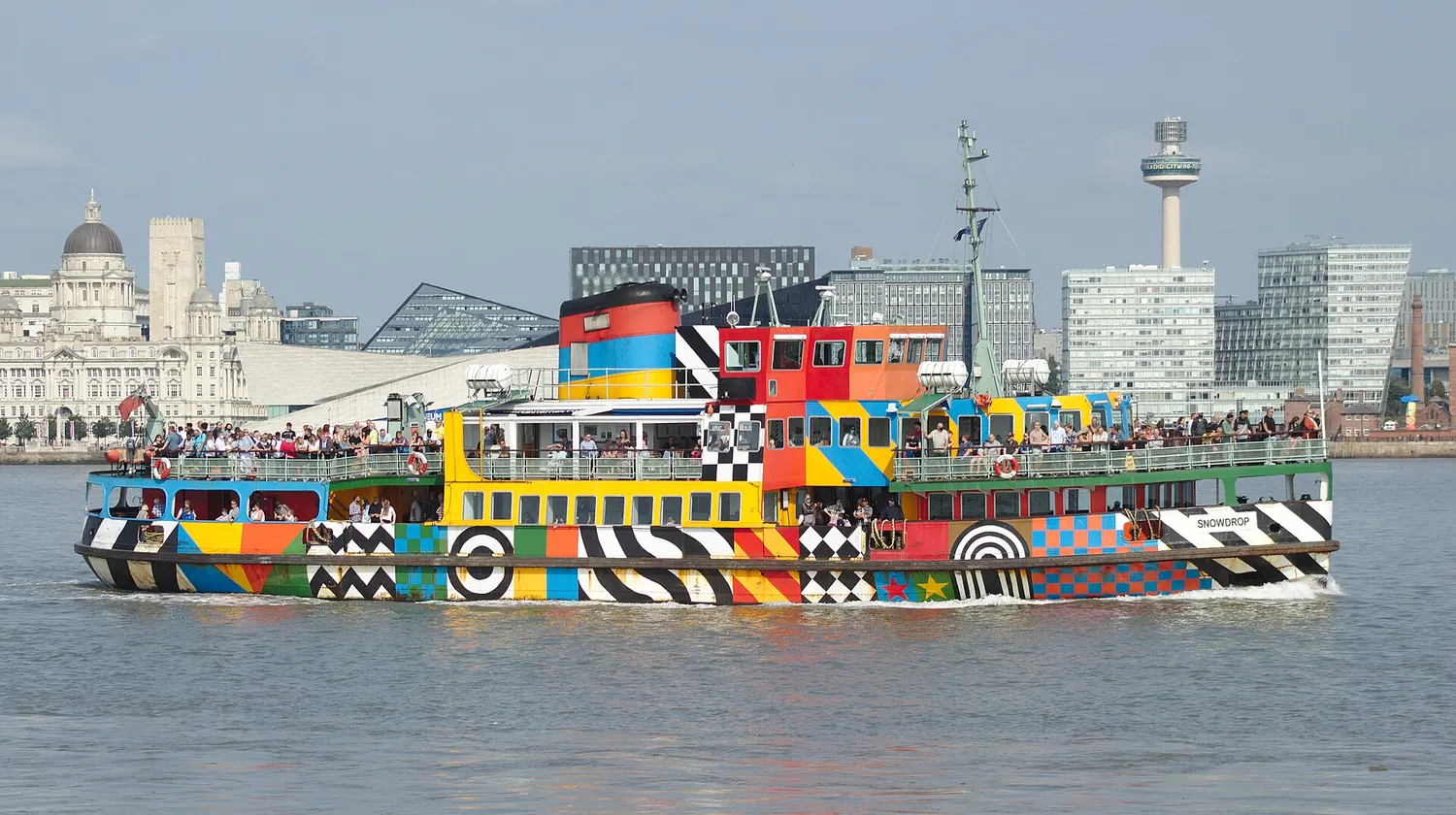
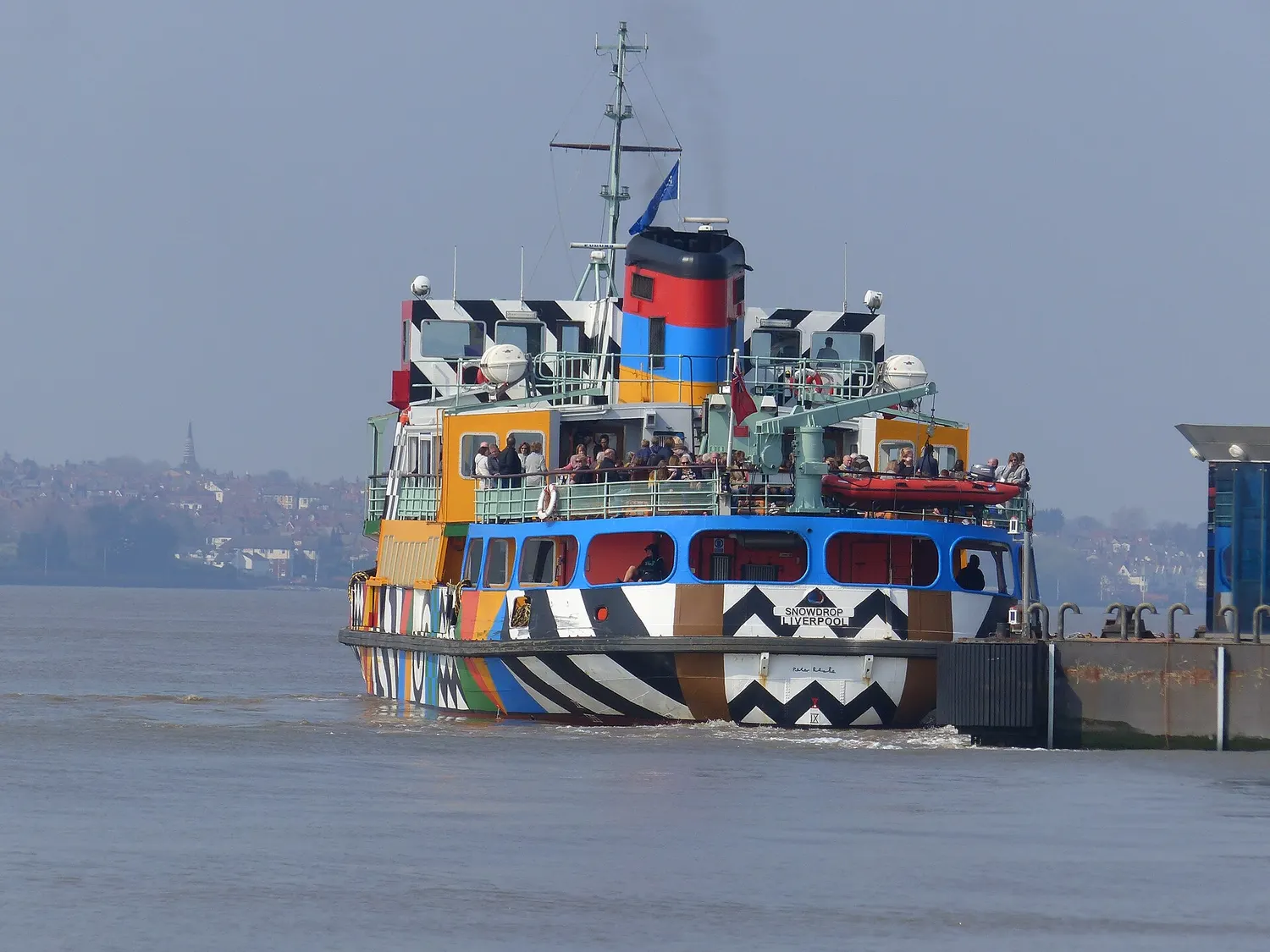
Snowdrop leaving the landing stage. Photo: Ruth Sharville (CC BY-SA 2.0) via Wikimedia Commons.
In 2015 Sir Peter Blake painted Everybody Razzle Dazzle onto the ferry Snowdrop for the First World War centenary, working with Liverpool Biennial, 14-18 NOW, Tate Liverpool, Merseytravel and National Museums Liverpool.
The design references dazzle camouflage, which was not meant to hide a ship at all. It was meant to make its course and speed hard to judge through a periscope. The paintwork was supposed to be temporary and is still there in 2026.
Snowdrop is a lot older than its paint: built in 1959, originally named Woodchurch.
The Royal Iris of the Mersey bows out
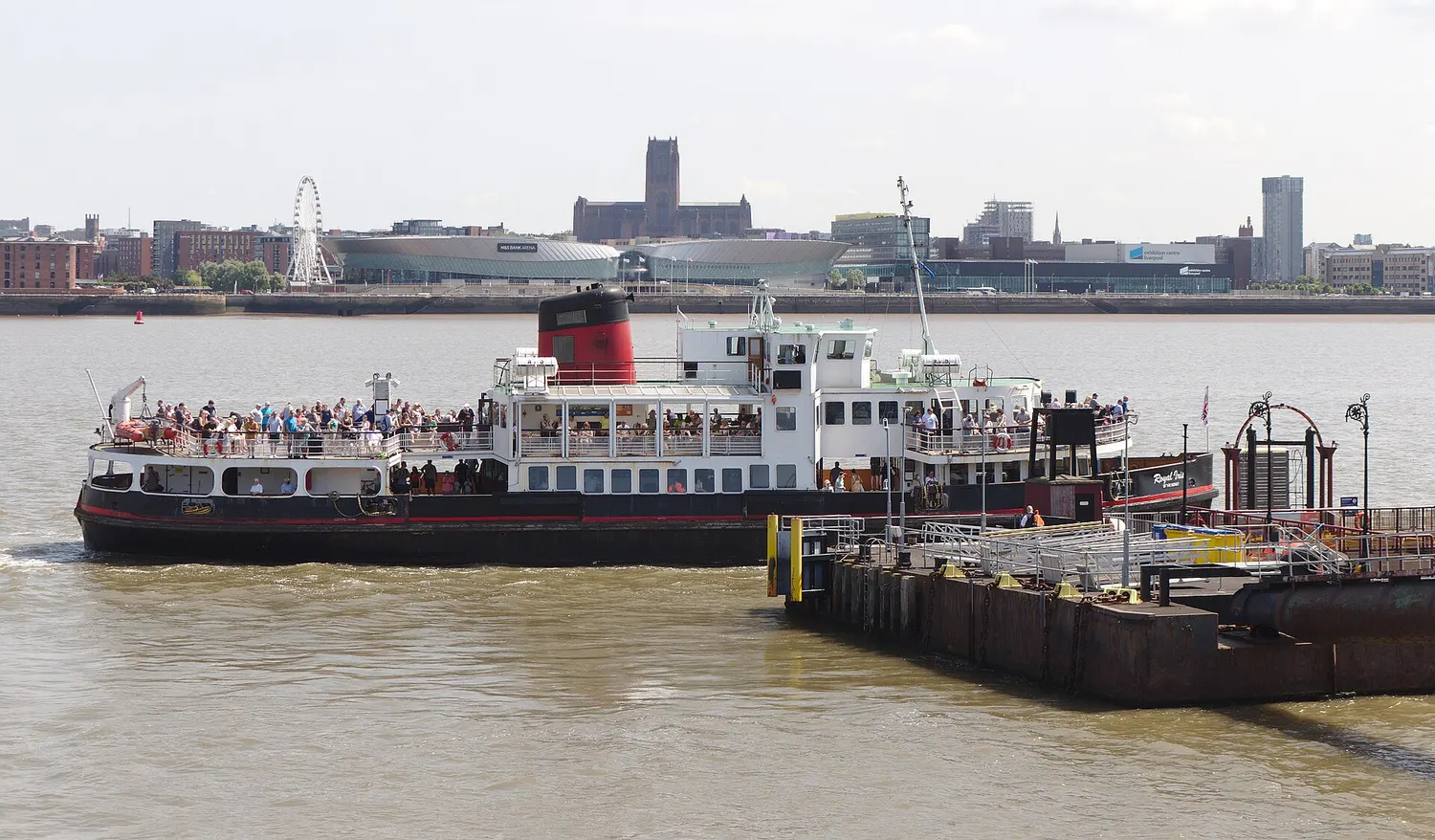
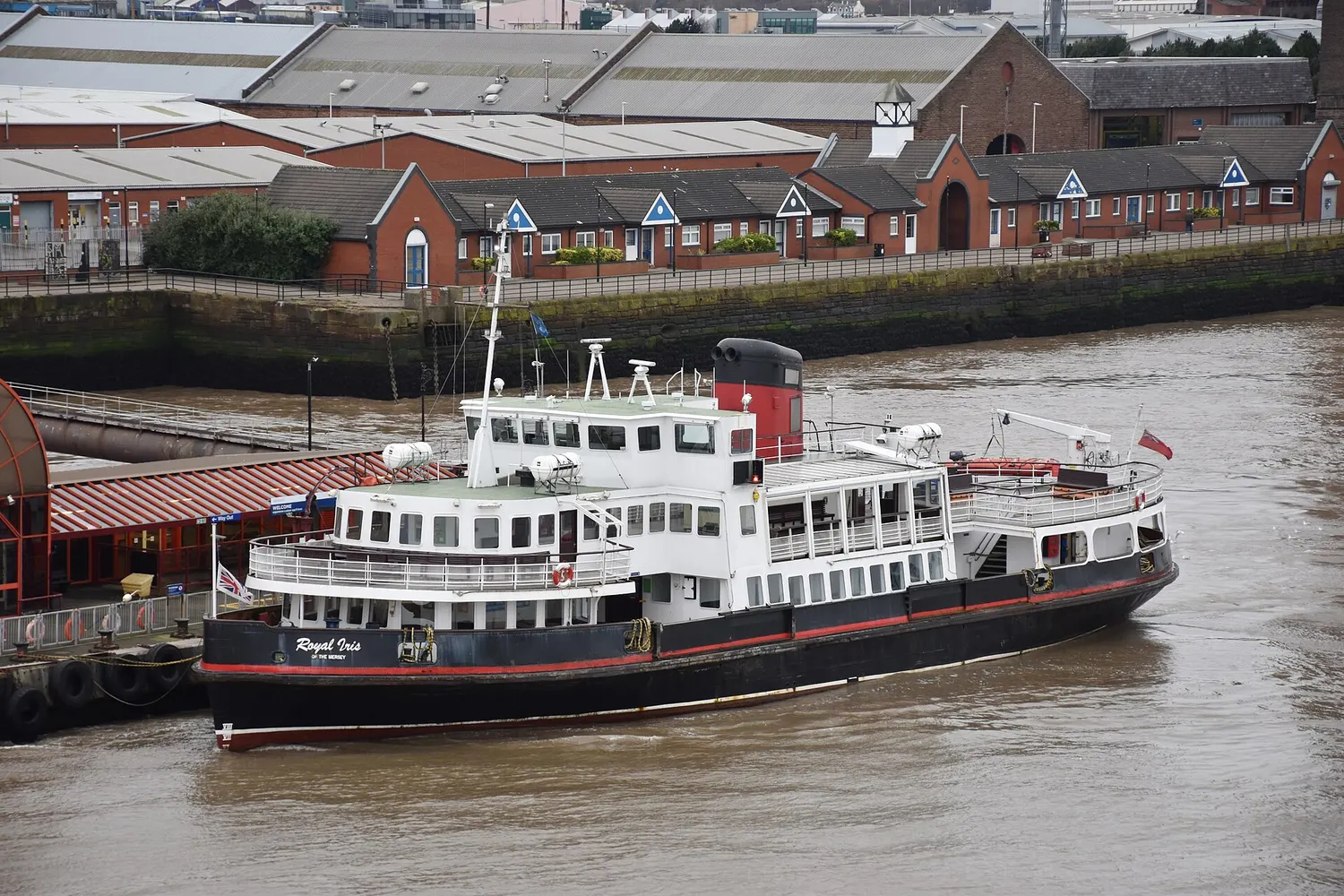
Royal Iris of the Mersey arriving at Woodside. Photo: Rodhullandemu (CC BY-SA 4.0) via Wikimedia Commons.
The Royal Iris of the Mersey made its last passenger sailing on Sunday 29 March 2026 and was formally decommissioned on Tuesday 31 March, after more than 60 years on the river. Snowdrop kept the service running.
Photo: Niels Johannes (CC BY-SA 4.0) via Wikimedia Commons.
Royal Daffodil, built in Birkenhead
The replacement brings the story back to within a mile of where it started. The Royal Daffodil is the first newly built Mersey Ferry in more than 60 years, a £26 million vessel built at Cammell Laird in Birkenhead.
It was announced by Metro Mayor Steve Rotheram in 2023, laid down at Cammell Laird on 10 January 2025, took to the river for the first time on 6 November 2025 and began sea trials in April 2026. It is the sixth Mersey Ferry to carry the name.
On board there is a lift to the upper deck, bike storage, bars and flexible event space, and the propulsion has been specified with lower-emission running in mind.
Royal Daffodil made her maiden voyage on Tuesday 22 September 2026, formally joining the fleet after a ceremony at the Gerry Marsden Ferry Terminal, complete with a traditional blessing and a tugboat salute. Her first public cruise is on Saturday 26 September 2026 at 11.30am, leaving the terminal and returning at 12.30pm, with places allocated by ballot. Ordinary scheduled passenger sailings are expected to start in October 2026, though Mersey Ferries has not yet published an exact date. Full details of what's on board are in L1Local's look inside Royal Daffodil.
Yes, you can still just use it
This is the bit people miss. The ferry is not only a cruise. There is a direct weekday commuter crossing between Seacombe and the Gerry Marsden Ferry Terminal, about 10 minutes across, every 20 minutes from 7.20am to 9.40am and 5pm to 6.40pm, Monday to Friday. It does not run on bank holidays.
Mersey Ferries direct cross-river commuter fares, checked 26 August 2026
Ticket
Adult
Single
£3.10
Return
£4.20
6-journey Flexi
£11.50
10-journey Flexi
£16.50
Monthly
£68.00
Quarterly
£171.00
Children aged 5 to 18 pay £1.60 single. Fares change, so check Mersey Ferries before you rely on these. Our Mersey Ferry commuter guide covers the practicalities of doing it daily.
If you want the sightseeing version instead, the River Explorer Cruise runs about 50 minutes between Liverpool and Seacombe at £14 adult and £9 for children aged 5 to 15. You can check River Explorer Cruise availability and book through LoveToVisit. This is an affiliate link, so L1 Local may earn a commission if you book through it, at no extra cost to you.
Woodside is shut
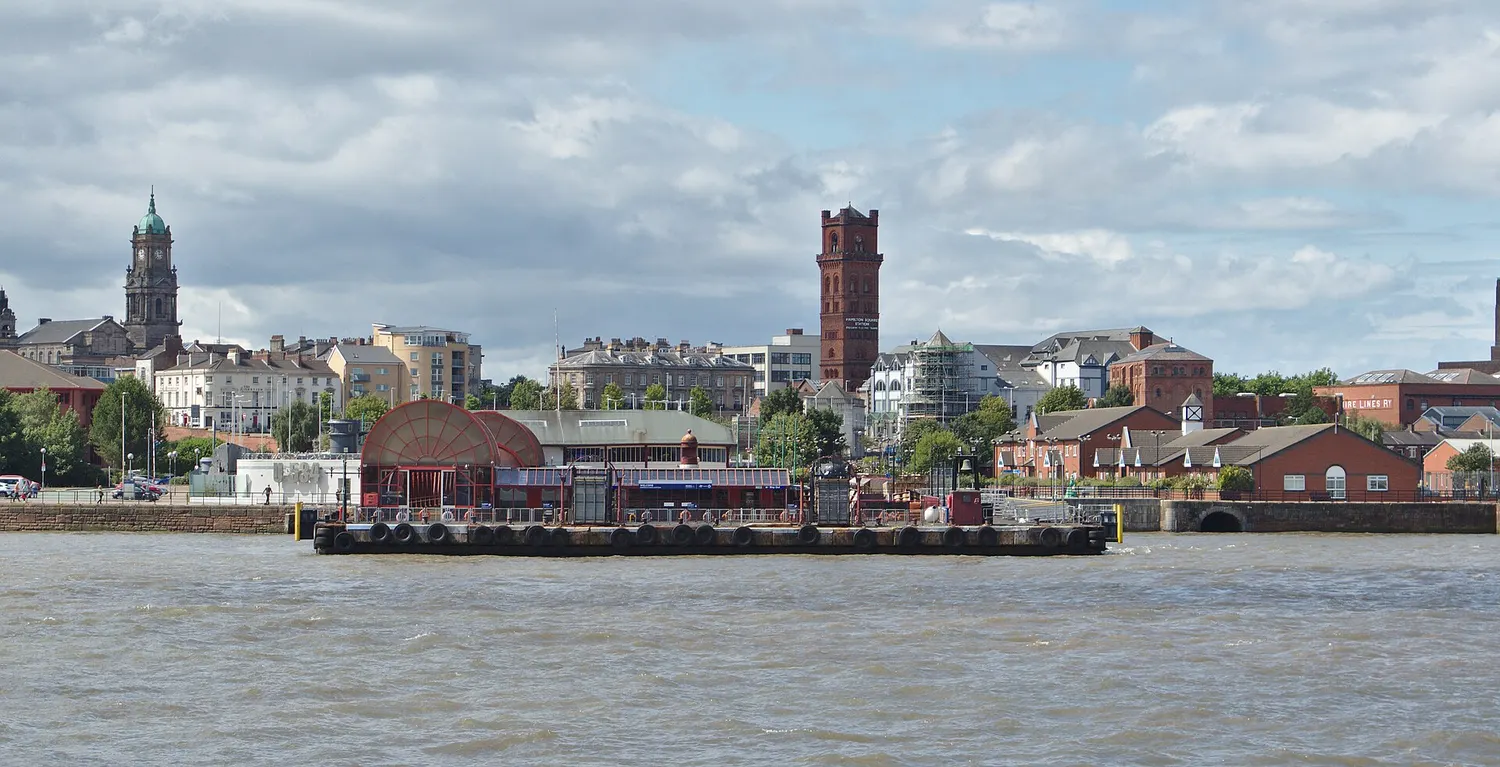
Woodside, closed for major refurbishment. Photo: Rodhullandemu (CC BY-SA 4.0) via Wikimedia Commons.
Historically the most important terminal of the lot, Woodside is currently closed for major refurbishment, and services run from Pier Head and Seacombe only. A new 52-metre landing stage and 120-tonne linkspan went in during December 2025 as part of a £9 million project, so it is coming back rather than going away.
Why it survived when nothing said it should
Look at what arrived to kill this thing off. Steam. A railway tunnel in 1886. The motor car. Queensway in 1934. Buses running under the river. Kingsway in 1971. Any one of them should have finished a medieval river crossing.
It survived because it stopped being only one thing. A service people used because they had to cross the Mersey became one people also used because they wanted to cross it on a boat, and the second reason turned out to be durable.
That is what the Royal Daffodil represents: £26 million of public money spent on keeping a working crossing working, rather than preserving a museum piece.
The boats have changed completely. The terminals have changed. Liverpool and Wirral are unrecognisable. The river has not moved, and people are still paying to get across it.
What to do next
If you have only ever done it as a cruise, do the 7.20am from Seacombe once. It costs £3.10 and it beats the tunnel queue for the same money.
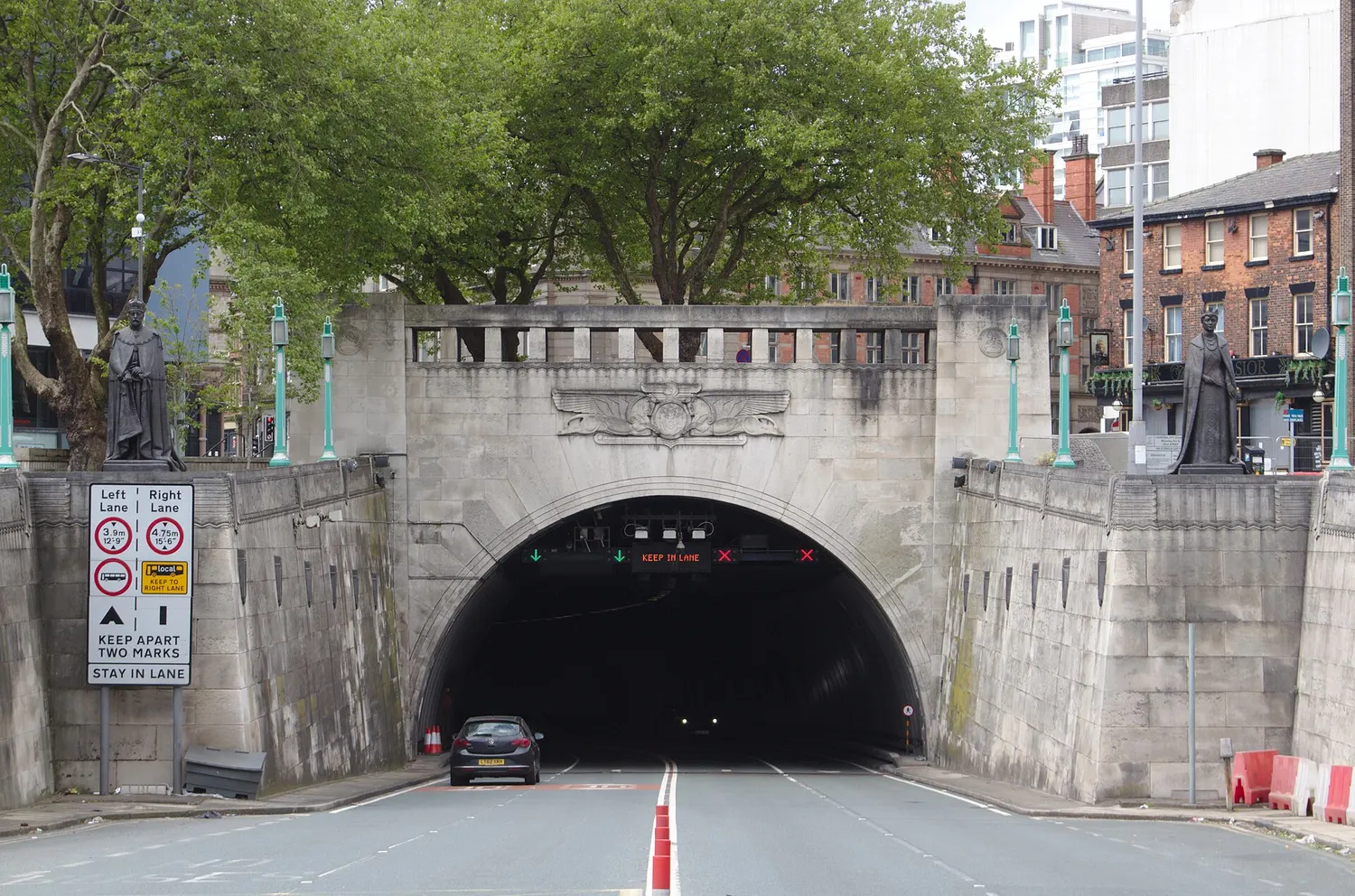
How Liverpool and Wirral were joined under the river: the 1886 railway tunnel, Queensway in 1934 and Kingsway in 1971, and what it took to build each one.
Mersey Ferries dates the crossing to around 1150, when Benedictine monks at Birkenhead Priory carried travellers to Liverpool on market days. That is roughly 875 years, and it predates Liverpool's 1207 charter by more than half a century.
How much is the Mersey Ferry commuter crossing?
The direct cross-river adult fare is £3.10 single and £4.20 return. A 6-journey Flexi is £11.50 and a 10-journey Flexi £16.50. Monthly is £68 and quarterly £171. Children aged 5 to 18 pay £1.60 single. Check Mersey Ferries before travelling, as fares change.
When does the Mersey Ferry commuter service run?
Every 20 minutes between 7.20am and 9.40am and between 5pm and 6.40pm, Monday to Friday, between Seacombe and the Liverpool Gerry Marsden Ferry Terminal at Pier Head. The crossing takes about 10 minutes. It does not run on bank holidays.
When does the new Royal Daffodil start?
Royal Daffodil made her maiden voyage and formally joined the fleet on Tuesday 22 September 2026, after a ceremony at the Gerry Marsden Ferry Terminal. Her first public cruise, allocated by ballot, is on Saturday 26 September 2026 at 11.30am, returning at 12.30pm. Ordinary scheduled passenger sailings are expected to begin in October 2026. It is the first newly built Mersey Ferry in more than 60 years and cost £26 million.
Why are the ferries called Royal Iris and Royal Daffodil?
The Wallasey ferries Iris and Daffodil were requisitioned for the Zeebrugge Raid of 23 April 1918. Both survived and returned to the Mersey, and King George V ordered that they carry the Royal prefix in recognition. Later ferries reused the names.
Comments
Join the conversation with your L1Local Community account. Keep it civil and on topic.
Liverpool this week
New places, local news, things to do and our latest guides. Weekly.
Comments
Join the conversation with your L1Local Community account. Keep it civil and on topic.