Seven months after Robert E. Lee surrendered at Appomattox, a Confederate warship sailed up the River Mersey and gave itself up to the British. The CSS Shenandoah had spent more than a year crossing the world's oceans, attacking American shipping and, for part of that time, fighting a war that had already ended.
On 6 November 1865, the Shenandoah entered the Mersey flying the Confederate flag and anchored in the Sloyne. Commander James Iredell Waddell surrendered the ship to the British through Captain James G. Paynter of HMS Donegal. The US National Archives calls it the final Confederate surrender of the American Civil War. But the Liverpool ending only makes sense alongside the city's much deeper connections to the Confederacy, cotton and slavery.
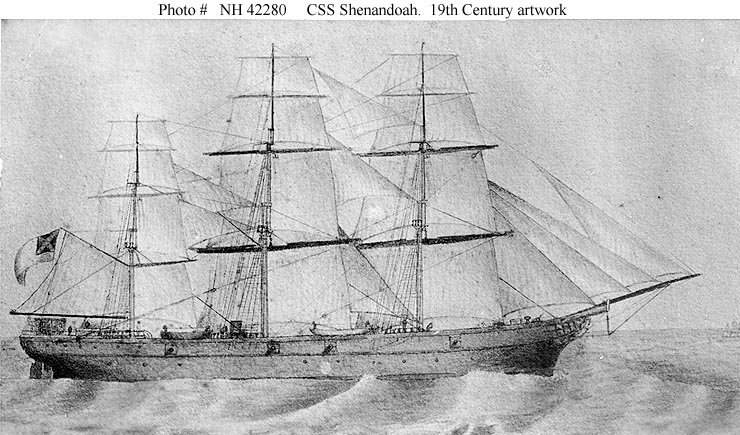
CSS Shenandoah. Public domain image from the U.S. Naval History and Heritage Command, via NOAA PMEL.
What happened on the Mersey on 6 November 1865
The Shenandoah reached Liverpool on the morning of 6 November 1865, flying the Confederate flag, and anchored in the Sloyne, a deep-water stretch of the Mersey off Rock Ferry and Tranmere. Waddell brought the ship close to HMS Donegal, the Royal Navy guardship, and passed a formal letter of surrender to Captain Paynter. The Confederate flag was lowered.
British personnel then took control of the vessel. Contemporary records describe Royal Marines, sailors from the Donegal and customs officers going aboard. Officials found chronometers, sextants, furs and other property taken from ships the Shenandoah had captured during its year-long campaign against American shipping.
The United States consul in Liverpool reported the ship's arrival the same day, recording the Confederate flag flying as it came into port and its anchorage in the Sloyne.
Was Liverpool really the final surrender of the Civil War?
Appomattox is usually treated as the end of the war, but it was not quite that simple. General Lee surrendered the Army of Northern Virginia to Ulysses S. Grant on 9 April 1865, yet other Confederate forces stayed in the field. Brigadier General Stand Watie surrendered his command in Indian Territory on 23 June 1865, the last Confederate general to give up a command. The Shenandoah, though, was still at sea.
The National Archives places the Liverpool event under the heading "The Final Surrender" and dates the last Confederate surrender to the ship's arrival on 6 November. There is a further date worth keeping separate: President Andrew Johnson did not formally proclaim the insurrection over throughout the United States until 20 August 1866, more than nine months later. Appomattox, Stand Watie's surrender, the Shenandoah's surrender and Johnson's proclamation mark different stages in the war's end. Liverpool's place in that sequence is specific: the site of the last Confederate military surrender.
How a Liverpool-built voyage turned a merchant ship into a raider
The vessel that entered the Mersey in 1865 had not been built as a warship. It began as the Sea King, a British merchant ship. Confederate agents bought it in Britain in 1864, but arming a Confederate warship openly in a British port would have broken Britain's neutrality, so the ship and its weapons travelled separately. The Sea King left Britain unarmed; a second ship, the Laurel, was chartered in Liverpool to carry guns, stores and men. The two met off Madeira, where the cargo was transferred, the ship was armed and Waddell took command as the CSS Shenandoah. The US State Department's historical record confirms the Laurel was chartered at Liverpool for exactly this purpose. Liverpool appears at both ends of the ship's Confederate career: supplying the raider in 1864, then receiving its surrender in 1865.
Liverpool's Confederate connections went much further
Liverpool was one of the great commercial ports of the nineteenth century, its merchants and financiers trading across the Atlantic and its economy tied to Lancashire's cotton mills. Much of that cotton came from the American South, produced through enslaved labour.
The city also held commercial networks that actively backed the Confederacy. Historic England's listing for Allerton Hall records that Charles Prioleau, a South Carolina-born businessman who ran the Liverpool branch of Fraser, Trenholm & Co, was closely tied to the firm during the war. Fraser, Trenholm acted as banker to the Confederate government, financed supplies in return for cotton, took part in blockade running and helped fund Confederate naval vessels. Confederate naval officers were entertained by Prioleau at Allerton Hall, away from the US consul's attention.
Not everyone in Liverpool backed the Confederacy, but important parts of its commercial world had direct financial and logistical links with it. Those links cannot be separated from slavery. The US National Park Service notes that professional historians overwhelmingly identify slavery as central to the crisis that produced secession. Liverpool had also been Britain's dominant slave-trading port in the eighteenth century, and National Museums Liverpool's transatlantic slavery collection sets out how that trade built much of the city's older wealth. Britain abolished its own slave trade in 1807, decades before the Civil War, but Liverpool's nineteenth-century cotton economy still depended heavily on a crop grown by enslaved people.
Around the world, fighting a war that had already ended
Once commissioned, the Shenandoah sailed round the Cape of Good Hope, across the Indian Ocean and into the Pacific as a commerce raider, aiming to damage the United States by destroying merchant shipping rather than fighting warships. It eventually pushed north into the Sea of Okhotsk, the Bering Sea and Arctic waters, where American whaling ships became its main targets.
There was no way to tell a ship in the Arctic that the war was over. Lee surrendered in April 1865, the Confederate government collapsed, and the Shenandoah kept attacking. By August 1865 it had captured or destroyed 38 vessels. Waddell only got reliable news of the collapse on 2 August 1865, from the British ship Barracouta, which carried word of the surrendered Confederate armies and the capture of President Jefferson Davis. He immediately halted attacks and had the guns dismounted.
Sailing into an American port risked arrest, particularly since some of the ship's attacks had happened after organised Confederate resistance had effectively ended. Waddell instead turned for Britain, crossing the Pacific and rounding Cape Horn: about 23,000 miles in 123 days from the Aleutians to Liverpool. The Shenandoah remains the only Confederate warship to have circumnavigated the globe, covering roughly 58,000 miles in just over a year at sea.
Where exactly was the surrender?
It is easy to place the surrender at the Pier Head, but that is not quite right. Contemporary records put the Shenandoah in the Sloyne, a deep-water anchorage further upriver, off the Tranmere and Rock Ferry shore of the Wirral, not the stretch of water directly in front of today's waterfront.
The Pier Head is still the best place to understand Liverpool's relationship with the river and Atlantic trade, and our Pier Head visitor guide covers the Three Graces and the surrounding waterfront. But the ship itself surrendered further south, at the Sloyne.
What happened to the ship and crew afterwards
The surrender did not end the uncertainty. The Shenandoah stayed under guard in the Mersey while British officials in Liverpool and London considered the legal status of the crew, particularly whether any British subjects had served unlawfully aboard a Confederate vessel. Most of the crew were eventually allowed to leave. On 9 November 1865, Paynter reported the ship and its stores ready to be handed to the US consul in Liverpool.
The National Archives records that a later attempt to sail the ship to New York was beaten back by severe winter weather, forcing a return to Liverpool. The Shenandoah was eventually sold to the Sultan of Zanzibar and renamed El Majidi. The US Naval History and Heritage Command records that it was driven ashore and wrecked in a hurricane at Zanzibar on 15 April 1872.
Liverpool's waterfront museums are currently closed
The wider history of Liverpool, slavery and maritime trade is usually told at the Merseyside Maritime Museum and the International Slavery Museum on Royal Albert Dock. Both closed in early 2025 for a £58 million redevelopment and are not due to reopen until 2028. The rest of Royal Albert Dock, including its shops and restaurants, stays open, as does the Museum of Liverpool at the Pier Head, and National Museums Liverpool continues to publish material from its transatlantic slavery collection online. Our Liverpool waterfront walk has the current route and museum closures for the Pier Head to Albert Dock stretch.
Why the surrender on the Mersey still matters
The strongest part of the Shenandoah story is not that the Civil War happened to end in Liverpool. It is that Liverpool was involved before the final scene: its finance in the Confederate war effort, its businesses in blockade running, the guns and men that left the city aboard the Laurel, and a cotton economy built on enslaved labour. Then, after a voyage round the world, the ship came back to the Mersey, and on 6 November 1865 its flag came down for the last time.
The surrender did not formally end the war; Johnson's proclamation came the following year. But it links a specific stretch of this river to the closing stages of the American Civil War, and to a much larger story of how nineteenth-century Liverpool was bound up with cotton, slavery, finance and Atlantic shipping. For that longer local story, our history of Liverpool traces how the docks, the slave trade and the cotton economy shaped the city.