Photo: Lt C H Parnall, Royal Navy official photographer, public domain, via Wikimedia Commons
Guide
The River Mersey in Two World Wars: Convoys, U-boats and the Battle of the Atlantic
How the River Mersey became Britain's wartime lifeline: the Zeebrugge Raid, the Battle of the Atlantic, the Liverpool Blitz and two world wars of convoys.
The River Mersey was Britain's most important wartime lifeline. In the First World War, Liverpool's port kept the nation supplied while German U-boats hunted shipping in the Irish Sea. In the Second World War, the river became the headquarters of the Battle of the Atlantic, the longest continuous military campaign of the conflict. Over 1,000 convoys arrived in the Mersey, and the Western Approaches Command directed the fight against the U-boat threat from a secret bunker beneath Liverpool city centre. The river was not a backdrop to the wars. It was the front line.
The Mersey in the First World War
When Britain declared war on Germany on 4 August 1914, Liverpool was the second port of the British Empire. The Mersey's docks handled a vast proportion of the nation's imports, and the river's shipyards at Birkenhead were already building warships for the Royal Navy.
One of the first shots of the war fired locally came on 28 July 1914, when a Wirral artillery battery fired a warning shot across the Mersey at an unidentified fishing vessel. It was a sign of what was to come.
The U-boat threat in the Irish Sea
German U-boats began attacking merchant shipping in the Irish Sea almost immediately. On 3 February 1915, the submarine U-21 sank three smaller vessels in the Irish Sea off the mouth of the Mersey. Later that month, a German submarine carried out a series of raids on British merchant vessels off Morecambe Bay and a few miles from the mouth of the Mersey, sinking at least three ships.
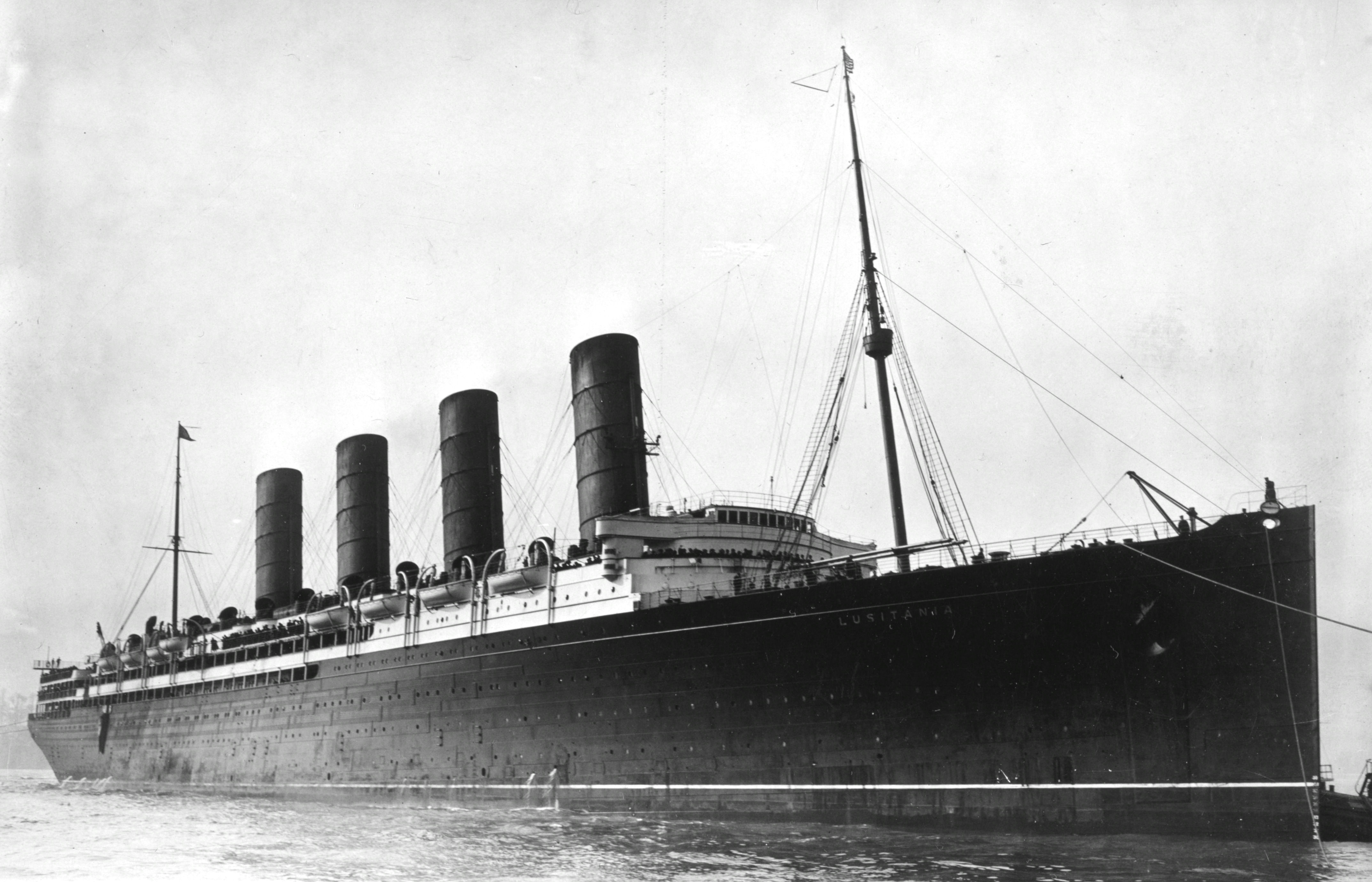
RMS Lusitania, photographed arriving in port between 1907 and 1913. Photo: George Grantham Bain, public domain, via Wikimedia Commons.
The most notorious attack came on 7 May 1915, when the Liverpool-registered liner RMS Lusitania was torpedoed by a German U-boat off the southern coast of Ireland. Of the 1,201 people who died, many were from Liverpool. The ship had been built at John Brown's yard on the Clyde but was owned by Cunard, whose headquarters were in Liverpool. A wreath was later cast on to the River Mersey to commemorate the tragedy.
Liverpool's shipping community was not easily intimidated. In 1915, a New York Times report noted that a submarine raid had failed to halt traffic to the port. A big liner had crossed the Irish Sea and arrived safely at the landing stage, while other vessels continued to arrive and leave. One steamer, the Graphic, was chased by a submarine over seven miles, with its boilers "put to the greatest test they ever had".
Dazzle camouflage on the Mersey
To counter the U-boat threat, the Royal Navy developed a form of camouflage known as dazzle painting. The idea was not to hide ships but to confuse enemy gunners about a vessel's course, speed and size. The artist Norman Wilkinson developed the technique, and Leonard Campbell Taylor worked under Wilkinson in Liverpool to camouflage ships with these patterns during the First World War.
The Mersey ferries at Zeebrugge
The most celebrated Mersey contribution to the First World War came from an unlikely source: two Wallasey passenger ferries, Iris II and Daffodil. Before the war, they carried commuters and day-trippers across the river. On 23 April 1918, they took on a very different role.
The Mersey ferries HMS Daffodil and HMS Iris II at Dover, soon after returning from the Zeebrugge Raid of 22 to 23 April 1918. Photo: Royal Navy official photographer, public domain, via Wikimedia Commons.
The ferries were drafted in to assist with the Zeebrugge Raid in Belgium. Zeebrugge was an outlet for German U-boats and destroyers. The aim of the raid was to sink three obsolete cruisers in the channel to block it. The plan required storming the mole, a long concrete harbour wall that reached into the sea. The ferries were to push the cruiser HMS Vindictive onto the pier so that Royal Marines could land and destroy shore batteries.
The ferries were chosen because their shallow drafts allowed them to dodge explosive mines. The raid was deemed a success. A submarine was exploded in place and two of the cruisers were sunk. Eleven Victoria Crosses were awarded for the night's action. After returning to the River Mersey under their own steam, Iris and Daffodil were awarded the Royal title by King George V, a distinction that Mersey ferries still carry today. The full story of the ferries, from medieval monks to the modern fleet, is in L1Local's history of the Mersey Ferry.
The Mersey in the Second World War
If the First World War established the Mersey's importance, the Second World War made it indispensable. Liverpool became Britain's main convoy port, maintaining the vital lifeline with the United States and Canada. Over 1,000 convoys arrived in the Mersey, on average three or four per week, with many warships and merchant ships repaired and built on Merseyside.
Between 1939 and 1945, the port of Liverpool handled more than 75 million tonnes of cargo, including 56 million tonnes of imports and 18.5 million tonnes of war supplies sent overseas.
Western Approaches Command and the secret bunker
The Battle of the Atlantic was the longest continuous military campaign of the Second World War. It was directed from Liverpool.
In February 1941, the Western Approaches Command was moved from Plymouth to Liverpool. The headquarters was established in a bomb-proof basement beneath Derby House, an office block at Exchange Flags in the city centre. The bunker was a combined headquarters for the Royal Navy and the Royal Air Force, responsible for protecting the vital supply convoys.
The Western Approaches Operations Room at Derby House, from where the Battle of the Atlantic was controlled, photographed in April 1945. Photo: Lt C H Parnall, Royal Navy official photographer, public domain, via Wikimedia Commons.
From this underground operations room, Royal Navy, Royal Air Force, and Women's Royal Naval Service personnel tracked convoys and U-boats on vast charts that covered the walls. The bunker is preserved today as the Western Approaches Museum, with the operations room kept as it was during the war. National Museums Liverpool's Battle of the Atlantic gallery at the Merseyside Maritime Museum covers the wider campaign.
The scale of the Battle of the Atlantic was immense. At least 111,000 sailors and military personnel from around the globe died in the six-year battle, including 26,500 British merchant sailors and 23,000 Royal Navy sailors. Some 3,500 merchant ships and 175 warships, representing 15 million tonnes of Allied shipping, were lost. Three in every four U-boats was sunk.
Shipbuilding and repair on the Mersey
The Mersey's shipyards were central to the war effort. Cammell Laird's yard at Birkenhead built three of the most famous warships of the Second World War: HMS Prince of Wales, HMS Ark Royal and HMS Rodney.
The Cammell Laird shipyard at Birkenhead, which built HMS Prince of Wales, HMS Ark Royal and HMS Rodney during the Second World War. Photo: Rudi Winter (CC BY-SA 2.0) via Wikimedia Commons.
During the war, the yard built more than 100 warships, mainly submarines, and several merchant ships. On average, Cammell Laird completed one ship every 20 days while also carrying out a great deal of ship repair and conversion work. Between 1939 and 1945, more than 100 warships and 2,000 merchant ships were repaired by the company.
More than 20,000 men and women were employed on Merseyside in vital ship repairing during the war. Alongside Cammell Laird, the main firms involved were Harland and Wolff, Archibald Brown and Grayson Rollo Ltd. Employees at these yards worked round the clock to mend thousands of merchant and naval ships, fitting them with guns and other war equipment. Everything was done to tight schedules so that ships would spend the least possible time in port.
Salvage teams from the Mersey Docks and Harbour Board, with help from the Liverpool and Glasgow Salvage Association, saved more than 200 ships that had been sunk or stranded in the River Mersey and its approaches. These salvaged ships, most of which had been bombed or mined, were invaluable to Britain later in the war.
The Liverpool Blitz
Liverpool's strategic importance made it a major target for the Luftwaffe. It was the second most bombed city in Britain after London.
The worst period was the May Blitz of 1941. Over one week in May, the German air force unleashed a firestorm on Liverpool and surrounding areas. During the bombing raids of May 1941, nearly 2,000 people lost their lives and more than 1,000 people were injured across Merseyside.
The statistics of that week are stark. An estimated 1,741 people were killed, including 1,453 in Liverpool and 257 in Bootle. More than 1,154 people were injured. In Liverpool alone, 4,400 houses were destroyed, 16,400 were seriously damaged and 45,500 were slightly damaged.
More than 90,000 houses were destroyed or damaged across Merseyside, and more than 75,000 people became homeless. Huge fires burned all over Merseyside and parts of Liverpool lay in ruins. Ships were wrecked in the docks and on the river, and huge warehouses stocked with food and supplies were pulverised. About 80 per cent of the buildings in the area were demolished.
One of the most tragic single incidents of the Blitz occurred on the night of 29 November 1940, when a direct hit on the large underground shelter in Durning Road, Edge Hill, crushed many of its 300 occupants. A total of 166 people died, with many more badly injured.
The Spirit of the Blitz memorial in Liverpool, commemorating those who lived through the bombing of the city. Photo: Rodhullandemu (CC BY-SA 3.0) via Wikimedia Commons.
The Liverpool Naval Memorial
The human cost of the Battle of the Atlantic is commemorated at the Liverpool Naval Memorial on the Pier Head, beside the River Mersey. The memorial commemorates over 1,400 men of the Merchant Navy who died serving with the Royal Navy during the Second World War and who have no grave but the sea.
The Liverpool Naval Memorial at the Pier Head, commemorating over 1,400 Merchant Navy personnel who died serving with the Royal Navy. Photo: John Bradley (CC BY-SA 3.0) via Wikimedia Commons.
The Western Approaches Museum at Derby House is open to the public and preserves the secret bunker from which the Battle of the Atlantic was directed. The operations room, with its charts and plotting tables, remains as it was during the war. The museum is a short walk from Liverpool's waterfront.
The Liverpool Naval Memorial at the Pier Head stands as a permanent reminder of the merchant seafarers who died keeping the sea lanes open. The memorial was restored in a "once in a generation" project completed in 2020.
The Mersey ferries continue to carry the Royal title awarded for their role in the Zeebrugge Raid. The current ferries operate commuter services across the river, and one still carries a dazzle design commissioned from the artist Sir Peter Blake, with an on-board display explaining the history of dazzle camouflage and the ferries' part in the First World War.
The River Mersey was not merely a waterway during the two World Wars. It was the artery through which Britain was fed, armed and supplied. The convoys that assembled in the Mersey, the ships built at Birkenhead, and the bunker beneath Exchange Flags were all part of a single effort to keep the Atlantic supply lines open. The river's role in those years remains one of the most significant chapters in Liverpool's history.