Liverpool ONE was not built on an empty patch of city centre.
Its 42-acre footprint covers streets that had existed for centuries: the remains of Liverpool's original tidal creek, the Old Dock that helped turn the town into an international port, Canning Place, the lost Custom House, the Sailors' Home, warehouses, a churchyard, post-war offices, a bus station and an earlier version of Chavasse Park.
The oldest surviving part is underground. More than 300 years after ships entered the Old Dock, sections of its brick and sandstone walls still stand beneath Liverpool ONE and can be visited today.
What stood on the Liverpool ONE site
The footprint: Liverpool ONE covers 42 acres linking the retail core around Church Street with the waterfront.
The Pool: Paradise Street and Whitechapel follow the natural contour of the tidal creek that gave Liverpool its name.
The Old Dock (1715): The world's first commercial enclosed wet dock was built here by Thomas Steers, allowing ships to load and unload regardless of the tide.
Transatlantic slavery: Slave ships operated from the Old Dock as Liverpool grew into Britain's dominant slave-trading port during the 18th century.
The Custom House (1828): After the dock was filled in 1826, John Foster Jr's vast neoclassical Custom House was built directly over the basin. It was bombed in the Blitz and demolished after the war.
Sailors' Home: Canning Place housed maritime offices and the ornate Sailors' Home (1851). Its restored gates now stand on Paradise Street.
Preserved archaeology: Major excavations in 2001 to 2005 uncovered the dock walls and thousands of artefacts, preserved beneath the modern shopping streets.
Liverpool ONE replaced several different versions of the city
Asking what stood here before Liverpool ONE does not produce one simple answer because the district repeatedly changed function over three centuries.
At different points, the exact same ground held:
A tidal creek → an enclosed wet dock → warehouses and merchant housing → major government customs buildings → hostels and facilities for sailors → post-war relief roads and offices → today's open-air retail, dining, residential and park streets.
Liverpool ONE was designed around surviving street alignments rather than as an enclosed indoor shopping mall. Paradise Street, College Lane, Peter's Lane and Hanover Street kept their historic names and routes, connecting modern shoppers with older paths through the town.
Before the shops there was the Pool
The oldest layer predates Liverpool's constructed docks. A tidal creek known as the Pool extended inland from the River Mersey and is widely recognised as the natural feature behind Liverpool's name.
Archaeological studies place the Pool beneath the modern city centre, curving along the line of modern Paradise Street and Whitechapel before meeting the old township boundary. Excavations around Chavasse Park uncovered water-laid silt deposits associated with the creek.
An 1808 guide to Liverpool described how the former tidal inlet had defined the edge of the early town. Before dock walls were built, the area around modern Paradise Street was an active, muddy shoreline directly exposed to the Mersey tides.
The Old Dock changed what Liverpool could do
As Liverpool's merchant trade grew in the early 18th century, the open tidal creek became inadequate for heavy cargo ships. In 1708, the Liverpool Corporation hired engineer Thomas Steers to design an enclosed dock.
Construction began in 1710 and the dock opened in 1715. By using lock gates to retain water at low tide, ships could stay afloat continuously, reducing loading and unloading times from weeks to days. It was the world's first commercially successful enclosed wet dock.
Construction cost roughly £12,000, placing heavy initial pressure on council finances, but it triggered a boom in maritime trade. The dock became known as the Old Dock only after newer docks were built north and south along the waterfront.
The Old Dock and the transatlantic slave trade
The commercial expansion made possible by the Old Dock was directly tied to Liverpool's central role in transatlantic slavery. Historic England records that slave ships departed from the Old Dock, and Sir Thomas Johnson, the Liverpool MP who promoted the dock's construction, financed early slave-trading voyages and traded in goods produced on plantations by enslaved people.
By the late 18th century, Liverpool had become Britain's pre-eminent slave-trading port. Wealth generated through the trafficking of enslaved Africans financed city institutions, civic architecture and further dock expansion. The Old Dock represents both groundbreaking civil engineering and the infrastructure of transatlantic slavery.
The Custom House was built inside the former dock
By the 1820s, Liverpool had outgrown its first dock. Larger vessels struggled to navigate the approach channel, and newer, deeper basins lined the river. The Old Dock closed in 1826 and was filled in.
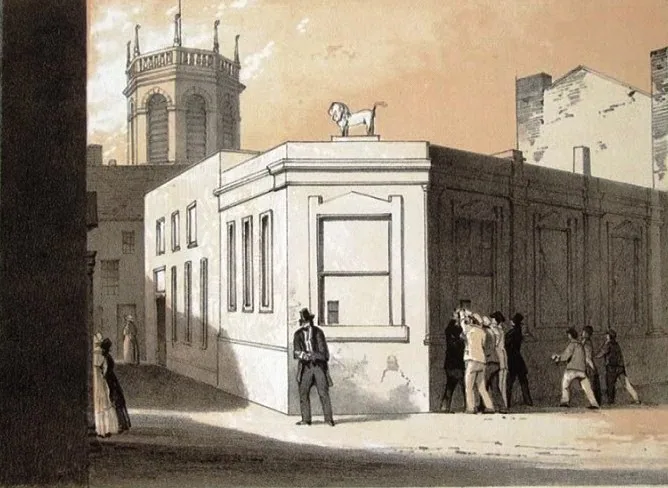
Canning Place in 1843, dominated by John Foster Jr's Custom House over the filled Old Dock. Print after William Gawin Herdman.
In 1828, work began on a vast new Custom House designed by John Foster Jr. Archaeological surveys confirmed that roughly 95 per cent of the building sat inside the footprint of the Old Dock, using the original 1715 dock walls as foundation retaining structures.
The massive classical building featured a central dome and grand ionic porticoes, housing customs officials, excise offices and the dock management. During the May Blitz of 1941, the Custom House was heavily damaged by incendiary bombs. Despite calls to preserve the surviving masonry shell, the building was demolished between 1946 and 1948, leaving Canning Place largely cleared.
Canning Place and the Liverpool Sailors' Home
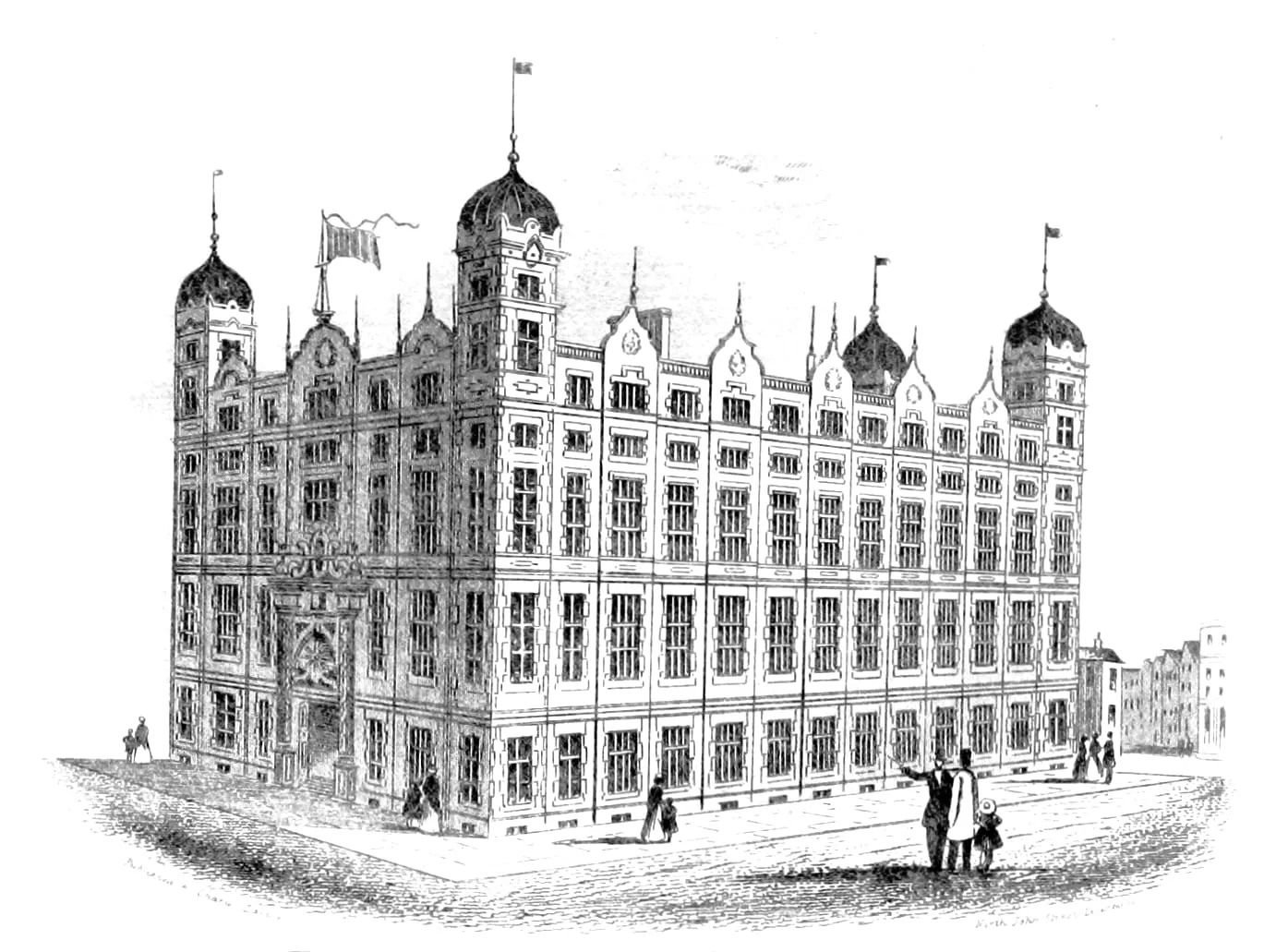
Nineteenth-century Canning Place was a dense maritime district serving seafarers from around the globe. Its most distinctive landmark was the Liverpool Sailors' Home, which opened in 1851 to provide safe accommodation, banking services and educational facilities for crews arriving in port.
Designed by John Cunningham in an ornate Elizabethan and Jacobean revival style, the building featured multi-tiered cast-iron balconies around a central hall, decorated with nautical motifs, anchors, ropes and mermaids. The Sailors' Home fell into decline during the 20th century and was demolished in 1974.
The Sailors' Home gates return to Paradise Street
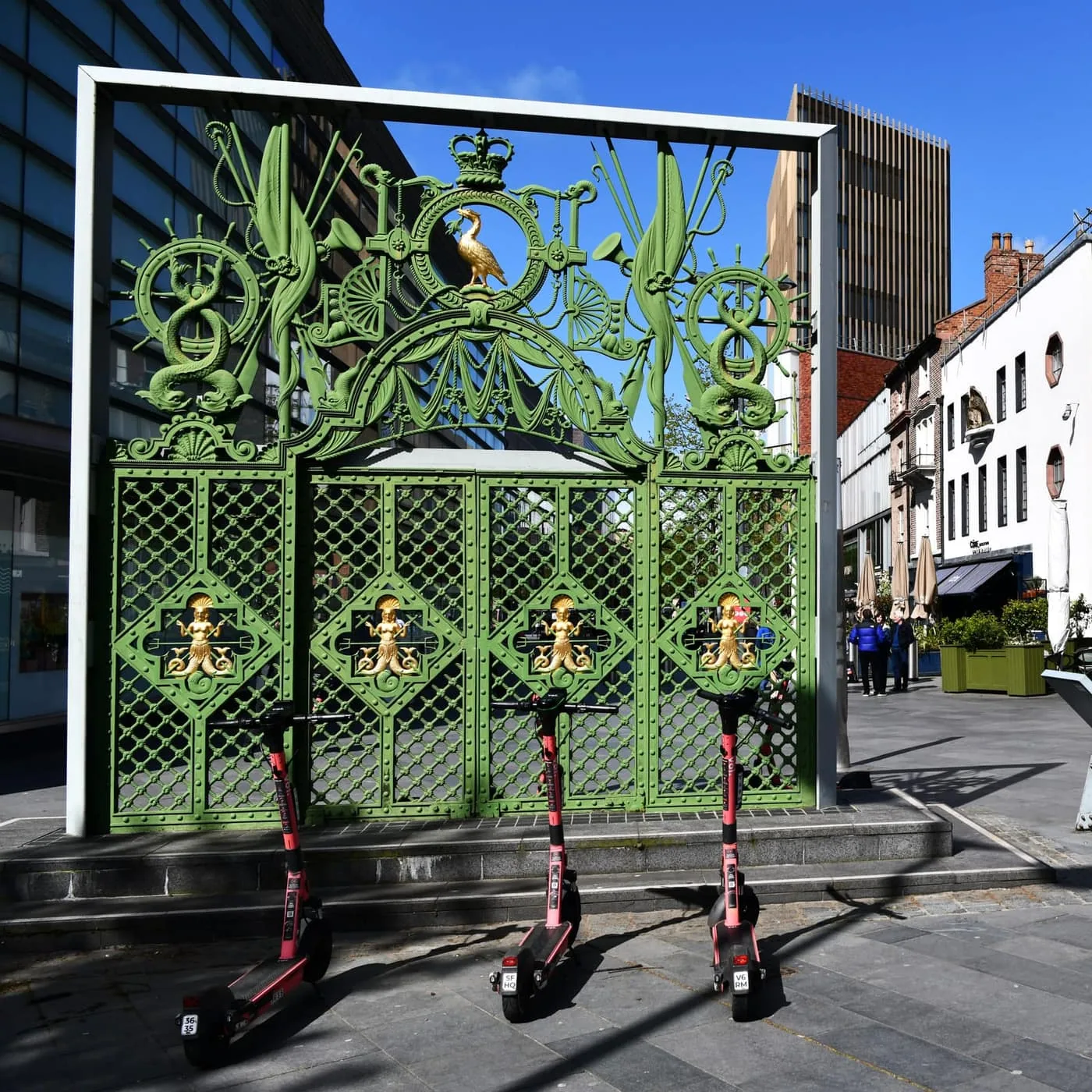
While the Sailors' Home itself was lost, its extraordinary cast-iron entrance gates were preserved. Removed in the mid-20th century and kept at the Soho Foundry in the West Midlands, the restored Grade II listed gates were returned to Liverpool in 2011.
The restored Sailors' Home gates standing on Paradise Street in Liverpool ONE. Photo: Michael Garlick (CC BY-SA 2.0).
They now stand in public view on Paradise Street, just yards from their original 1851 position. Decorated with dolphins, mermaids, ship steering wheels and a Liver Bird, they remain one of the most vivid physical links to Canning Place's maritime past.
St Thomas's Church and the Tate family vault
The southern edge of the Liverpool ONE site near Park Lane was once home to St Thomas's Church, consecrated in 1750. Its 240-foot spire was once a major river navigation mark before structural defects forced its removal in the early 19th century. The church closed in 1905 and was demolished.
During the Paradise Street archaeological investigations in 2005, researchers uncovered the churchyard and the Tate family burial vault, linked to eccentric Liverpool merchant Joseph Williamson (known for the Williamson Tunnels in Edge Hill). Because the cemetery had never been formally deconsecrated, Liverpool ONE created a quiet memorial garden above the site.
The Paradise Project and the archaeological rediscovery
In 1999, Liverpool City Council launched the Paradise Project to reconnect the city's retail core with the waterfront. Developer Grosvenor was appointed to deliver the 42-acre regeneration scheme.
Before construction began, Oxford Archaeology carried out extensive digs across Chavasse Park and Paradise Street between 2001 and 2005. Archaeologists uncovered remarkably preserved sections of the 1715 Old Dock, including handmade brick walls, sandstone coping stones, oak mooring posts and thousands of clay pipes, ceramics and ship fittings.
Rather than destroying the remains, Grosvenor and the council redesigned the foundations of the new development to protect the dock basin. A dedicated underground viewing facility was built beneath Chavasse Park and Thomas Steers Way, where the original brickwork can be viewed on guided public tours.
What you can still see today
You can explore the history of the site on foot today:
The Old Dock Tour: Guided tours run by National Museums Liverpool descend beneath Liverpool ONE to view the preserved 1715 dock walls. Bookings can be made via Liverpool ONE's Old Dock tour page.
The Sailors' Home Gates: Standing on pedestrianised Paradise Street, freely accessible at all times.
The Heritage Trail: A free 16-stop self-guided trail across Liverpool ONE explaining the history of Chavasse Park, Sugar House Lane, Canning Place and the Pool. Follow the trail via the Liverpool ONE Heritage Trail guide.
St Thomas's Memorial Garden: Located near the southern entrance beside Park Lane.

Comments
Join the conversation with your L1Local Community account. Keep it civil and on topic.