For a generation of Liverpool families, summer meant a caravan in North Wales: Nan and Grandad's place, bingo at night, a pocket full of change for the arcade, Rhyl Sun Centre if you were lucky and the fair when the lights came on.
There was a time when asking a Liverpool kid where they were going on holiday did not produce Tenerife, Turkey or Florida.
It produced: "Me nan's caravan in Wales."
For plenty of Liverpool families in the 1980s and 1990s, Rhyl, Prestatyn, Towyn, Kinmel Bay and the rest of that stretch of North Wales coast were not a consolation prize. They were the summer holiday. The drive was short enough that the excitement barely had time to build before you arrived, piling out of a car packed as if the family were emigrating.
Bedding. Towels. Food. Coats despite it being August. A football. Several carrier bags inside another carrier bag. Then somebody needed the toilet before you had properly left Merseyside.
Eventually you arrived at the caravan, and a box on wheels that looked fairly modest to an adult became an entire world to a child.
If Nan and Grandad had a caravan, you had a holiday home
The jackpot was grandparents who owned the caravan.
That meant the family had accidentally invented a timeshare before most of us had heard the word. One week Nan and Grandad were there. The next week your family had it. Then your auntie. Then the cousins. Sometimes everybody appeared at once and the official number of berths became more of a suggestion.
You knew the caravan as well as you knew their house in Liverpool. You knew which cupboard had the biscuits. You knew where the cards were kept. You knew which plastic cup was yours even though none of the cups matched.
Grandad had a chair.
Not a chair. His chair.
Nobody sat in Grandad's chair unless they wanted a constitutional crisis before breakfast.
The television aerial usually required two people to operate it. One outside moving it by fractions of an inch and another inside shouting, "THERE! DON'T MOVE IT!" through the window.
And Nan had somehow brought enough food and cleaning products from Liverpool to suggest that North Wales did not yet have shops.
The manual "Hoover" that was not actually a Hoover
Every caravan seemed to have one.
Not an electric vacuum cleaner. That would have been far too straightforward.
It was the little push-along carpet sweeper that everybody simply called the Hoover. It lived in a narrow cupboard and made that familiar scraping sound as Nan pushed it backwards and forwards over the carpet every morning.
Scrrrch. Scrrrch.
The carpet itself was often some heroic brown, orange or patterned material apparently capable of concealing anything short of a structural fire. Nan cleaned it anyway.
You could have eight relatives squeezed into the caravan. You could eat chips several nights in a row. Grandad could leave a pint on the windowsill.
But walk in with half of Towyn attached to your trainers and suddenly there were rules.
"Shoes off!"
Behind the manual Hoover there was usually a dustpan and brush, a bag full of other bags and something bought years earlier that nobody could remember the purpose of.
It sounds trivial now. That is exactly why people remember it.
As a kid, a big caravan park felt like a small country. Rows of caravans. Kids everywhere. A club. An arcade. Somewhere selling chips. A shop where you could somehow spend your entire holiday money before Tuesday.
You would arrive and make a new mate within about 20 minutes. Nobody organised it. Parents did not swap phone numbers. You saw another child with a football and that was enough.
You knew their first name, which caravan they were staying in and almost nothing else.
For six days you were inseparable. Then their dad packed the car.
"See yer."
And you never saw them again.
Winkups is still operating today. Its current facilities include an arcade, showbar and cash bingo, although that should not be taken as proof that every part of today's park worked the same way in the 1990s.
At night, the arcade came alive
Daytime was one thing. The caravan park after tea was different.
The arcade lights came on. The club got busy. Somewhere nearby somebody was carrying chips. And you had two quid in change and briefly considered yourself independently wealthy.
An amusement arcade on Sandbank Road in Towyn, photographed in 2015. Photo: David Dixon (CC BY-SA 2.0), via Wikimedia Commons.
The 2p machines were works of psychological genius. A great metallic landslide appeared to be one nudge away from happening at all times.
It never was.
You could feed two pounds into the machine trying to win about 37p and walk away feeling you'd nearly cracked the system.
Then there were racing games, shooting games and prize counters where a week's worth of tickets could eventually be exchanged for a plastic keyring and two sweets.
Economically, it was a disaster.
When you were nine, it was magnificent.
The best part was being allowed to stay out a little later. The arcade was brighter because it was dark outside. The fair sounded louder. The walk back to the caravan felt later than it really was.
That was nightlife.
Family bingo was not a joke
Then came bingo.
Not ironic bingo. Not bingo with DJs, bottomless drinks or an Instagram backdrop.
Proper family holiday bingo.
Nan had the tickets laid out. Grandad had a pint. Somebody had gone for crisps. Mum was still talking despite the fact the caller had quite clearly started.
Then came the words that could silence several generations of one Liverpool family at once:
"Eyes down."
You learned the rules quickly.
Do not knock Nan's drink.
Do not talk when she is waiting for one number.
And under absolutely no circumstances shout "HOUSE!" as a joke.
There were limits to childhood freedom.
If somebody at the table actually won, the reaction suggested the family finances had been transformed forever. Everyone checked the numbers. The caller confirmed it. Nan was delighted. Grandad quietly worked out how much had already been spent on bingo that week.
Then everyone bought another ticket.
There is something underneath the joke. The whole family was in the same room, watching the same thing, waiting for the same numbers. Nobody was half watching while scrolling a different screen.
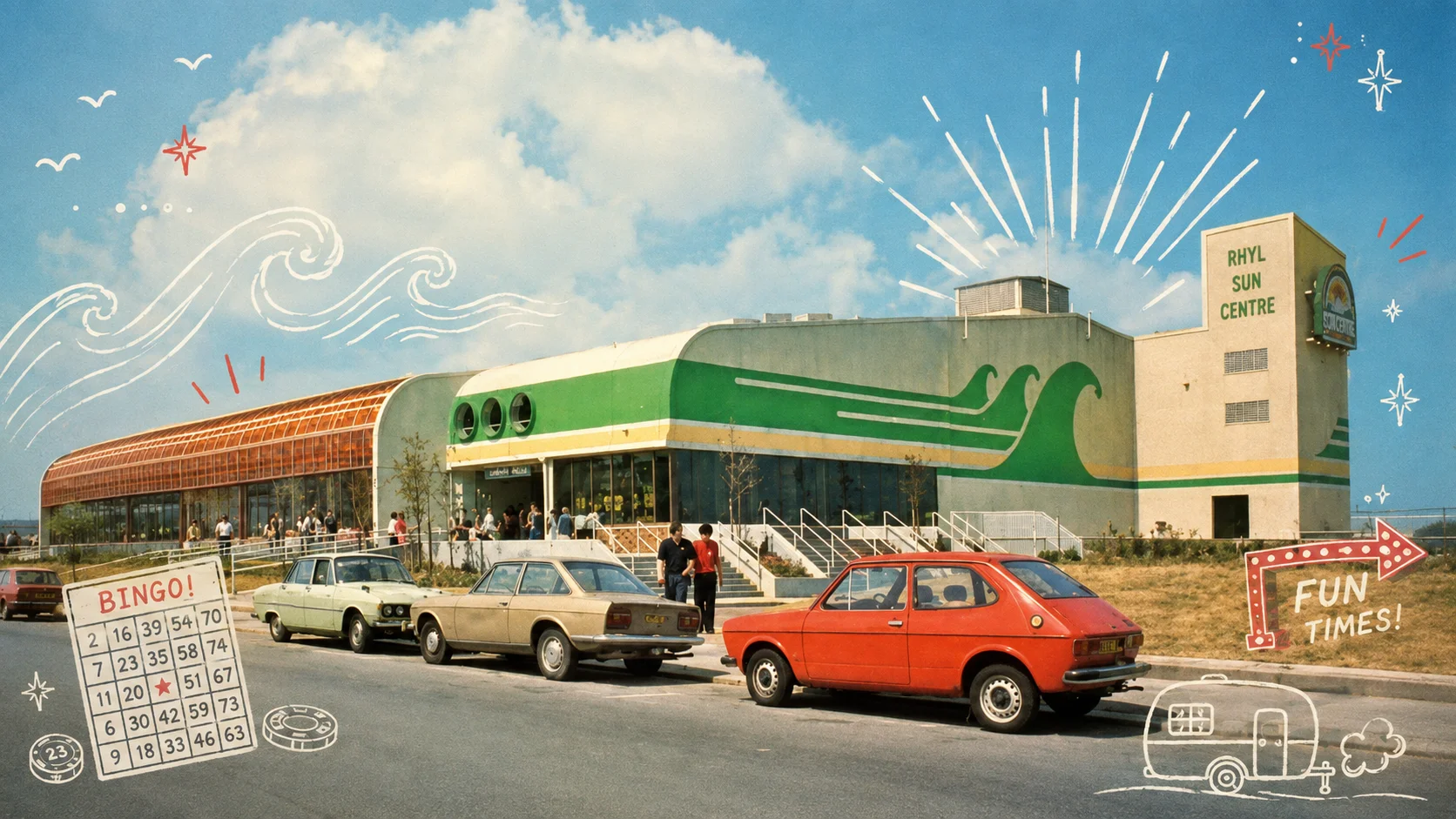
The nostalgia around it is backed by some fairly extraordinary facts. The Sun Centre opened in 1980. The Royal Commission on the Ancient and Historical Monuments of Wales records three pools, Europe's first indoor surfing pool, an artificial indoor-rain system, sandy areas, cafes and a monorail.
To a Liverpool kid in the 1990s, this was advanced civilisation.
Rhyl Sun Centre around 1989, during the era remembered by many North West families. Photo: Ronald Searle (CC BY-SA 2.0), via Wikimedia Commons.
Outside, North Wales could be doing a convincing impression of November.
Inside, there were slides, water, waves, tropical effects and a monorail travelling above your head.
We did not need Florida. We had Rhyl.
One member of Royal Commission staff later described their own 1990s visits: the Octopus, Elephant and Dragon slides, racing back for the tropical storm, eating chips in towels and riding the monorail afterwards. That memory is probably capable of unlocking several others across Merseyside.
The smell of chlorine. The heat when you walked in. Waiting for the waves. The missing sock in the changing room afterwards.
Say "Rhyl Sun Centre" to the right age group and somebody will usually answer with the same question:
"Remember the monorail?"
Over the railway bridge to the fair
For some families, getting to the fair is remembered almost as strongly as the fair itself.
The walk. The railway. The bridge. Hearing the rides before you could properly see them.
If your route involved going over the railway bridge, the fair announced itself before you reached it. Music, lights and the sound of machinery on the other side.
That bridge had its own weather. It caught the wind off the coast and funnelled it straight down the walkway, so you crossed with your hood up and your voice raised over rides you couldn't see yet. Nobody was flying off somewhere sunny instead: easyJet's first Liverpool flights did not launch until October 1997.
Then you were there, with a few quid that had somehow been expected to cover rides, sweets, arcade machines and chips.
It never did.
Rhyl's fairground history went back long before the 1990s. The Rhyl Miniature Railway's history records that Rhyl Amusements developed Ocean Beach between the promenade and Marine Lake from the 1920s.
Children arriving decades later did not need to know any of that.
They knew the important information: which ride they were going on, which ride Mum had already ruled out as looking unsafe, and how much Dad had just said "HOW MUCH?" at the price.
The former Ocean Beach Fun Fair site in Rhyl in December 2007. Photo: Wonderwiki (CC BY 3.0), via Wikimedia Commons.
Rain did not cancel the holiday
Of course, it rained.
This was North Wales. Rain was part of the operating system.
But rain in a 1990s caravan did not automatically cancel the day.
Dad would look through a window being hit sideways by water and announce:
"It's brightening up over there."
Where "over there" was remained unclear. Possibly Ireland.
The coats went on anyway.
You went to the arcade. You got chips. Your trainers got wet. Everything was hung around the caravan to dry and by the following morning almost none of it had.
Then somebody suggested Prestatyn.
Off you went again.
We did not think we were missing anything
This is the part that gets lost when those holidays are reduced to a joke about cheap caravans and bad weather.
As children, we did not generally experience them as the inferior version of something else.
The caravan was exciting because you were sleeping somewhere different.
The park was enormous because you were small.
Two pounds for the arcade was serious money.
Being allowed out until the lights came on felt like independence.
Rhyl Sun Centre felt enormous because, to you, it was.
Nan winning the bingo was not thirty quid or forty quid or whatever the prize happened to be that night. It was a major family event.
The scale was different because we were different.
Cheap flights changed the map
By the end of the 1990s, the range of holidays available to ordinary Liverpool families was changing quickly. The Mersey Tunnels still carried families towards North Wales every summer, but plenty of them were also heading to Liverpool John Lennon Airport instead.
That did not suddenly end the North Wales caravan holiday, and it would be wrong to pretend one airline changed everybody's habits overnight. But low-cost flying helped make European trips much more accessible over the years that followed.
North Wales remained close, familiar and affordable. What changed was that it was no longer competing only with other British seaside holidays. Alicante, Majorca and the Canaries were increasingly realistic family options.
What those holidays were really about
There is a temptation with nostalgia to pretend everything was better.
It wasn't.
Caravans got damp. Bedrooms were tiny. Parents argued while parking. The weather could be appalling. Children got bored. Somebody always lost something. And the television picture could disappear because a seagull had looked at the aerial.
But dismissing those holidays because they were modest misses what they gave families.
For a week, normal life changed.
Nan and Grandad were there.
Your cousins might be in the next caravan.
You stayed up later.
You played football with children you'd met that morning.
You went to the arcade after dark.
The adults played bingo.
You listened to rain on the caravan roof.
And tomorrow, you would probably do most of it again.
The details that survive are tiny: the manual carpet sweeper, the change in your pocket, the bingo tickets, the bridge, the smell of chips, Grandad's chair, Nan shouting about shoes on the carpet.
That is why they matter.
Social history is not only grand buildings, famous people and dates on plaques. It is also the ordinary routines thousands of families repeated without thinking they were making history at all. L1Local's history of Liverpool covers the city's formal timeline, but much of what shaped a generation happened in a static caravan an hour down the A55.
For a generation of Liverpool kids, North Wales was where a lot of those summers happened.
Not because everything was better then.
Because Nan had the caravan key, Grandad had his chair, you had two quid for the arcade, and for a week that was enough.
Liverpool this week
New places, local news, things to do and our latest guides. Weekly.
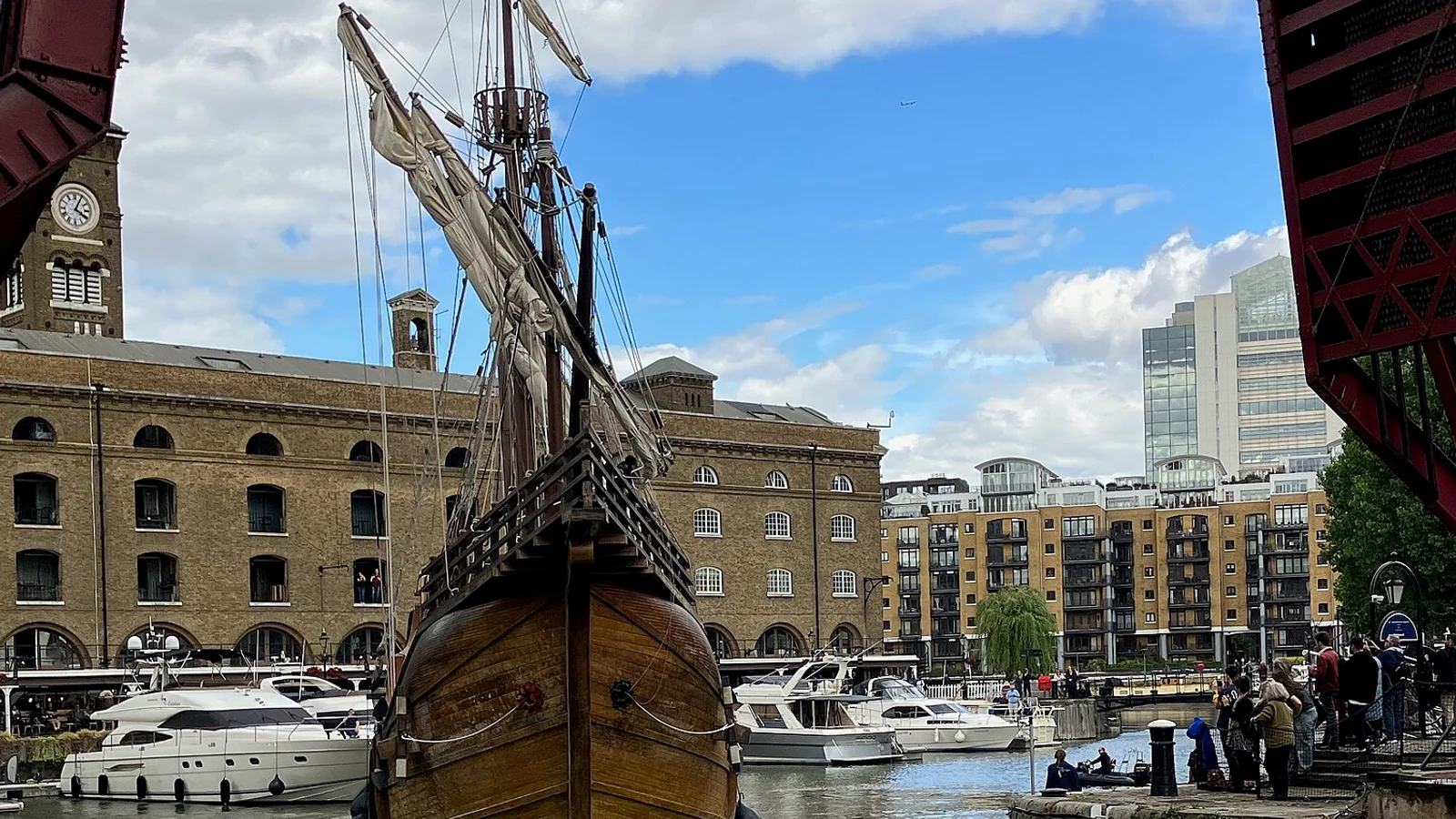
A full-scale replica of the Santa María docks at Royal Albert Dock, 12-25 August 2026. Tickets, opening hours and the history the tour material leaves out.


Comments
Join the conversation with your L1Local Community account. Keep it civil and on topic.