Why You Should Care About Speke’s Missing Park and Liverpool City Council’s Missing Answers
Liverpool City Council put a new park in Speke on paper in 2000. Over 25 years on, residents are still asking what happened to it and where the paperwork went.
Liverpool City Council once put a new neighbourhood park in Speke on paper. More than 25 years later, residents are still trying to establish what happened to it.
Growing up in Liverpool, I heard Margaret Thatcher’s name a lot.
I still do.
The 1980s, unemployment, Toxteth, the battles with Westminster and what national government did to Liverpool remain part of the way this city talks about itself.
What I heard much less about was the scale of the failures later documented much closer to home, inside Liverpool City Council itself.
In 2021, a government-ordered Best Value inspection found serious failures in planning, regeneration, highways, property management and governance. Ministers told Parliament there had been a “worrying lack of proper record keeping”, with documents in some cases created retrospectively, thrown into skips or destroyed.
The findings were serious enough for central government to appoint commissioners with statutory powers over parts of the council. That intervention ended in June 2024.
Then came Operation Aloft. In March 2025, Merseyside Police charged 12 people following an investigation connected to Liverpool City Council commercial and business contracts between 2010 and 2020. Former elected mayor Joe Anderson is among those charged with bribery and misconduct offences. He pleaded not guilty to all the charges he faces. His trial was put back by six months and is now due to start on 5 April 2027. He and the other defendants are entitled to the presumption of innocence. The charges are allegations, not findings of guilt.
And in September 2025, the Information Commissioner’s Office served Liverpool City Council with an enforcement notice after finding that only 56 per cent of Freedom of Information requests had been answered within the legal 20-working-day deadline between January and July that year. There were 75 overdue requests.
That history is why a dispute about an old park in Speke matters.
Not because it proves another scandal. It does not.
It matters because Liverpool has already been told, repeatedly and officially, that records, scrutiny and transparency matter.
So what happens when residents ask a basic question and still cannot get a clear answer?
First, Speke lost a park
Historic accounts place the old Speke Park on land later occupied by the Morrisons shopping development.
Residents campaigning today say the understanding at the time was that replacement green space would follow and that the supermarket development helped fund it.
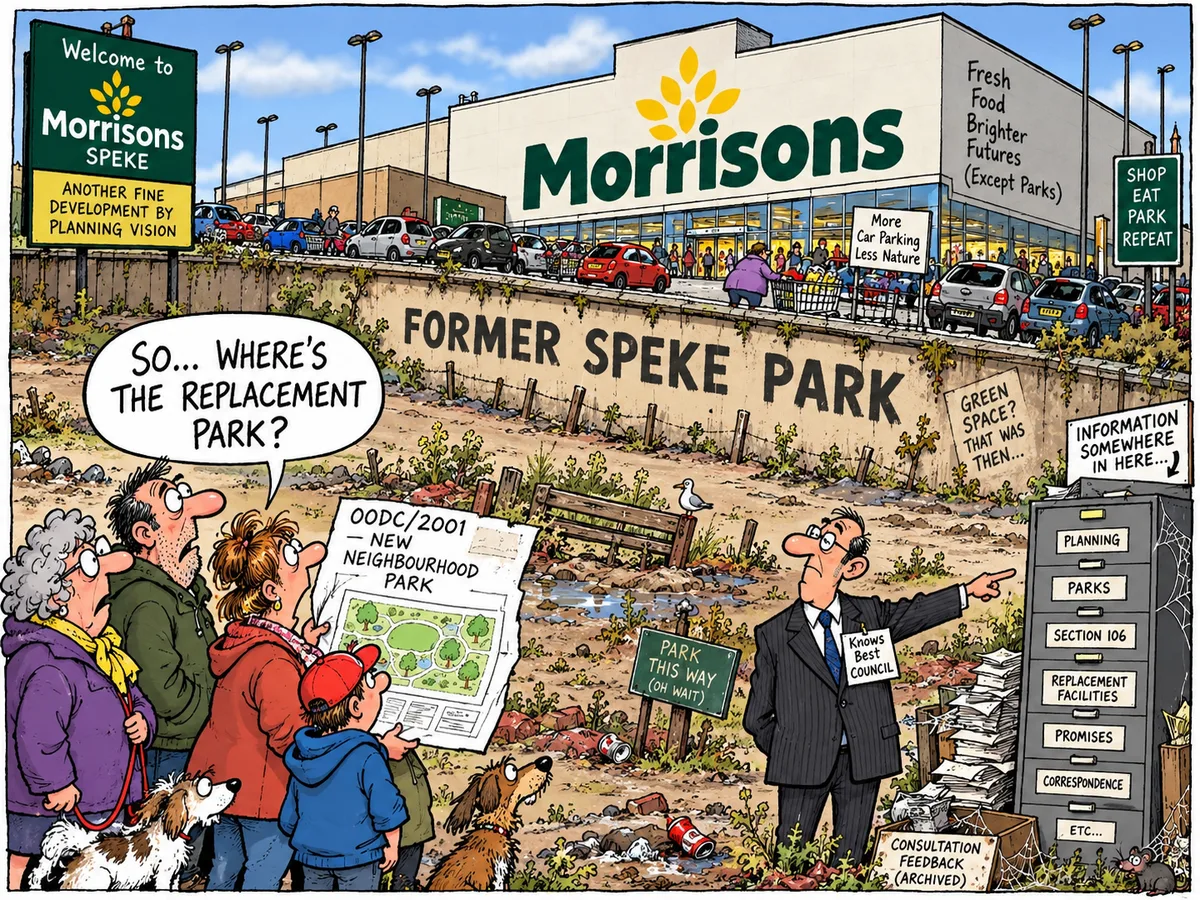
Satirical cartoon. Illustration generated with ChatGPT for L1 Local. It is a cartoon, not a record of events: L1Local has not established who, if anyone, funded a replacement park, and Morrisons is not accused of any wrongdoing.
L1Local has not yet obtained the legal agreement proving that Morrisons paid a specific sum earmarked for a replacement park. That is an important missing part of the paper trail, and we are not going to present it as settled fact until the document is found.
What we do have is a Liverpool City Council document dated 18 September 2000.
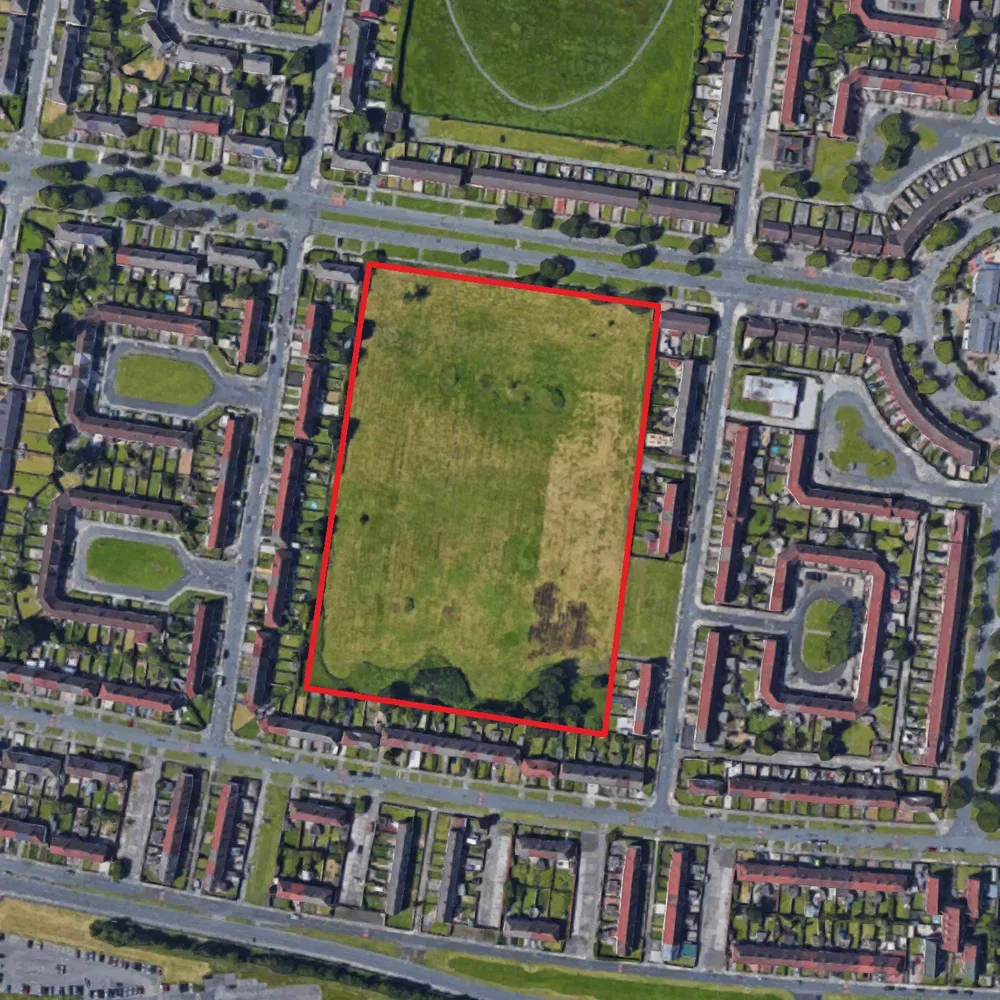
The site is the former Speke Comprehensive School, Lower School, Stapleton Avenue. The planning reference is 00DC/2001.
The same letter says the proposal was being considered and that work should not start until formal planning permission had been issued.
So where is the rest of the file?
Was the park approved?
What conditions were attached?
Was it formally connected to the loss of the old Speke Park?
Was it later changed, replaced or abandoned?
Who made that decision, and where is the document showing it?
More than 25 years later, residents are still trying to piece that together.
Then came more development, and more money for open space
Speke did not stand still. More land went through the planning system. More housing was approved.
Liverpool City Council’s own 2019/20 Infrastructure Funding Statement records £302,500 from four Speke developments under open-space or public-realm headings.
In October 2025, The Post reported that a Speke resident’s FOI requests had revealed “only 10% of the £500,000 Speke had received through Section 106s had been spent”. The same report said a council report showed Liverpool had more than £17 million in Section 106 payments banked, and that although £12 million had been allocated to projects, none of it had been spent at that point.
That money has not been shown to be connected to the park proposed in 2000. There is no evidence before L1Local that it disappeared or was misspent.
But it creates another straightforward question:
Where is it being spent, and what did Speke get for it?
That should be answerable. Liverpool’s own planning policy says developer contributions can be used to provide or improve open space where it cannot be provided adequately on a development site.
Money comes in. Conditions are imposed. Decisions are made. The public should be able to follow what happened next.
Instead, residents say they got the runaround
According to correspondence supplied to L1Local, residents investigating the park, planning records and Section 106 contributions have submitted information requests, chased overdue responses and entered the council complaints system.
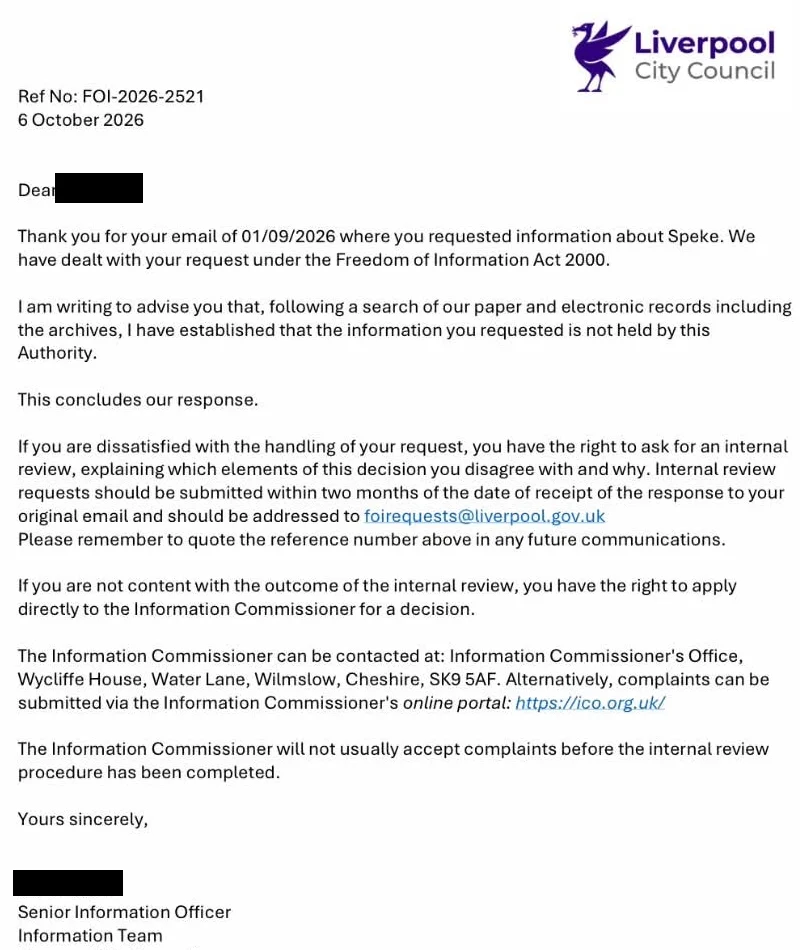
On 6 October 2026, the council replied to one Freedom of Information request about Speke, reference FOI-2026-2521. It said that “following a search of our paper and electronic records including the archives”, the information requested was “not held by this Authority”.
Liverpool City Council’s reply to FOI-2026-2521, 6 October 2026. Supplied to L1Local. Personal names removed by L1Local.
Another request was acknowledged, but residents say the deadline passed without the substantive response they were waiting for.
They complained. They tried to escalate.
According to the correspondence they supplied, Stage Two could not proceed because Stage One had not been completed. But Stage One being unresolved was why they wanted to escalate in the first place.
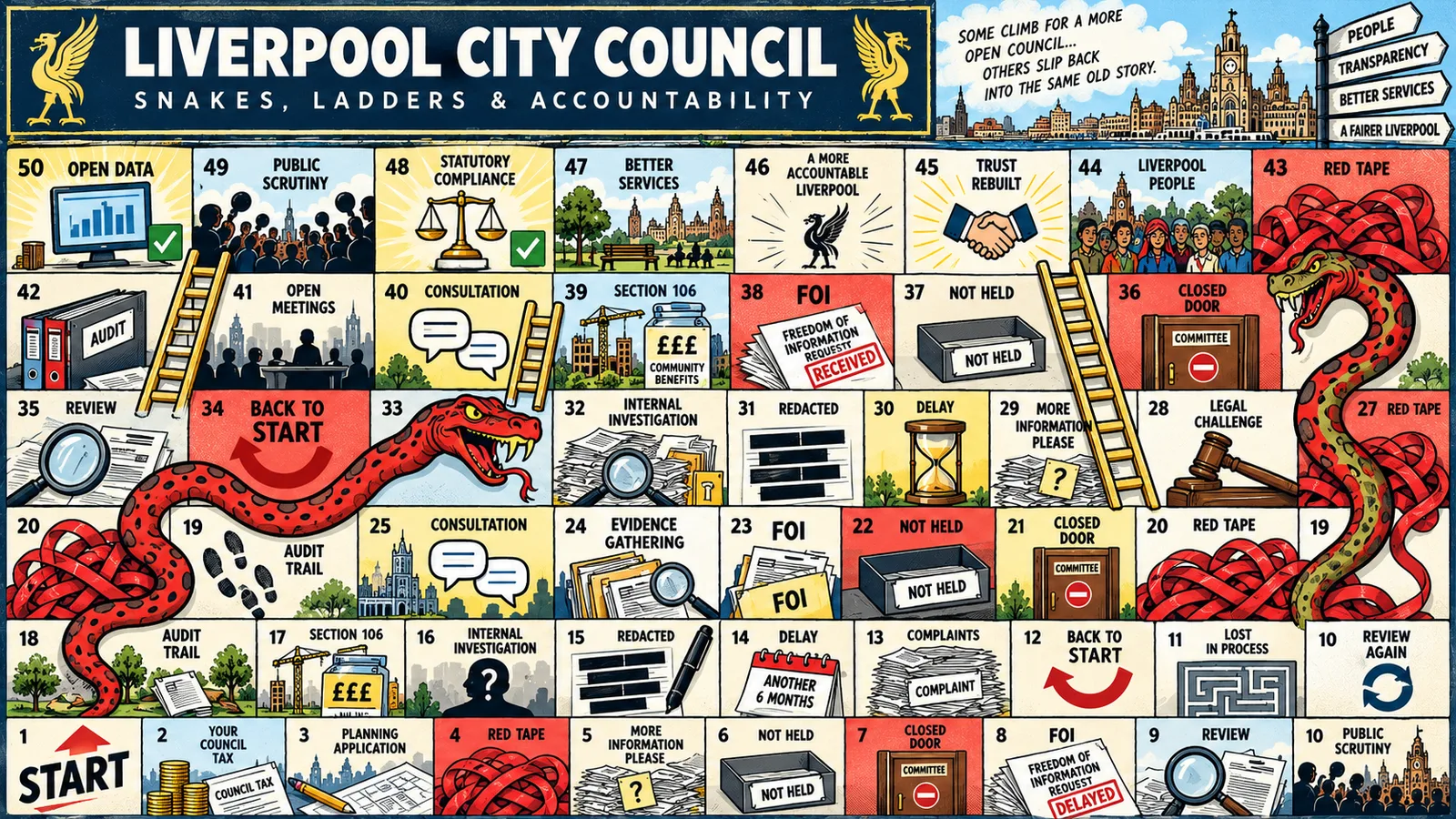
Ask. Wait. Chase. Complain. Try to escalate. Back to the start.
Liverpool City Council should be given the opportunity to explain that sequence and provide the missing records. L1Local asked the council for comment. No comment had been received at the time of publication.
Because after everything the authority has been through, residents should not need to become amateur archivists to discover what their council decided.
The council pays a firm to look after its records
Here is the part of this story that should not be hard to understand.
Liverpool City Council pays a private company to store its legal paperwork.
A notice on the government’s Contracts Finder service shows the council awarded a Secure Document Storage contract to Secure Storage Services Ltd on 2 May 2025. It is worth £119,412.72 and runs from 9 May 2025 to 8 June 2027.
In the council’s own description, the contract covers “an extensive array of legal documents, including property deeds, contracts and various records that are essential for the administration and governance of the city”. It adds that these documents “hold significant legal importance, relating to land ownership, planning permissions, and community services”.
Paying a specialist to store records is normal, and sensible. Nothing here suggests the company has done anything wrong.
But it does set out what the council itself says those records are for: land ownership, planning permissions and the governance of the city.
Which is exactly what residents in Speke are asking about.
The council told one Speke requester it had searched its paper and electronic records, including the archives, before replying that the information was not held. Residents are entitled to ask what that search covered, and whether the planning file behind a 2000 proposal for a new neighbourhood park, and the agreements behind the open-space money that followed, are among the records the council pays to keep.
Rules for residents, discretion for councillors
Speke is not the first time Liverpool residents have had to fight for basic information about how the council applies its own rules.
In 2017, Liverpool City Council brought in a private firm, Kingdom Services, to patrol the streets for litter. In its first six months, Liverpool Confidential reported, the patrols issued 13,689 fixed penalty notices worth just under £700,000. About 93 per cent were for dropped cigarette ends. For every £80 fine, the council paid Kingdom £42.50.
Over roughly the same years, a different set of rules was being applied to some of the people running the city.
In February 2023, after a 16-month Freedom of Information fight, the Liverpool Echo revealed that 14 serving and former Labour politicians had together had 51 parking penalty charge notices rescinded by council officers between April 2015 and December 2020, without using formal processes. Most were cancelled on the “discretion” of officers.
A Labour Party spokesperson said these were historical issues that had already been investigated under the council’s code of conduct, that no councillor was found to have breached the code, and that they had been following what they were told was standard practice. The council said it was not current practice.
That may well be right. But the pattern is hard to miss. Residents were fined for a cigarette end by a firm that kept part of the fine. Councillors’ parking tickets were quietly cancelled. And it took a newspaper 16 months to get the names out.
That is the backdrop residents in Speke are working against when they ask for their own paperwork.
Why should you care if you do not live in Speke?
Because Liverpool City Council affects far more of your life than bin collections and council tax.
Your home. The council decides planning applications, including developments beside your property and many extensions you may want to build yourself.
Your street. It regulates HMOs and licensing, and planning decisions can alter parking, density, noise and the character of a neighbourhood.
Your children’s services and schools. Local government has major responsibilities across children’s services and ensuring sufficient school places.
Public land and regeneration. Councils can sell land, approve redevelopment and, where strict legal tests are met, use compulsory purchase powers.
Developer money. The council can secure contributions intended to offset the impact of new development. Residents should be able to see what was agreed and where the benefit went.
You might not care about planning reference 00DC/2001 today.
You will care if the unanswered question is about the field behind your house, the HMO next door, your child’s school site or money that was supposed to improve your neighbourhood.
That is why transparency is not council paperwork for its own sake. It is how ordinary people check what those with power decided in their name.
Liverpool says it has changed
There has been accountability. The 2021 inspection happened. Commissioners were appointed. The council went through years of intervention and reform, and the statutory intervention ended in June 2024.
Liverpool City Council now talks openly about governance, integrity and transparency. That progress should be recognised.
But the real test is not a strategy document or a new committee. It is what happens when somebody asks a difficult but reasonable question.
The ICO’s 2025 enforcement notice showed that problems with access to information had not simply disappeared. It found Liverpool City Council was meeting the legal FOI deadline in only 56 per cent of cases during the period it examined.
So the Speke case is a small but revealing test.
Can the council take a planning reference from 2000 and show residents what happened?
Can it produce the decision, the conditions and any agreement behind it?
Can it show where later open-space contributions were allocated and spent?
If residents have misunderstood the original promise, the documents should settle that. If the park was properly cancelled or replaced, show the decision. If the later money paid for improvements elsewhere, identify them.
No rumour is required. No accusation is required.
Just show the paperwork.
Why the park still matters
Speke is not an empty canvas. It is a residential community bordered and broken up by some of south Liverpool’s biggest land uses: the airport, major roads, industrial and employment land, large shopping developments and successive housing schemes.
There is green space in and around Speke, including Speke Hall and smaller recreation and play areas. But that does not make the loss or promised replacement of usable neighbourhood green space meaningless.
A local park is somewhere children can play without being driven across the city. It is somewhere to walk, somewhere to sit, and somewhere that does not require spending money.
Once that land is built on, getting it back is difficult.
That is why residents have kept asking the question for more than two decades.
The campaign is being documented by Speke Together for a Brighter Future, where residents have been sharing records, correspondence and their attempts to get answers.
For them, this is not an argument about a line in an old planning database. It is about what their community was told it would have, what happened to the land around them and why getting a straight explanation has taken so long.
Liverpool spent years under intervention because serious failures of governance and record-keeping had already been exposed. The council says it is different now. This is a chance to show it.
Find the file. Explain the decision. Show where the money went.
And finally answer the question Speke has been asking for 25 years:
Liverpool City Council acknowledgement letter, 18 September 2000, planning reference 00DC/2001, supplied to L1Local
Liverpool City Council FOI response FOI-2026-2521, 6 October 2026, supplied to L1Local
Liverpool City Council Infrastructure Funding Statement 2019/20
Common questions
What was planned for the former Speke Comprehensive School lower school site?
A Liverpool City Council letter dated 18 September 2000, planning reference 00DC/2001, describes the proposal for the site on Stapleton Avenue as “Setting out of new neighbourhood park.” The letter said work should not start until formal planning permission had been issued.
How much Section 106 money has Speke received?
The Liverpool Post reported in October 2025 that a resident’s FOI requests showed only 10% of the £500,000 Speke had received through Section 106 agreements had been spent. Liverpool City Council’s 2019/20 Infrastructure Funding Statement records £302,500 from four Speke developments under open-space or public-realm headings.
Does Liverpool City Council pay a company to store its records?
Yes. A Contracts Finder notice shows the council awarded Secure Storage Services Ltd a £119,412.72 Secure Document Storage contract on 2 May 2025, running from 9 May 2025 to 8 June 2027, for legal documents including property deeds and records relating to land ownership and planning permissions.
Comments
Join the conversation with your L1Local Community account. Keep it civil and on topic.
Liverpool this week
New places, local news, things to do and our latest guides. Weekly.
Comments
Join the conversation with your L1Local Community account. Keep it civil and on topic.