Can you swim in the River Mersey? What the byelaws say, the tidal and water-quality risks, the Across Mersey Swim, and safer places to swim near Liverpool.
If you have looked at the Mersey from the Pier Head and wondered whether you could swim in it, or swim across it, the honest answer has two parts. People do swim the river, and there is an organised annual crossing between Liverpool and Wirral. That does not make the stretch of water beside the city centre an ordinary swimming spot.
The Mersey through Liverpool is a working tidal waterway with fast currents, commercial shipping, hard-to-reach banks and water-quality risks. The legal position is also more involved than a simple yes or no. This guide sets out what the rules say, why the water is dangerous, and where to swim instead.
For almost everyone, the practical answer is short: do not get in the Mersey here for an unsupervised swim, and do not attempt your own crossing. If you want to swim across, enter the organised Across Mersey Swim. If you want to try open-water swimming in the city, Queen's Dock is a far more controlled option.
Whether Mersey swimming is banned
Is swimming in the Mersey banned outright? The Port of Liverpool General Byelaws 2021 contain no general "no swimming" rule, but they do control access to the Dock Estate and the river is a managed shipping channel.
Can you get in wherever you like? No. You must obey barriers, signs and officers on the Dock Estate, and several water activities need written permission from the Harbour Master.
Can you swim across? Yes, through the organised Across Mersey Swim, which runs in pods with rescue boats and works with the port.
Is there a safe tide for a solo crossing? No. There is no sensible do-it-yourself "safe tide" for swimming the Mersey.
Where can you open-water swim in Liverpool? Liverpool Watersports Centre runs sessions in Queen's Dock, which is an enclosed dock rather than the tidal river.
Where is water quality officially checked nearby? The Wirral has five designated bathing waters: New Brighton Beach East, Wallasey, Moreton, Meols and West Kirby. The central Mersey at Liverpool is not one.
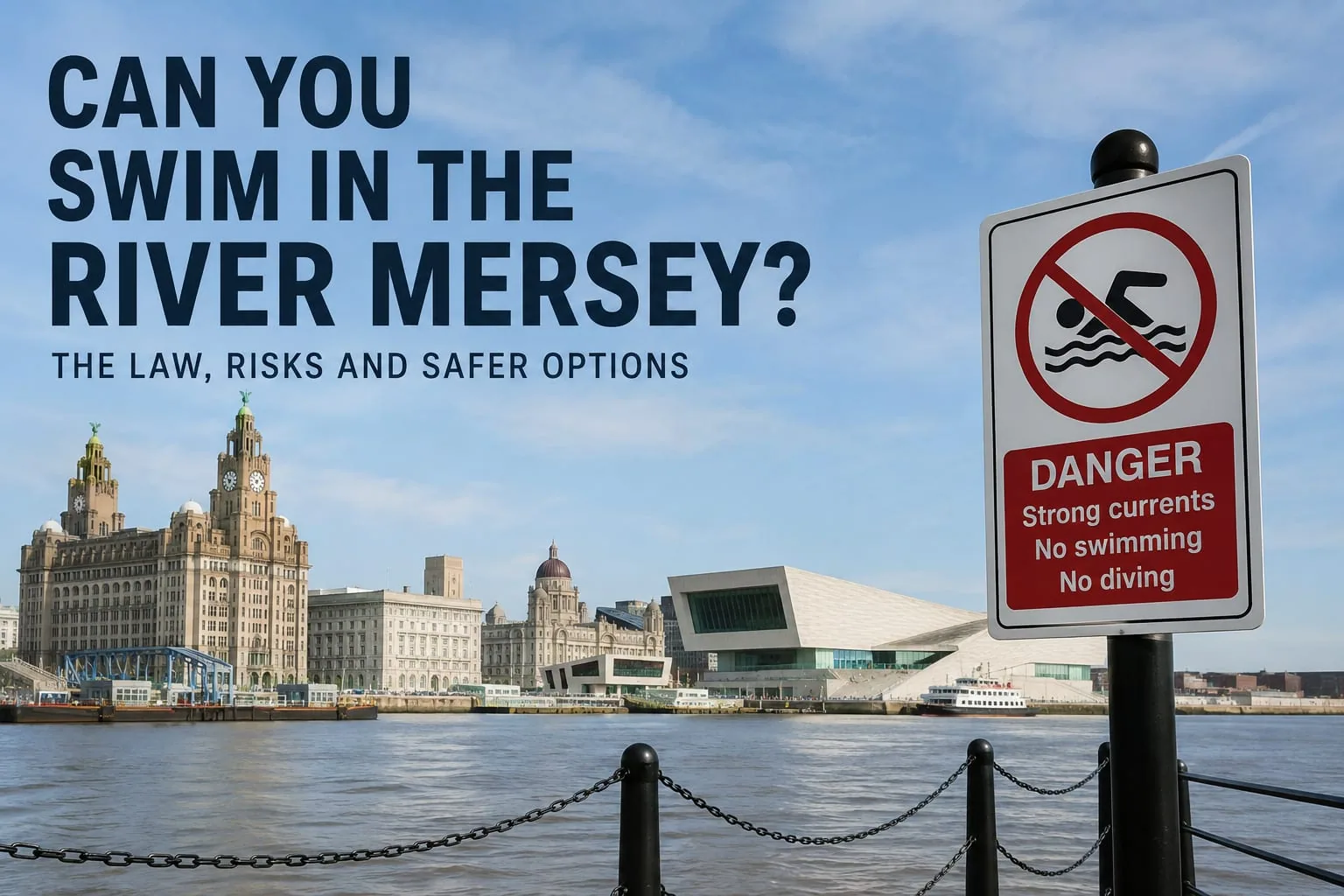
The Mersey at the Pier Head is a commercial shipping channel, not a swimming beach. Photo: Chowells, CC BY-SA 3.0, via Wikimedia Commons
What the law and the byelaws say
There is no single law in England that bans swimming in tidal rivers. That is the starting point people usually mean when they say wild swimming is "legal". It does not make the Mersey at Liverpool a public swimming area.
The river and docks here are managed by the Mersey Docks and Harbour Company, part of Peel Ports, under the Port of Liverpool General Byelaws 2021. These were made under the Mersey Docks Acts Consolidation Act 1858 and confirmed by the Secretary of State for Transport in March 2021. They apply within the Dock Estate, which means the docks, piers, quays, jetties, landing stages and land the company controls, and to vessels using the port.
Reading through all 39 byelaws, none of them prohibits swimming or bathing. What they do control is relevant:
You must not pass beyond or across a fence, chain or barrier that restricts access without permission, and you must not ignore a notice or sign prohibiting or limiting access (byelaw 23).
You must enter and leave the Dock Estate by approved entrances (byelaw 29), and tell an officer your business there if asked (byelaw 27).
Diving operations need written permission from the company (byelaw 38).
Water skiing, aquaplaning, power boat racing "or any similar activity" need written permission from the Harbour Master, in areas and on conditions the Harbour Master sets (byelaw 38).
Breaching a byelaw is a criminal offence, punishable on summary conviction by a fine of up to level 4 on the standard scale, which is currently £2,500.
So the useful way to put it is this. There is no blanket "swimming is illegal" rule for the whole river, but climbing a barrier, ignoring a "no swimming" sign on the waterfront, or organising a swim without speaking to the port can each be a different matter. Anyone planning an organised activity on the river should deal directly with Peel Ports and the Port of Liverpool rather than assuming the absence of a swimming ban amounts to permission. This article is a practical guide, not legal advice.
Why you should not simply get in
The Mersey can look calm from the Pier Head. The water is a different story.
Tides and currents
The Mersey has a large tidal range and fast tidal currents, strongest where the river narrows between Liverpool and Birkenhead. Merseyside Fire and Rescue Service warns specifically about strong currents and fast-moving tides around the Mersey, and about hidden currents in open water that can put even strong swimmers in difficulty.
This is why "I will go at slack water" is not a plan. Local conditions depend on more than the published tide times: wind, river flow, vessel movements, and your exact entry and exit points all matter. The RNLI advises open-water swimmers to learn local tides and currents, check the weather and tide times, swim with other people, and use places with known safe entry and exit points.
It is a working port
The Mersey is not a large recreational river that happens to run past the city. Peel Ports manages navigation in the Port of Liverpool, with commercial ships, pilots and a vessel traffic service coordinating movements on the water. Organised events on the river are run in agreement with the port and its traffic service, with safety boats and warnings issued to other vessels. That coordination is one of the clearest reasons not to treat a solo swim across the shipping channel like crossing a lake.
Getting out can be harder than getting in
A swimmer needs a safe exit. Merseyside Fire and Rescue warns that steep or slippery banks make it hard to climb out of open water, that underwater debris can injure or trap someone, and that depth is difficult to judge from the surface. Around Liverpool's central waterfront, most edges are walls, dock structures and landing stages built for ships rather than slopes a swimmer could climb out on.
Cold water shock
Warm weather does not warm the Mersey. The RNLI says entering water below 15°C can seriously affect your ability to breathe and move, and the Mersey sits below that for most of the year. Sudden entry can cause cold water shock: an involuntary gasp, then rapid breathing you cannot control. It affects fit swimmers as well as beginners. The RNLI recommends entering open water gradually to let your body adjust, wearing suitable kit, and not swimming alone.
Pollution and water quality
Government health guidance says swimming in rivers and estuaries carries a higher risk of illness than swimming at monitored bathing waters. That can mean stomach upsets and infections of the skin, ears, eyes and airways. Open water can carry organisms linked to illnesses including E. coli infection and leptospirosis.
Heavy rain makes it worse. Rain washes bacteria and pollution from streets, farmland and sewer systems into rivers and the sea, so water quality is often poorer for a day or two afterwards.
The Liverpool waterfront is not a designated bathing water
A designated bathing water is a beach, lake or river swimming spot that sits inside the government's monitoring system. During the bathing season, the Environment Agency samples the water and classifies each site as excellent, good, sufficient or poor.
The 2026 list includes five designated bathing waters on the Wirral side of the estuary, under Wirral Council:
Designated bathing waters on the Wirral, 2026
Bathing water
Status for 2026
Meols
Designated
Moreton
Designated
New Brighton Beach East
Designated, new for 2026
Wallasey
Designated
West Kirby
Designated
The central River Mersey beside Liverpool is not on that list. Government guidance is clear that non-designated rivers and open waters are not routinely tested for the two bacteria used to judge bathing-water quality, intestinal enterococci and E. coli. Clear-looking Mersey water has not been checked and passed for swimming that day.
The organised way to cross: the Across Mersey Swim
The established way to swim the river is the Across Mersey Swim, run by the Liverpool triathlon organisation Tri4Life. The modern event was revived in 1994 and crosses from Cockle Inlet in Liverpool to the Monks Ferry slipway in Birkenhead, roughly one to two miles depending on the tide.
The 2024 swim was the 31st, with 173 swimmers. The 33rd swim took place in early August 2026, and Merseyside Lieutenancy reported just under 200 swimmers taking part, organised into groups accompanied by rescue boats and lifeguards.
This is a managed event, not hundreds of people picking a convenient tide. Swimmers enter in pods, each raising money for a nominated cause. You cannot enter on the day, and you must first complete a qualifying swim signed off by a Mersey Swim coach. Entry was £45 in 2025.
There was no confirmed 2027 date on the organiser's pages when this was checked on 27 August 2026. Check Tri4Life's Across Mersey Swim page and the event registration site before planning around it.
Do not try to work out your own safe time
It would be misleading to name a tide time and suggest it makes an independent crossing safe. The organised event works with the port and safety crews because the river presents several risks at once: fast tidal currents, cold water, commercial traffic and difficult exit points. If your aim is to swim across the Mersey, join the organised event rather than trying to reproduce it yourself.
Where to open-water swim in Liverpool instead
If you want the experience of outdoor swimming without taking on the tidal river, there is a practical option close to the waterfront.
110 Mariners Wharf, Queen's Dock, Liverpool, L3 4DG. Session starts at 9.30am, 10.45am, 12pm, 1pm, 2.15pm and 3.30pm, with later slots sometimes arranged in summer. A waiver form is required. Phone 0151 708 9322.
Queen's Dock is part of the enclosed South Docks system, not the open tidal Mersey, which makes it a very different proposition from entering the river off a stretch of waterfront. Session times can change outside summer, so check the centre's current booking information rather than relying on an old timetable.
Seeing the river without swimming it
If the appeal is being out on the Mersey rather than in it, the Mersey Ferries River Explorer Cruise is the straightforward way to do it. The 50-minute cruise runs from the Pier Head and calls at Seacombe and Woodside in Wirral. The same boats also run a scheduled commuter service, covered in our Mersey Ferry commuter guide.
Affiliate offer
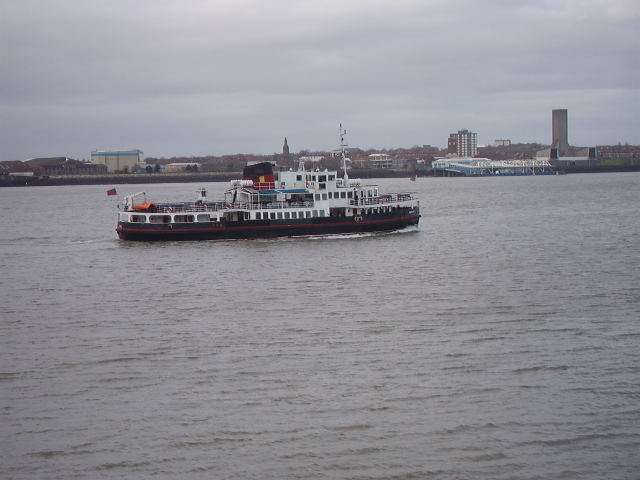
The Mersey Ferry, the sanctioned way to be out on the river. Photo: Raintheone, CC BY-SA 3.0, via Wikimedia Commons
For sea or estuary swimming rather than dock swimming, the designated bathing waters around the Wirral are the option with monitoring behind them. The 2026 list covers New Brighton Beach East, Wallasey, Moreton, Meols and West Kirby. New Brighton Beach East was designated for the first time for the 2026 season, which opened on 15 May 2026.
New Brighton, at the mouth of the Mersey, has a designated bathing water. Photo: Des Blenkinsopp, CC BY-SA 2.0, via Wikimedia Commons
England's bathing season runs from 15 May to 30 September, and that is when the Environment Agency samples designated waters. Designation does not mean a beach is safe every day. Waves, tides, currents and temporary pollution still matter, and the RNLI recommends choosing a lifeguarded beach and swimming between the red and yellow flags where you can. Before travelling, check the Environment Agency's Swimfo bathing-water pages for the latest classification and any pollution warning.
Swimming after heavy rain
It raises the health risk. Government guidance says heavy rainfall washes bacteria from urban areas, farmland and sewage systems into rivers and coastal waters. At designated bathing waters, the Environment Agency sometimes issues a pollution-risk forecast when quality is temporarily reduced. On an undesignated stretch like the central Mersey, there is no equivalent routine monitoring to rely on, so a sunny day and clear-looking water tell you nothing about whether it is safe.
If you do go open-water swimming
At a suitable venue or a designated beach, the RNLI's advice is to:
Check the weather and tide times.
Know where you will get in and out before you start.
Swim with someone else, not alone.
Wear a brightly coloured swimming cap and consider a tow float so you are easier to see.
Carry a means of calling for help.
Get in slowly to let your body adjust to the cold.
Stay within your depth and your ability, and keep away from alcohol beforehand.
Use a lifeguarded beach where possible.
For the water-quality risks, government advice is to cover cuts with a waterproof dressing, avoid swallowing the water, and wash after swimming.
If someone gets into trouble in the Mersey
Do not get in after them. Merseyside Fire and Rescue uses the phrase Call, Tell, Throw:
Call 999. For an emergency on the river or the coast, ask for the Coastguard.
Tell the person to float on their back.
Throw them something that floats, such as a life ring, if one is nearby.
Going in yourself is how one casualty becomes two. If you are the person in difficulty, the RNLI's advice is Float to Live: lean back, keep your airway clear of the water, relax and control your breathing, and float until the cold-water gasp passes. Then call for help or swim to safety if you can.
So, can you swim in the Mersey
The technical answer is more involved than "it is illegal". The practical answer is that the Mersey through Liverpool is not a place to treat as an unsupervised swimming area. The byelaws contain no blanket swimming ban, but port access is controlled and the river is a managed shipping channel with fast tides and cold water.
The Across Mersey Swim shows the river can be swum. It also shows how much organisation that takes: safety boats, qualified coaches, pods and coordination with the port. If you want to swim outdoors in Liverpool, Queen's Dock is the clearer route. If you want a beach swim, use a designated Wirral bathing water, check the latest classification, and follow RNLI advice. If your aim is specifically to cross the Mersey, wait for the organised event.



Comments
Join the conversation with your L1Local Community account. Keep it civil and on topic.