Stand next to the Queen Victoria Monument in Derby Square and you are standing on a castle. There is nothing left to look at, which is why most people walk over it without knowing.
Liverpool Castle held that corner of the city for close to five hundred years. It was a real fortress with a rock-cut moat, four towers and a garrison, and it was attacked, besieged, garrisoned and finally pulled down for building land. This guide covers where it stood, what it looked like, what happened to it, and what has been found underneath the modern city.
The castle also outlasted almost everything Liverpool now treats as old. It was standing before the docks, before the slave trade, before the Liver Building by nearly seven hundred years. Everything below was checked against the Victoria County History of Lancashire, Historic England, National Museums Liverpool and the Historic Society of Lancashire and Cheshire on 26 August 2026.
Where Liverpool Castle stood
Where: Derby Square, between Castle Street, Lord Street and James Street, on high ground above the Pool.
Who built it: most likely William de Ferrers, 4th Earl of Derby, in the 1230s. Not King John.
First firm record:1235, a licence to strengthen a castle that already existed.
Size: roughly 50 yards square, with a moat about 20 yards wide cut out of solid rock.
Royal visitor:Edward II lodged there from 24 to 30 October 1323.
Attacked: by rebels on 25 October 1315, and fought over twice during the Civil War in 1643 and 1644.
Demolished: ordered down in 1659, finished off by about 1726.
What replaced it: St George's Church, then the Queen Victoria Monument of 1902 to 1906.
What survives: no walls, but the moat has been found underground twice, and the name Castle Street.
Where Liverpool Castle stood
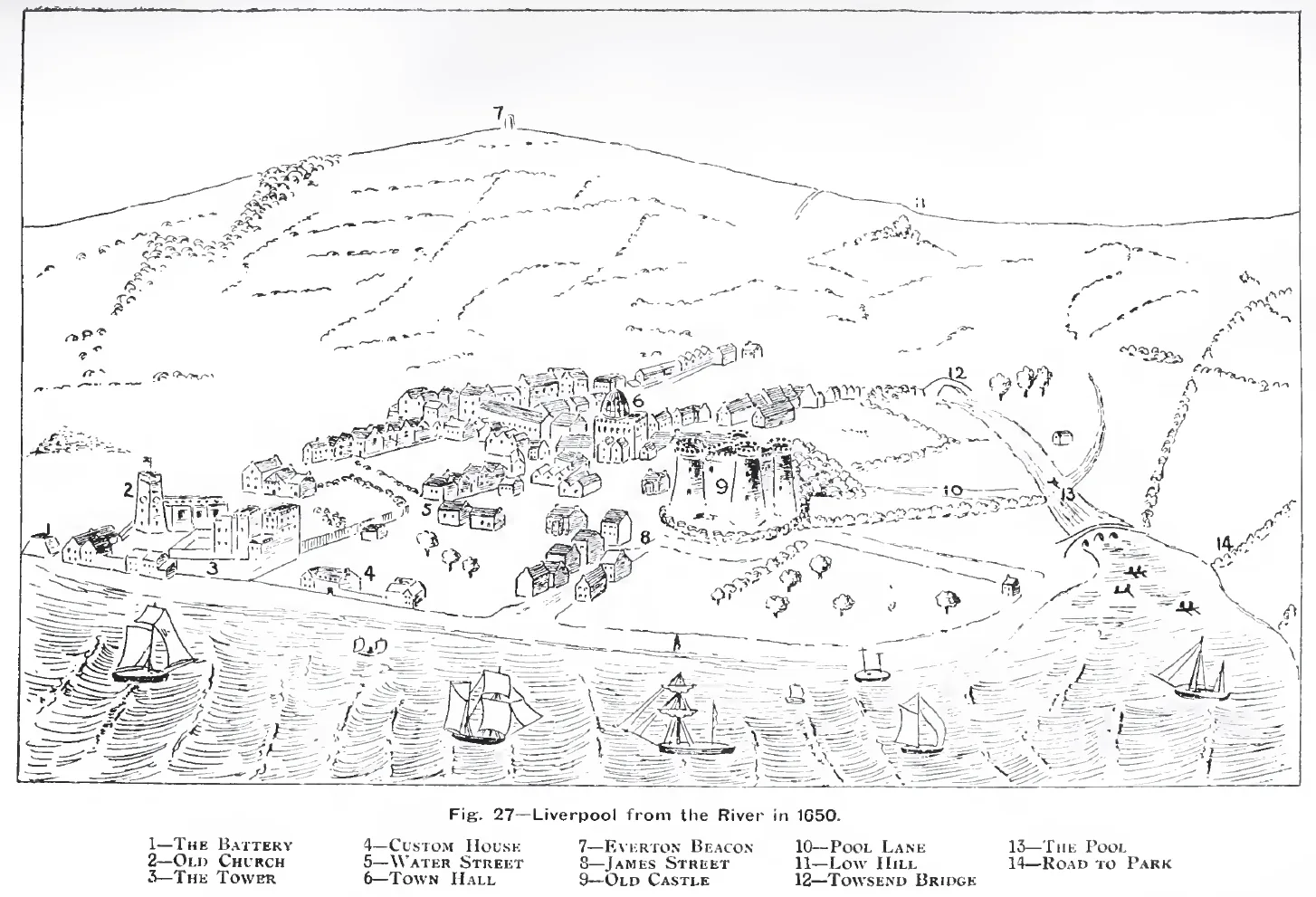
Liverpool in 1650, with the castle above the Pool. From William Ashton, The Evolution of a Coast-Line (1920). Public domain via Wikimedia Commons.
The castle sat on a rocky rise at what is now Derby Square, just west of the top of Lord Street. If you are trying to place it, the Queen Victoria Monument is the marker.
The ground around it looked nothing like today. A tidal creek called the Pool ran inland roughly along the line of Paradise Street and Whitechapel, and the Mersey came in much closer than the modern waterfront suggests. The castle took the strongest position available, looking down over the creek, the shore and the approaches to a very small town.
That position is the whole reason the castle was there. Liverpool in the 1200s was a few streets and a few hundred people, but it had a sheltered inlet and a short crossing to Ireland, and whoever held the rise above the Pool controlled both. If you want the wider story of how that grew into a port, we cover it in our history of Liverpool from 1207 onwards.
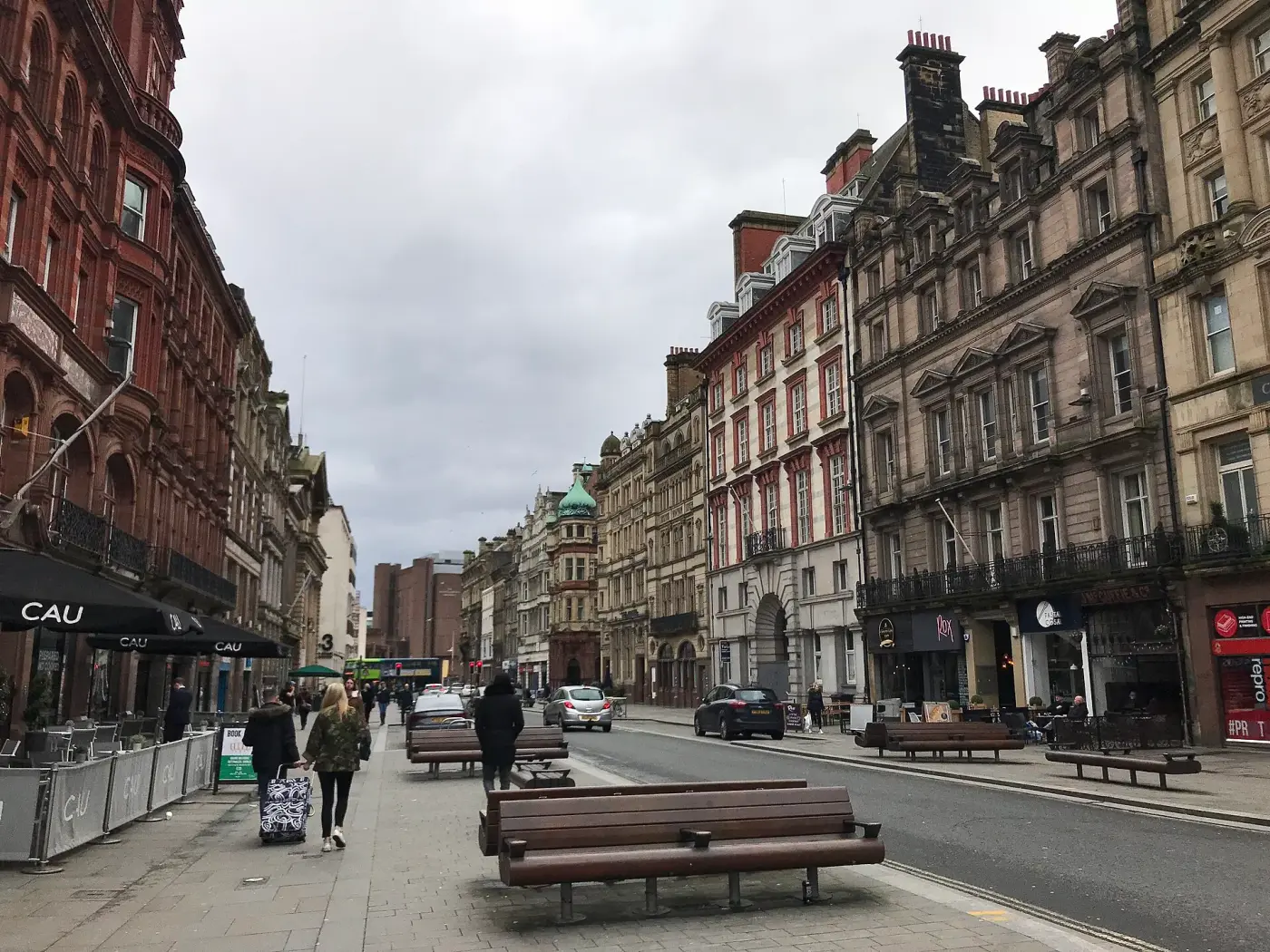
The name is the clearest survival. Castle Street runs from Derby Square to the Town Hall and is named for the building, not for anything still standing.
Who built it, and why it was not King John
King John made Liverpool a free borough by Letters Patent on 28 August 1207, and the document is still held by Liverpool Record Office. That is where the "King John's castle" idea comes from, and it does not hold up. John died in 1216.
The castle belongs to the reign of his son, Henry III. Historic England's research record describes it as built early in that reign, probably by William de Ferrers, 4th Earl of Derby. Most accounts put the work somewhere between about 1232 and 1237.
No document records the day building started, which is why the date is given as a range. The firm evidence is a royal licence of 1235 allowing de Ferrers to strengthen his castle at Liverpool. The wording matters: you cannot strengthen something that is not there, so a castle of some kind already existed by then.
West Derby lost its garrison to Liverpool
Liverpool was not the first castle site in the area. West Derby Castle came first, built around 1100, and West Derby was then the more important place by a distance. In 1213 it held a garrison of 140 foot soldiers, ten knights and crossbowmen.
By 1235 those garrisons had moved to Liverpool. West Derby's castle faded out, was probably disused by 1297, and a document of 1326 refers to the site of a ruined castle there. The site was levelled in 1817.
That transfer is the moment Liverpool started to matter more than its neighbour, and it happened three centuries before the docks.
What the castle looked like
There is no photograph and no complete contemporary drawing, so the shape has to be pieced together from surveys, later plans and archaeology.
The Victoria County History describes a compact fortress of almost exactly 50 yards square. At the north east corner stood a great gatehouse topped by two small towers, with three circular towers at the other three corners. Around it ran a dry moat some 20 yards wide, cut out of the solid rock. Dry means a defensive ditch rather than one kept full of water.
The fullest medieval description comes from a survey of 1347, which lists four towers, a hall, a chamber, a chapel, a brewhouse and a bakehouse with a well inside, plus an orchard and a dovecot.
That list is worth reading twice. An orchard and a dovecot are not siege equipment. This was a place where people lived, brewed, baked and kept records as well as a place built to be defended.
Work continued into the 1400s. A south east tower was added in 1442 at a cost of £46 13s 10¼d, a figure precise enough to show someone was keeping proper accounts.
brewing equipment, tables and brass cooking vessels
186 beds in a fortress 50 yards square tells you it was expected to fill up fast when it needed to. The rest of the year the permanent staff was small, and the accounts mention little more than a doorkeeper and a watchman.
The attack of 1315
The castle's first recorded fight came out of a local power struggle. Thomas, Earl of Lancaster had put Liverpool Castle and other lands in the hands of Robert de Holland, and a group of Lancashire landowners who resented Holland's rise took up arms in what became known as the Banastre Rebellion.
On 25 October 1315, Adam Banastre, Henry de Lea and William de Bradshagh attacked Liverpool Castle. They were beaten off within an hour.
It is a small episode, and it settles one thing. By the early 1300s the castle was a working stronghold that local landowners thought worth storming, and it held.
Edward II's week in Liverpool, October 1323
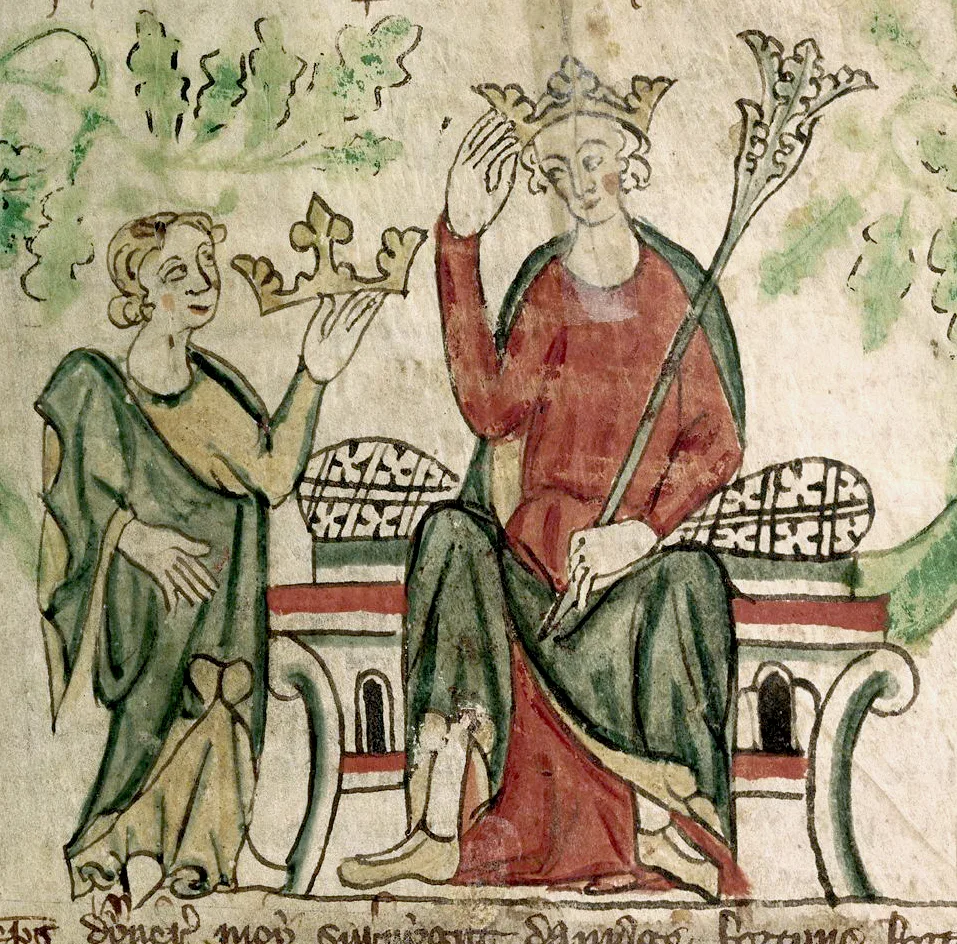
Edward II receiving his crown, from a 14th century Chronicle of England. British Library, Royal MS 20 A ii. Public domain via Wikimedia Commons.
The castle's most notable guest arrived eight years later. Edward II lodged at Liverpool Castle from 24 to 30 October 1323.
The preparation is the human detail. The accounts record 20d spent on repairing the roof of the great hall before the king arrived, which suggests the roof was already leaking on a building barely ninety years old.
Liverpool stayed useful to the Crown as a place to move troops and supplies towards Ireland and Scotland, and that, rather than any grand strategy, is why an English king ended up spending a week here.
The Molyneux century
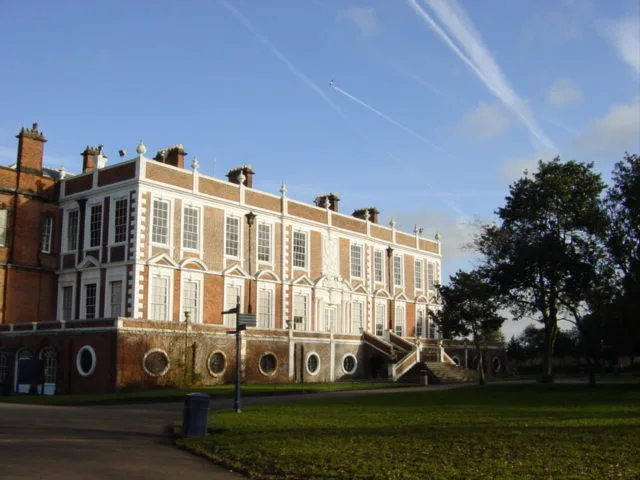
Croxteth Hall, the Molyneux family seat and now a country park. Photo: Sue Adair (CC BY-SA 2.0) via Wikimedia Commons.
Through the 1400s the castle became tied to the Molyneux family of Sefton, who went on to become the Earls of Sefton.
Sir Richard Molyneux obtained the constableship in 1421 to 1422, had it renewed for life in 1440 to 1441, and in 1445 the office was made hereditary. Sources differ slightly on the exact years, but the direction is clear: what began as a royal appointment turned into family property, and the Molyneux successors claimed the right until around 1672.
Holding the castle came bundled with power over West Derby, the forests and the parks, so this was local politics as much as defence. You can still visit the family's later seat at Croxteth Hall and Country Park.
By 1559 it was falling down
Anyone imagining an intact medieval fortress standing until the 1700s should read the Tudor survey.
Commissioners inspected the castle for Elizabeth I in October 1559 and found the towers and gatehouse in "utter rwyne and decay". The roofs were slateless and the rain came straight through, which the commissioners called a great pity. Almost all the timber and lead had gone, with no lead remembered there within living memory. Only the Great Tower was in decent enough shape to be considered as a store for court records.
On the cost of repairs the sources genuinely disagree. The Victoria County History and Historic Liverpool put the commissioners' estimate at around £100, while Royden and other accounts give £150. Either way the warning was the same: leave it, and it would be "a grate defacement unto the said towne of Litherpole".
Nothing much was done. The castle spent its last century and a half as a decaying building that happened to be defensible.
The Civil War brought it back into use
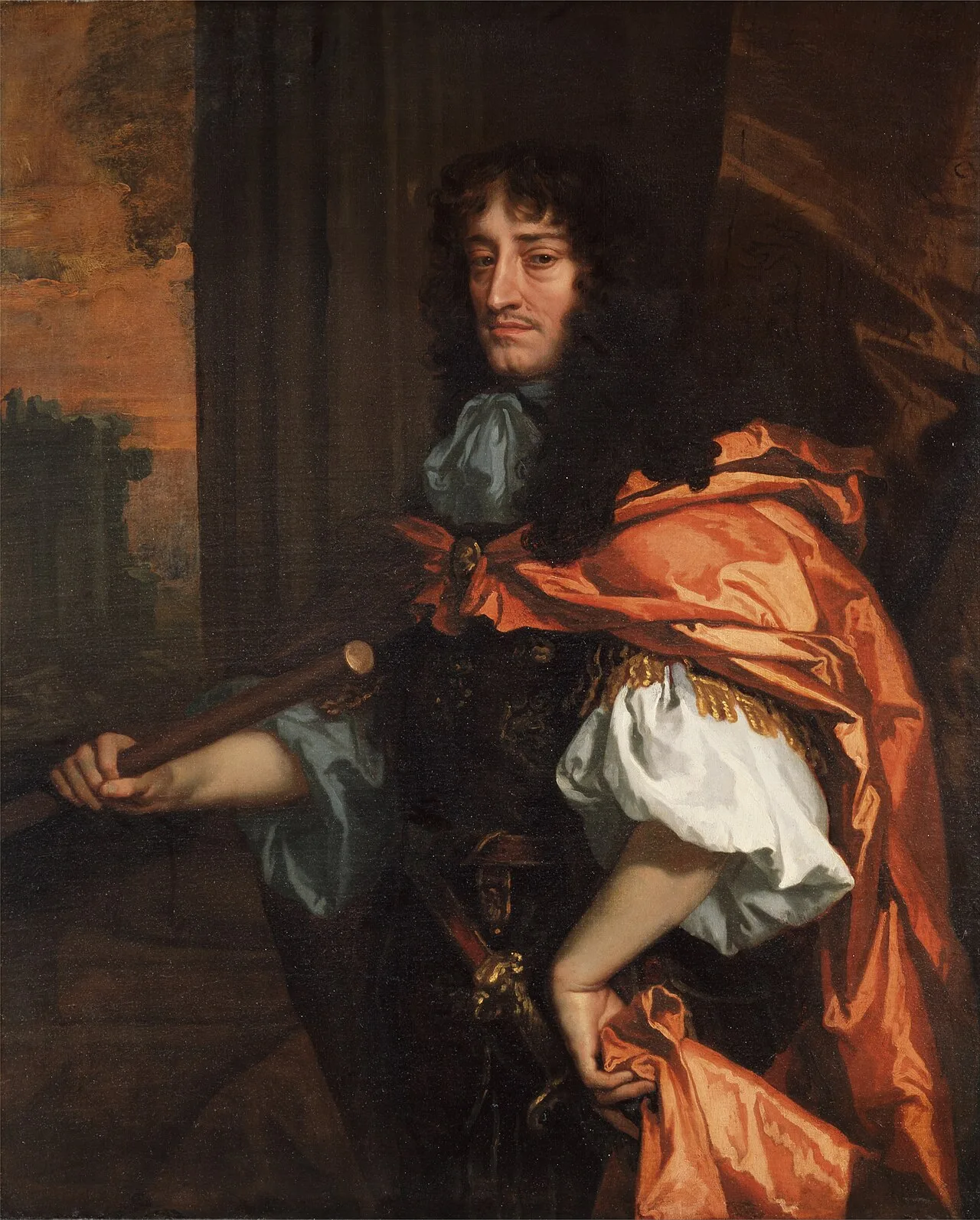
Prince Rupert of the Rhine, painted by Peter Lely. Prince Rupert stormed Liverpool in June 1644. Public domain via Wikimedia Commons.
Liverpool's port and river position made it worth fighting for in the 1640s, and the old castle was pulled back into service as part of the town's defences, ringed with gun batteries.
Parliament's forces under Colonel John Moore took the castle from the Royalists in 1643, killing around 80 and capturing 300. Accounts differ on whether this was April or May of that year.
In June 1644, Prince Rupert of the Rhine brought a Royalist army against the town. Liverpool held out for weeks before the defences broke and Rupert took the town and the castle. The casualty figures from this fighting vary a great deal between accounts and should be treated with caution: the often repeated claim that Rupert lost 1,500 men is a contemporary Royalist figure, not a verified count.
Royalist control did not last the year. By November 1644 Liverpool had surrendered back to Parliamentary forces under Sir John Meldrum.
Demolition took about seventy years
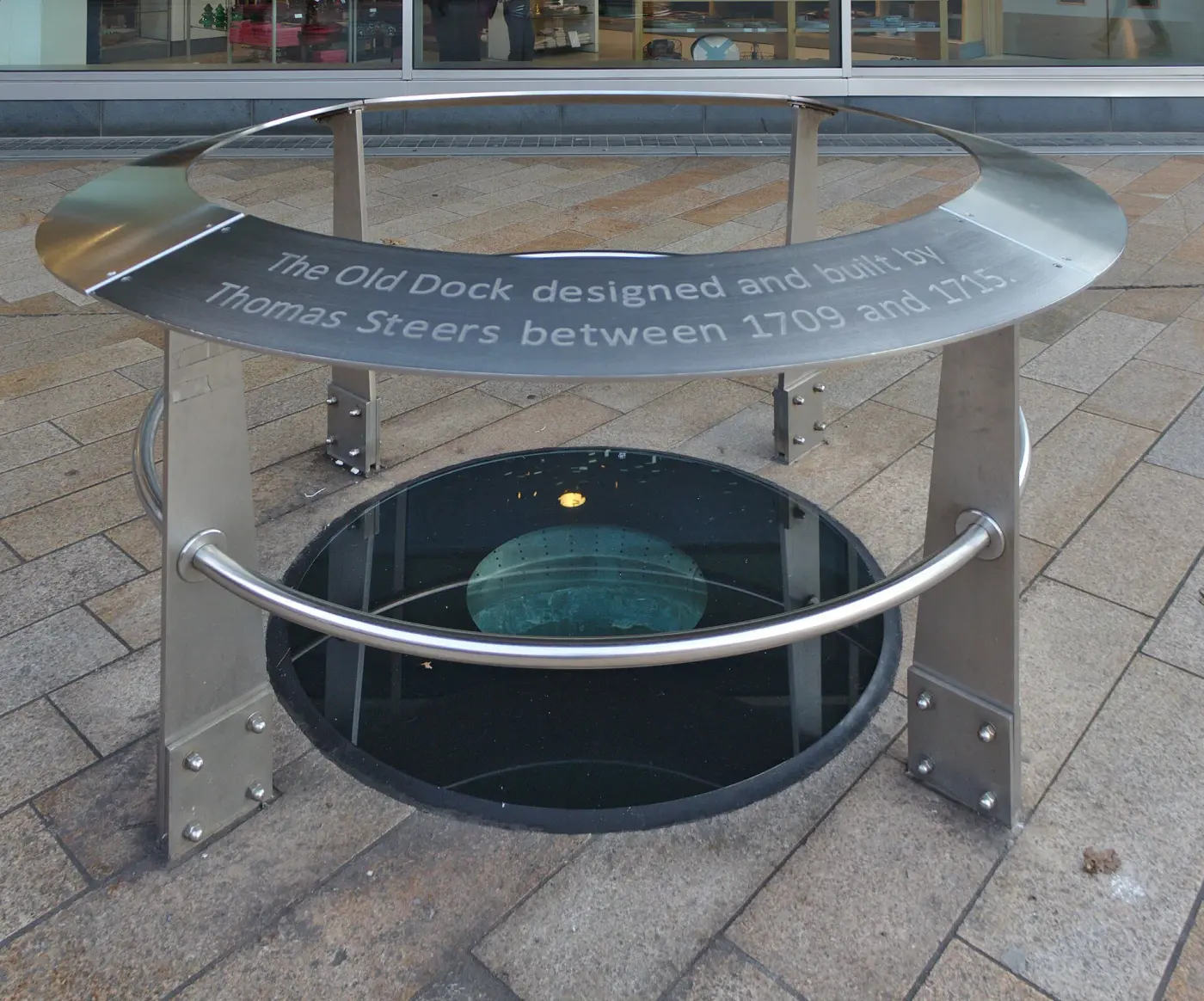
The Old Dock viewing window on Thomas Steers Way. Stone from the castle was proposed for the dock walls. Photo: Rodhullandemu (CC BY-SA 4.0) via Wikimedia Commons.
After the war Parliament had no reason to keep a fortress in Liverpool. Demolition was ordered in 1659, and it was only partly carried out. The gatehouse and sections of wall came down and a good deal of the rest stayed standing, which is why descriptions and pictures of the castle continue for another sixty years.
What finished it was property, not politics. Liverpool was growing and the site was valuable. The corporation secured a lease of the castle ground from the Crown in the mid 1700s, an Act of Parliament in 1715 provided for a new church there, and clearance ran on into the following decade. Sources put the end anywhere between 1720 and 1726, with 1726 the date usually given for the last substantial remains.
The Old Dock stone story
You will often read that Liverpool Castle was torn down to build the Old Dock. Treat that as likely rather than proven.
In 1707 to 1708 the engineer George Sorocold suggested reusing the castle's stone to save money on the dock walls. The suggestion is documented. Whether identifiable castle stone ended up in the dock is not, and no record settles it. What is certain is that Liverpool's dock building and the castle's disappearance overlapped, and that demolition stone was too valuable in a growing port to waste.
The church that sank into the castle ditch
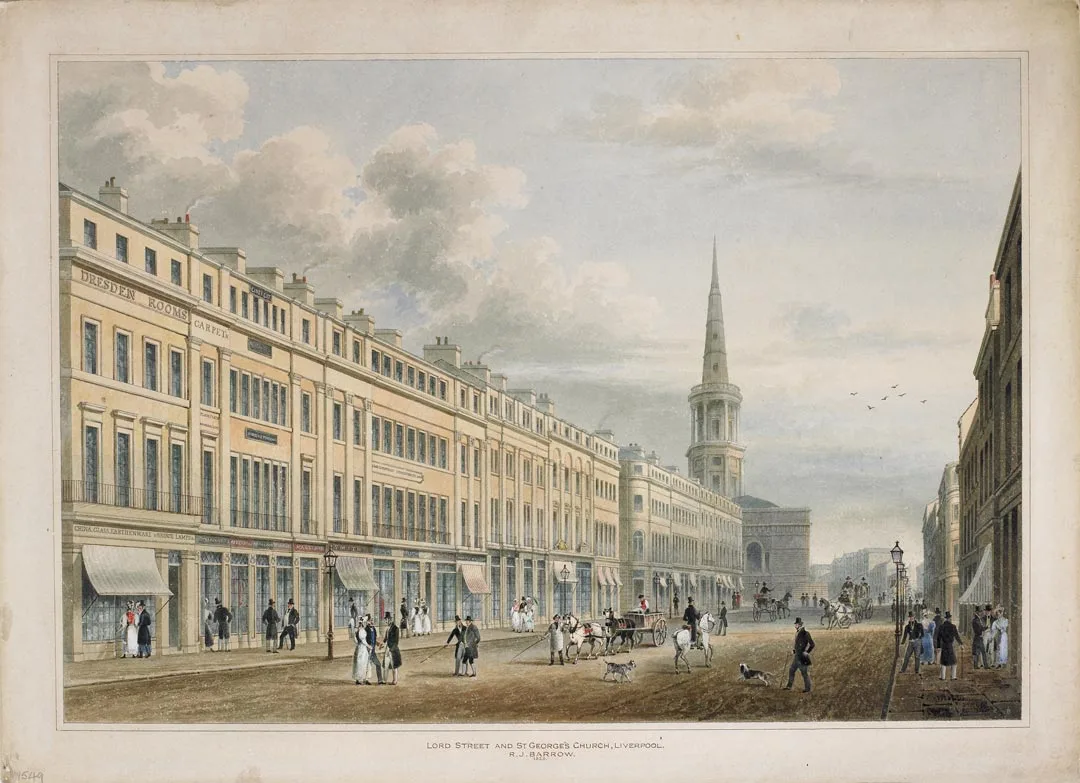
Lord Street and St George's Church, painted by Robert Irving Barrow in 1828. Walker Art Gallery, WAG 1549. Public domain via Wikimedia Commons.
St George's Church was built on the castle site between 1726 and 1734 and consecrated in 1734. Its designer was Thomas Steers, the same engineer behind the Old Dock.
The castle then caused a problem of its own. Part of the church tower had been built over the filled in castle ditch, the ground settled under the weight, and the tower had to be taken down in 1809. Church and tower were rebuilt between 1819 and 1825.
The second St George's closed in 1897 and was demolished in 1899. In under two hundred years the site had gone from medieval castle to Georgian church to cleared ground again.
The Queen Victoria Monument
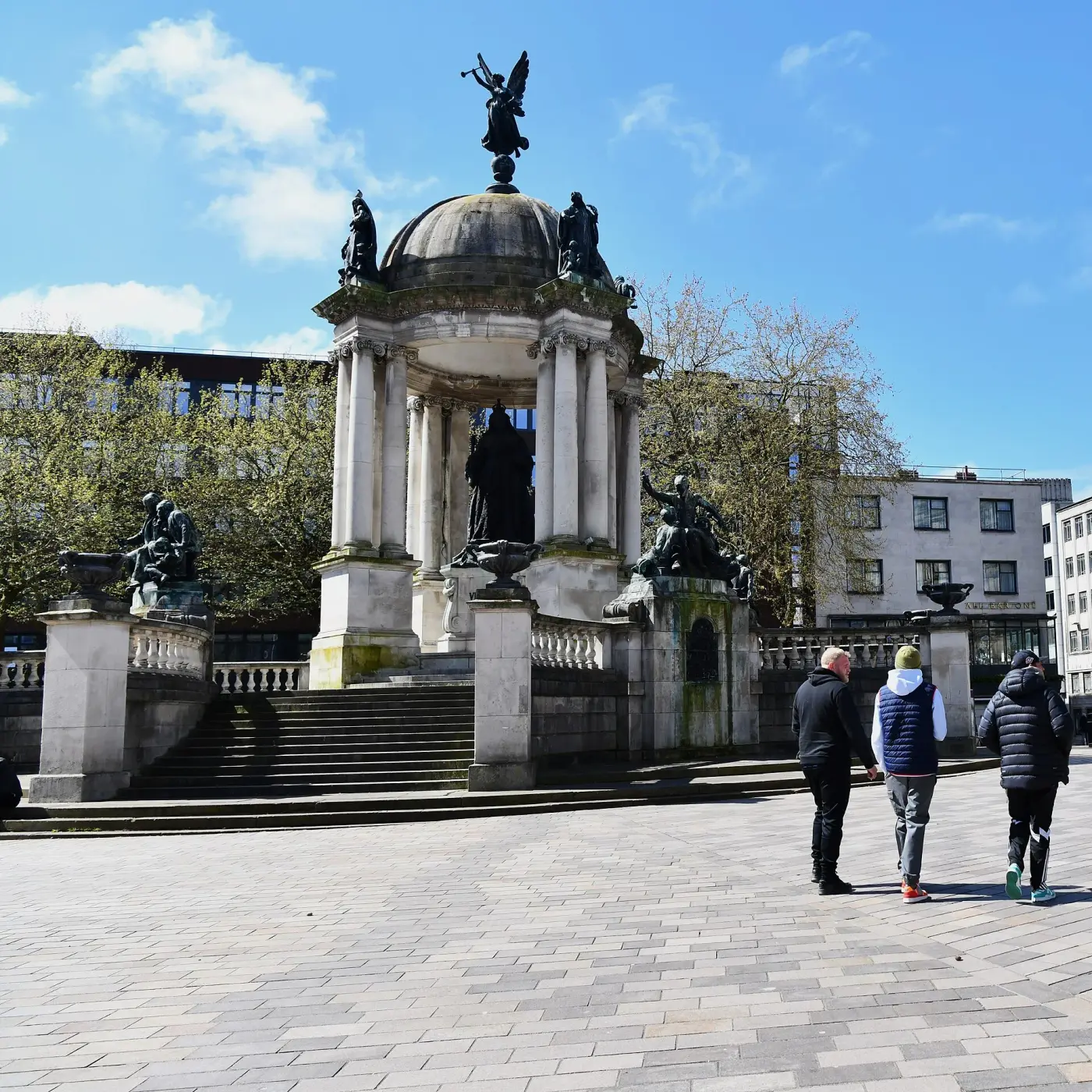
The Queen Victoria Monument in Derby Square, built over part of the castle site. Photo: Michael Garlick (CC BY-SA 2.0) via Wikimedia Commons.
What stands there now went up straight after the church came down. The Queen Victoria Monument dates from 1902, designed by F. M. Simpson with Willink and Thicknesse, with sculpture by Charles John Allen completed in 1906. It is Grade II listed.
It is a domed canopy on four sets of coupled Ionic columns, with figure groups representing Education, Industry, Commerce and Agriculture at the base, Justice, Wisdom, Charity and Peace above, and a trumpeting angel for Fame on the dome. A plaque on the site records the castle. If you like this sort of thing, it also appears on our Liverpool heritage trail and in the local guide to Liverpool architecture.
What has been found underground
The castle is not known only from books. Twice, building work has run straight into it.
In 1927, excavation for underground public conveniences in Derby Square, north west of the monument, exposed the west moat. The archaeologist F. Charles Larkin recorded the ditch cut directly into the sandstone bedrock and published his findings in the Transactions of the Historic Society of Lancashire and Cheshire. His trench did not reach the bottom of the ditch: he stopped two feet below a rock ledge and probed with an iron bar to establish that the drop continued for another four or five feet.
In 1928, work on a bank nearby uncovered the north moat.
Worth being clear about what was not found. Neither dig turned up standing castle masonry. The evidence for the castle's position and scale is the ditch it sat inside, not its walls, so claims that complete foundations are sitting intact under Derby Square go further than the record supports.
The tunnel under James Street
Liverpool has a long habit of tunnel stories, and this one has something real behind it.
During the same 1920s work, about twenty feet from the south west corner of the bank building, a subterranean passage running south under James Street was recorded. Historic England's record suggests it probably connected the moat or ditch with the old tower or defences down on the shore. It was later turned into a sewer.
So there was a passage. What has not been demonstrated is the bigger claim that a network of secret escape tunnels runs under the city centre from the castle. If you enjoy that territory, we sort the documented from the invented in our piece on Liverpool's tunnels, legends and strange stories.
How much to trust the pictures
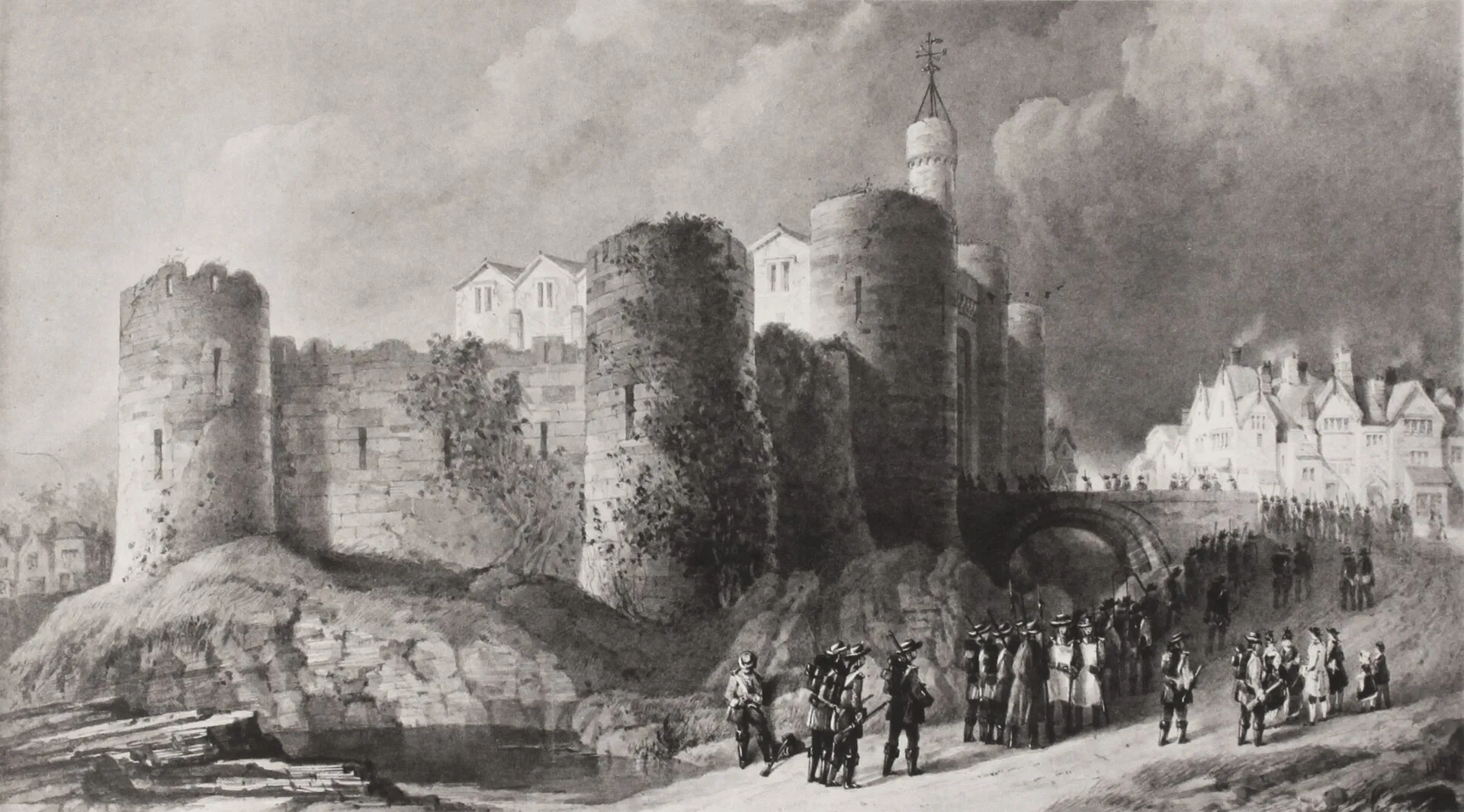
The image at the top of this guide is the one that circulates most, and it needs a caveat.
It was painted by William Gawin Herdman for Pictorial Relics of Ancient Liverpool, published in 1878. It shows the castle in 1689, when supporters of William of Orange occupied it, but it was painted nearly two centuries after the event and roughly 150 years after the building came down. It is a Victorian reconstruction, not a witness.
The other influential reconstruction is by the Liverpool antiquarian Edward W. Cox, who assembled plans, measurements and records into a detailed drawing published in 1895. Cox's work shaped most later images of the castle, including the replica at Rivington. Larkin later warned that parts of it were built on inaccurate copies of earlier plans.
Treat every picture of Liverpool Castle as a reasoned reconstruction. We know the footprint, the tower arrangement and the moat. We do not know the building well enough to draw every window with confidence.
The replica at Rivington
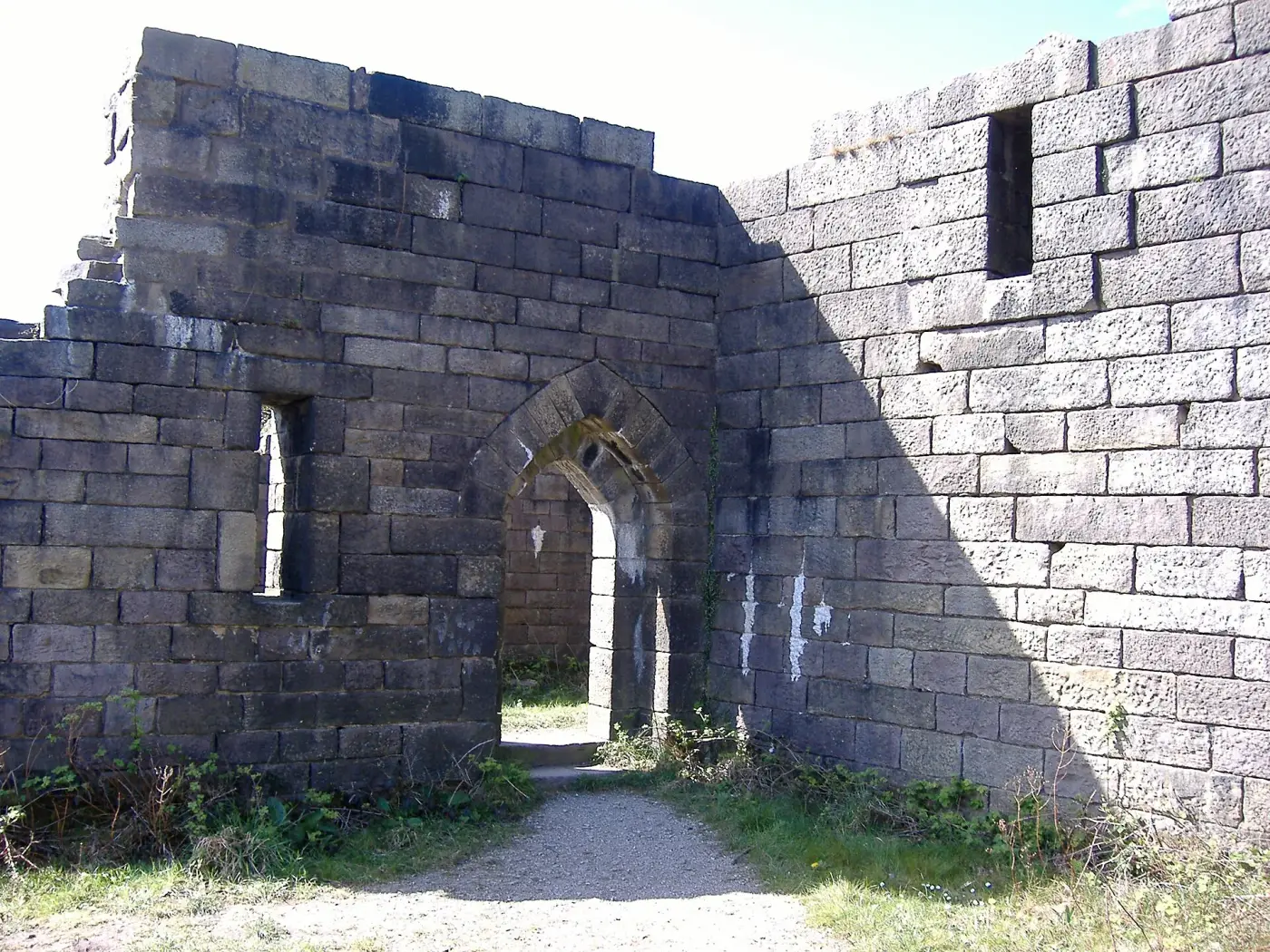
The Liverpool Castle replica at Lever Park, Rivington, built to look like the ruin rather than the working fortress. Photo: Havaska (CC BY-SA 2.5) via Wikimedia Commons.
There is one place you can walk through something shaped like Liverpool Castle, and it is about 20 miles away.
At Lever Park in Rivington, near Horwich in Lancashire, the Liverpool born industrialist William Hesketh Lever, later Lord Leverhulme, began a replica in 1912. Lever had given the park to Bolton in 1902 and had it laid out by the landscape architect T. H. Mawson.
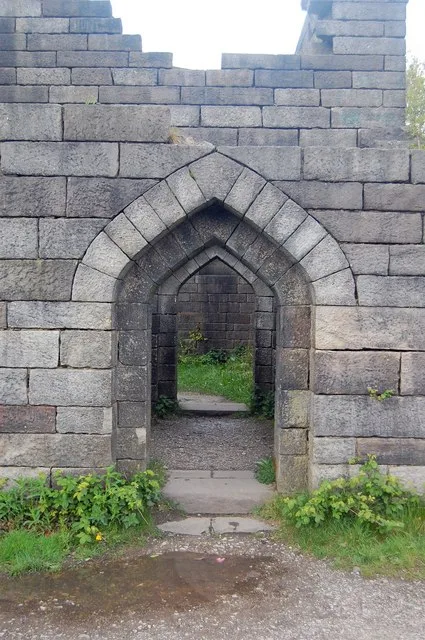
The clever part is the choice of subject. Historic England's listing describes it as a replica of the ruins of the former Liverpool Castle: squared gritstone, an almost rectangular bailey, a great hall on the north side, gatehouses and circular corner towers. It copies the castle as a wreck after the Civil War, not at its strongest.
Triangular headed doorways inside the Rivington replica. Photo: Trevor Harris (CC BY-SA 2.0) via Wikimedia Commons.
It was left unfinished. Leverhulme died in 1925 with the work incomplete, though most of the intended layout had been built. It has been Grade II listed since 17 April 1967, and it is free to walk up to in the park.
Liverpool Castle timeline
Date
What happened
1207
King John makes Liverpool a free borough
c.1232 to 1237
Liverpool Castle built, most likely by William de Ferrers
1235
Licence to strengthen the castle; West Derby's garrisons transfer to Liverpool
25 October 1315
Banastre rebels attack the castle and are beaten off within an hour
24 to 30 October 1323
Edward II lodges at the castle
1347
Survey records four towers, hall, chamber, chapel, brewhouse, bakehouse, well, orchard and dovecot
1442
South east tower built for £46 13s 10¼d
1445
The Molyneux constableship becomes hereditary
October 1559
Elizabethan survey finds the castle in "utter rwyne and decay"
1643
Parliament's forces under John Moore take the castle
June 1644
Prince Rupert storms Liverpool and takes the castle
November 1644
Liverpool surrenders back to Parliament under Sir John Meldrum
1659
Parliament orders demolition; only partly carried out
1689
Supporters of William of Orange occupy the castle
1715
Act of Parliament provides for a church on the site
c.1726
Last substantial remains cleared
1734
St George's Church consecrated on the site
1809
Church tower taken down after settling into the castle ditch
1825
Rebuilt St George's Church completed
1899
St George's demolished
1902 to 1906
Queen Victoria Monument built
1912
Replica begun at Rivington
1927 and 1928
West and north moat found during building work
What you can see today
Castle Street, named for a building that has been gone for three hundred years. Photo: Jonathan Hutchins (CC BY-SA 2.0) via Wikimedia Commons.
There are no medieval castle walls above ground anywhere in Liverpool city centre. What you can do is stand in the right place and read it.
Start at the Queen Victoria Monument in Derby Square and find the plaque recording the castle. From there, look along Castle Street towards the Town Hall, then down James Street towards the river. Castle Street is the medieval line, James Street is the direction of the recorded passage, and the drop towards the water is the slope the castle was built to command.
It is a five minute walk from Liverpool ONE and about three minutes from James Street station, so it fits easily into a walk down to the waterfront.
If you want to see the shape rather than the site, go to Rivington. The replica is free, outdoors and open, and it is the closest anyone can get to walking through Liverpool Castle.
It stood on the rocky high ground now occupied by Derby Square, between Castle Street, Lord Street and James Street. The Queen Victoria Monument sits over part of the site, and a plaque there records the castle.
Did King John build Liverpool Castle?
No. King John made Liverpool a borough in 1207 and died in 1216. The castle belongs to the reign of his son Henry III and is usually credited to William de Ferrers, 4th Earl of Derby, in the 1230s. The first firm record is a licence of 1235 to strengthen it.
Why was Liverpool Castle demolished?
It had no military use left and the town wanted the land. Parliament ordered demolition in 1659 but only part of it came down. An Act of 1715 provided for a church on the site, and the last remains were cleared by about 1726.
Is anything left of Liverpool Castle?
Nothing above ground. The rock-cut moat has been found twice by accident, in Derby Square in 1927 and during bank building work in 1928, along with a passage running south under James Street that was later turned into a sewer.
Why is there a Liverpool Castle in Lancashire?
Lord Leverhulme began a replica of the ruined castle at Lever Park in Rivington in 1912. It was deliberately built to look like the castle after the Civil War rather than in its prime, was left unfinished, and has been Grade II listed since 17 April 1967.
Comments
Join the conversation with your L1Local Community account. Keep it civil and on topic.
Liverpool this week
New places, local news, things to do and our latest guides. Weekly.

Comments
Join the conversation with your L1Local Community account. Keep it civil and on topic.